
Home / Candy & Chocolate / Reese's Popped Snack Mix 113g
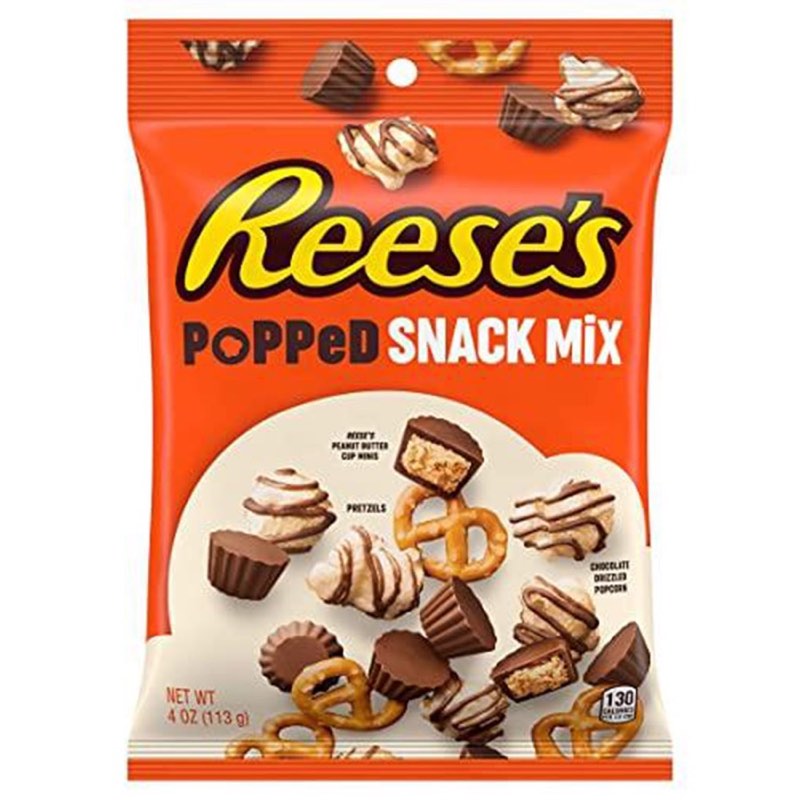
Reeses · 113g
Read the full guide
Reese's Popped Snack Mix 113g
£3.99
✔ In stock — ready to ship
Fresh stock
Free over £20
Same-day dispatch
Secure checkout
A snack mix is not eaten the way a sweet is eaten. Nobody takes one piece out of a mix, considers it, and puts the bag down. You take a handful, and the handful is the unit — which means the first thing to understand about the Reese's Popped Snack Mix is that its behaviour is decided not by any single piece but by what happens when several arrive in your mouth at once.
Open the 113 g bag and the sound is the first signal. A mix rustles rather than rattles, because the pieces are light and irregular and they slide over one another instead of knocking together. Tip some into a palm and they land almost without weight. This is a low-density product: 113 g of popped pieces occupies a great deal more space than 113 g of anything dense, and the first impression on pouring is nearly always that there is more here than the number on the front suggests.
The full guide to Reese's Popped Snack Mix 113g
5,616 words on how it eats, who it suits, how to serve it and what to put beside it.
The first handful
Look at what is in your hand and you will notice the thing that defines the format — the pieces are not identical. A mix is, by definition, several different things sharing a bag, and they differ in size, in shape, in surface and in weight. That variation is the entire point. A bag of one thing gives you the same mouthful every time; a mix gives you a slightly different mouthful each time, because the ratio in your hand is never quite the ratio in the last one. It is the confectionery equivalent of shuffling a deck.
Then the bite. Light, expanded pieces give way immediately and with noise — they do not resist the teeth so much as collapse under them, and the collapse is audible inside your own head in a way that few foods are. This is the characteristic that separates a popped format from every other format in the shop. A gummy is silent. A chew is silent. A popped piece is loud, and the loudness is a large part of the pleasure.
What happens after that is a crowd effect rather than a solo. Several pieces of different sizes break down at different rates — the smallest disappear almost at once, the larger ones survive a few chews longer, and anything with a coating or a softer centre outlasts the rest. So a single mouthful has a sequence to it, from a loud, fast beginning to a slower, softer finish, without you having done anything to arrange it. That sequence is what mixes exist to produce, and it is the reason people who like mixes find single-format bags slightly boring by comparison.
Why a mix is eaten by the handful, not the piece
There is a practical reason and a psychological one. The practical reason is size: individual pieces in a mix are small enough that one is not a mouthful, so the hand does the portioning automatically. The psychological reason is more interesting. With a bag of identical sweets, each piece is a decision — you are choosing to have another one. With a mix, the choice is which pieces, and "which" is a much easier question than "whether". The decision to keep eating gets made once, at the start, and then the bag empties.
That is worth knowing before you buy, because it decides what size of purchase makes sense. A 113 g bag of a mix is a sitting, not a supply. Treat it the way you would treat something opened in front of a film rather than something kept in a cupboard and rationed, and you will not be surprised by how quickly it goes.
It also decides how it behaves on a table. Put a mix in a bowl at a party and it will be eaten continuously by everybody passing, at a rate that no single-format sweet matches, because there is no natural pause built into it. If you want it to last, put out a small amount and refill rather than emptying the bag at the start.
The standard note that belongs on any sweet page: these are a treat rather than everyday food. Small hard sweets and whole gummies are a choking risk for young children and should be eaten with an adult nearby. Anyone with an allergy should read the manufacturer's packaging on the bag itself when it arrives, before anything is opened — the pack is the only authority on its own contents, not a shop description.
What kind of purchase this is
At £3.99 for 113 g this is not a pocket-money buy and it is not a bulk buy. It sits in the import bracket: a branded American bag bought deliberately, usually by somebody who has either met the brand before or specifically wants something that is not on the shelves of an ordinary supermarket.
The clearest buyer is the person shopping for a sharing moment with a bit of occasion to it. A film night where the point is partly the snack, a long evening in with something on, a drive where two people are going to work through one bag between them. Mixes are sociable in a way that individually wrapped items are not — a bag passed between two people is a shared object, and passing it back and forth is part of the thing.
The second buyer is the gift or hamper assembler. An imported bag is visually distinctive on a shelf of British lines, and in a hamper it does the job of the item people have not seen before. That is a genuinely valuable role: hampers are judged on surprise as much as on quantity, and one unfamiliar thing lifts a box of familiar ones.
The third is the person buying for someone who has asked for it by name. Brand loyalty in confectionery is unusually strong and unusually specific, and people who want a particular American brand will not accept a British substitute, however similar it looks. If that is why you are here, the useful thing to know is that we also hold the Reese's Dipped Pretzels in a 120 g bag at £5.29, which is the nearest relative on the shelf and a sensible second item if you are putting a small themed parcel together.
Who it does not suit: anyone feeding a crowd on a budget. 113 g does not go round a room. For that, weight is what you are buying and the loose sweets section is where the money stretches. It also will not suit somebody who wants a sweet to last — this format is fast by design, and no amount of willpower makes a crisp mix a slow eat.
Import shelves, seaside shops and the long British habit of buying foreign sweets
There is a whole culture sitting behind a bag like this, and it is older than the current fashion for American imports by about a century. Britain has always bought sweets in places that were not primarily sweet shops, and the places it bought them in shaped what got sold.
The corner shop is the first of them. For most of the twentieth century, the nearest shop to any British house sold newspapers, cigarettes, milk and sweets, in roughly that order of floor space. The sweet section was not chosen by a confectioner; it was chosen by a shopkeeper with limited shelf space who needed everything on it to sell reliably and keep for months. That constraint produced the British sweet canon — hard-boiled, long-life, individually wrapped, cheap, familiar — and it is why the traditional lines are all things that sit in a jar without complaint. An aniseed balls sweet jar at £16.99 is that world preserved intact: a shape and a flavour that exist precisely because they survived on a shelf for a very long time.
The counter mattered as much as the shelf. Sweets behind a counter, weighed out by an adult into a paper bag, made buying sweets a transaction with a grown-up rather than a self-service grab. That is where the quarter came from, and where the habit of asking for a mix rather than a single thing came from too. The modern pick and mix format is a direct descendant, and it survives because the appeal was never only about price — it was about choosing.
The seaside shop and the logic of a holiday
The second great British sweet venue is the seaside, and it operates on entirely different rules. A seaside sweet shop is not selling to regulars; it is selling to people who are on holiday, who will not be back for a year, and who are buying partly as a souvenir. That changes the product completely. Seaside sweets are larger, more spectacular, more novel and less practical than corner-shop sweets, because they are being bought for the buying as much as the eating.
Everything about the seaside shop is designed around that. The jars are enormous. The displays are stacked high. The products are things you would never buy at home — the ridiculous size, the absurd novelty, the thing that exists to be carried down the front and shown to somebody. A seriously giant spray at £1.89 is exactly that product: cheap, silly, impossible to take seriously, and perfect for the context.
The seaside shop also invented the modern import habit. Coastal towns have always stocked things from elsewhere, because "elsewhere" is itself the appeal on a holiday. American bags on a British seaside shelf are not a new phenomenon dressed up as one; they are the current form of something those shops have been doing for as long as they have existed.
Where a 113 g American bag sits in that story
The import shelf as we know it now — the run of brightly coloured American bags in a corner shop, a newsagent, a service station — combines both traditions. It has the corner shop's practicality, in that these are shelf-stable bags that sit for months without trouble, and the seaside shop's logic, in that a large part of what is being bought is unfamiliarity.
What has changed is who knows about them first. Thirty years ago an imported bag was discovered in a shop; now it is discovered on a phone and then looked for in a shop. That reverses the whole flow — the shopkeeper is no longer introducing the product, they are supplying a demand that arrived from somewhere else entirely. It is the reason import lines sell out unpredictably, and the reason a shop like this carries a rotating rather than a fixed American range. Our candy and chocolate shelf is where that part of the shop lives — twenty-six lines, mostly branded, mostly not British.
The other thing the import shelf has done is broaden what counts as a sweet. Traditional British confectionery is fairly narrowly defined: boiled, chewy, gummy, chocolate. The American shelf brings in things that are technically snacks, technically biscuits, technically several categories at once — and a popped snack mix is squarely one of those. It belongs in a sweet shop because it is bought for the same reasons and eaten in the same moments, not because it fits the old taxonomy. That is a genuine shift in what a British sweet shop is, and it happened without anybody announcing it.
Set it against the rest of the American shelf and the range of what "sweet" now means becomes obvious. Jelly Belly American Classics in the 70 g bag at £2.40 is the old-fashioned end: a bean, a flavour, nothing else. Junior Mints at £2.59 and Milk Duds at £2.99 are cinema-counter classics that arrived here through films long before they arrived in shops. Nerds in grape and strawberry at £1.49 are the cheapest way onto that shelf at all. A mix sits at the far end from all of them, closer to a bowl of crisps in behaviour than to a bag of sweets — and that stretch, from a boiled bean to a popped mix, is the whole modern shelf in five products.
Crisp, crunch and the engineering of a popped piece
Texture is the most under-discussed thing in confectionery and the most carefully designed. People talk about flavour because flavour has words attached to it; texture mostly does not, which is why descriptions fall back on "crunchy" for about nine different sensations that have nothing in common.
A popped piece is one that has been expanded, so that most of its volume is air held inside a thin solid framework. That single structural fact determines everything about how it eats. Because it is mostly air, it is light for its size — which is why the bag feels underfilled and the bowl looks full. Because the framework is thin, it gives way suddenly rather than gradually, which produces a clean break instead of a slow compression. And because it is full of open space, whatever is on it reaches your tongue immediately rather than being released slowly from inside a dense mass.
The suddenness is the key design property. A dense food deforms before it fails: you press, it squashes, then it breaks. An expanded structure does not deform meaningfully at all — it holds, and then it fails completely. That "holds, then fails" behaviour is what the mouth reads as crisp, and it is why crispness feels clean and chewiness feels like work.
Crispness is mostly a sound
This is the part people find hard to believe until they test it. A large share of what we experience as crispness is not felt at all — it is heard, through the bones of the jaw and skull rather than through the air. When a thin structure fails, it does so fast enough to produce a sharp acoustic event, and that event is conducted straight to the inner ear from inside your own head.
The proof is easy and slightly unsettling: eat something crisp with your ears blocked, or with loud noise playing, and it feels stale. Nothing about the food has changed. The sensation has, because you have removed part of the signal your brain was using to construct it. Food scientists have run this experiment properly with headphones and volume controls, and the effect is large enough that people will rate the identical sample as fresh or stale depending only on how loud they hear themselves eating it.
Two consequences follow for anyone putting a mix on a table. First, a mix is a better film snack in quiet scenes than people realise and a worse one than people admit — the same acoustics that make it satisfying to eat make it audible to everybody else. Second, texture is fragile in a way flavour is not. A bag that has gone soft has lost the most important thing it had, and no amount of remaining flavour compensates.
How a mix is balanced for texture
Assembling a mix is a texture problem before it is a flavour problem. The pieces have to differ enough to be interesting and behave similarly enough that none of them dominates. Get it wrong in one direction and the mix is monotonous; get it wrong in the other and one component becomes the thing everybody picks out, which ruins the ratio for whoever gets the bag last.
The balance is struck across three variables. Size, first: small pieces are the background and large pieces are the events, and a good mix has considerably more background than events. Density, second: a mix of only light pieces feels insubstantial, while a mix of only dense ones feels heavy, so the two get combined so that each mouthful has both. And surface, third — smooth pieces and textured pieces feel entirely different against the tongue even when everything else about them is identical.
There is a settling problem too, and anyone who has eaten from the bottom of a bag knows it. Pieces of different sizes and densities separate under vibration, so the small dense ones migrate down and the large light ones rise. That means the top of a bag and the bottom of a bag are different products. The fix is to shake the closed bag before opening it, which sounds fussy and genuinely works.
Why crispness is the first thing to go
An expanded structure is full of open space, and open space is where moisture from the air goes. As moisture is taken up, the thin framework stops failing cleanly and starts deforming instead — the sudden break becomes a gradual squash, and the acoustic event disappears. That is staleness, and it is a physical change in behaviour rather than anything going wrong with the food.
The rate depends almost entirely on how much air the product is exposed to. A sealed bag is nearly stable. An open bag in a dry room takes hours. An open bag in a kitchen with a kettle going takes considerably less, and an open bowl on a table in a warm crowded room is the worst case of all. Every practical storage instruction further down this page follows from that one mechanism.
It also explains why mixes and gummies should not share a bowl. A gummy is a moist item and a popped piece is a dry one, and putting them together means the dry one takes up what the moist one gives off. Separate bowls, always — it costs nothing and it is the difference between a mix that stays crisp all evening and one that does not.
Building a table around it
A mix covers one job extremely well and no others. It is the continuous, crisp, background item — the thing people eat while talking without thinking about it. Everything else on the table should be doing something this does not.
The first gap is a slow item. Something that occupies one person for a minute or two provides a rhythm that a mix never will. Maoam Pinballs in the 140 g bag at £1.99 are the cheapest way to cover that — a proper working chew, and at half the price of this bag. The Airheads 6 Bar Theatre Box at £2.49 covers it differently, with six individually wrapped bars, which makes taking one a deliberate act rather than an automatic reach.
The second gap is something sharp. A crisp mix is comfortable rather than exciting, and after a while everything tastes the same; a sharp item resets that. The giant spray is the novelty version of the fix and the cheapest. For a more conventional sharp element, sour lines belong in their own bowl well away from anything crisp, for the moisture reason above.
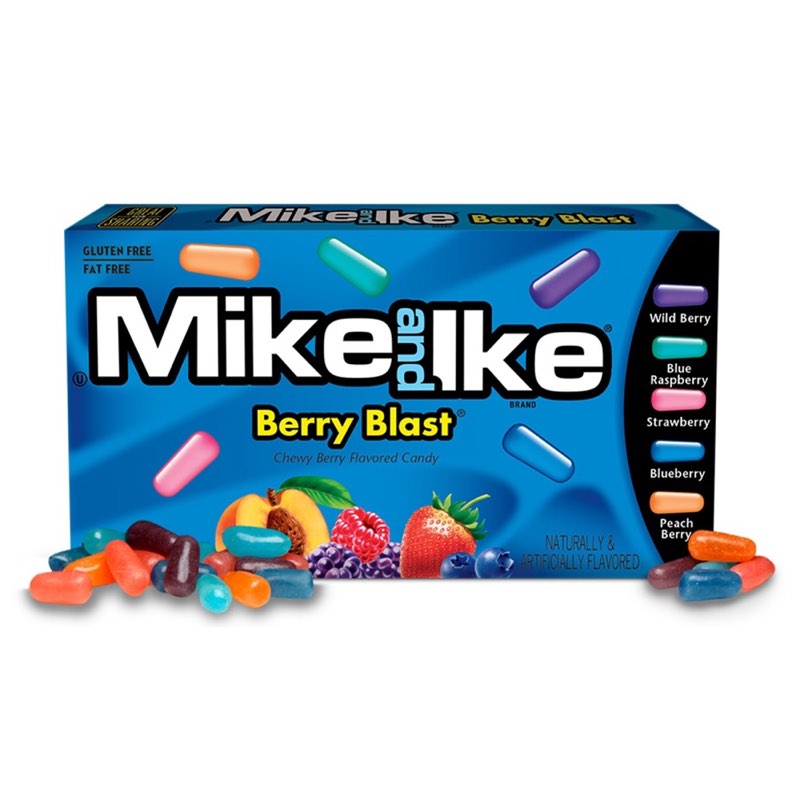
The third gap is something soft, and it is the one that produces the biggest contrast. Charms Fluffy Stuff Cotton Candy at 71 g and £2.49 is the most extreme soft item we hold — it collapses on the tongue rather than being chewed at all — and the jump from a loud crisp mouthful to something that vanishes silently is genuinely striking back to back. The Mike & Ike Berry Blast theatre box at £2.25 is the more moderate version of the same move, with a chewy bite and a fruit flavour set to contrast against something that has neither.
The fourth gap is volume, and 113 g bags are not how you solve it. Browsing the full listing and picking one large item to sit underneath everything else is the right approach, or buying by weight so the bulk costs what bulk should cost. A table with three interesting small things and one generous large thing reads far better than four small things.
If you want the whole spread to hold together as a theme rather than a pile, the American shelf is the easiest one to build around. A second bag from the same brand at £5.29, a cinema-counter box or two, a bean bag and one novelty gives you five items that plainly belong together, and the coherence is noticed even by people who could not say why.
Occasions it earns its place at
Film nights. The natural home. A mix is the closest thing in a sweet shop to a savoury snack in behaviour, which is exactly why it works across a two-hour film where a single sweet would have been finished in the first ten minutes. One bag between two people is about right.
Gaming and long sessions. Same reasoning, longer duration. The relevant property is that a mix can be eaten one-handed from a bowl without looking at it, which not many sweets manage.
Road trips. A bag that gets passed between seats is the standard form here, and a mix is ideal for it — no wrappers to collect, no melting mess in warm weather, and the ability to take a small amount repeatedly rather than committing to a whole item.
Hampers and parcels. An import bag in a hamper does the surprise job. At £3.99 it is substantial enough to be a real component rather than a filler, and the packaging is distinctive on a shelf of British lines. Putting a 70 g bag of American Classics beans in alongside it at £2.40 doubles the effect for very little extra.
Parties, with a caveat. Mixes are eaten faster than anything else you can put out, so the caveat is quantity. One bag on a table of ten people is gone in minutes. Either buy several, or accept that it is the thing that opens the evening rather than the thing that sustains it.
Christmas and the in-between days. The stretch between Christmas and New Year is the peak period for exactly this sort of thing — a bowl that stays on a table for three days while people wander past it. Crisp items suit that pattern better than anything that needs to be unwrapped.
£3.99 for 113 g, and what you are actually buying
The arithmetic is straightforward: 113 g at £3.99 works out at roughly £35 a kilo. That is a high rate by the standards of anything bought loose, and it is a normal rate for a branded imported bag. Import lines carry costs that domestic lines do not — smaller shipments, longer supply chains, less predictable availability — and the price reflects that rather than anything about the contents.
The more useful comparison is per sitting rather than per kilo. As a shared bag for two people over a film, £3.99 is roughly two pounds a head for the evening's snack, which is a reasonable number and considerably less than anything bought at a cinema counter. Judged that way it is good value. Judged as a way to get sweets into a house by weight, it is poor value, and there is no arguing with that.
Where people misjudge it is volume. Because popped pieces are light, 113 g looks like considerably more than 113 g of a dense sweet, and the bag fills a bowl convincingly. That works in your favour on a table and against you in the cupboard: it looks generous and goes quickly. If you are catering rather than snacking, count portions rather than trusting the look of it.
Buying two is often the right call, and not for the reason people think. A second bag is not insurance against running out; it is insurance against opening the first one and then having nothing crisp left for the following evening. Crisp items do not survive being half-eaten and put away as well as wrapped items do, so two whole bags used on two occasions beats one bag stretched across both.
Keeping it crisp
Everything here follows from one fact: moisture in the air is the enemy, and exposure time is the variable you control.
Seal it properly the moment you stop eating. Folding the top over is not sealing; a clip, a tie or a transfer into an airtight tub is. Of the three, the airtight tub is meaningfully the best, because bags develop small gaps at the folds that you cannot see. If a bag is going to be open across several evenings, decant it on the first one.
Keep it away from steam. The cupboard above a kettle and the shelf beside a hob are the two worst storage spots in a normal kitchen, and both are where people put snacks because they are convenient. A cupboard on the other side of the room genuinely makes a difference over a week.
Do not refrigerate, and do not freeze. A fridge is a humid environment and a crisp product will take up moisture in there faster than it would on a shelf, then take up more again as condensation forms when you bring it out. This is the opposite of the advice for chocolate, which is why people get it wrong.
On a table, put out less and refill. A bowl standing in a warm room with people around it is a dehumidifier running in reverse, and the last third of a bowl put out at eight o'clock is a different product by ten. Small bowl, topped up from a sealed bag, every time.
If a bag has gone soft, it is not ruined — it has simply stopped being crisp, and it is still perfectly good to eat. The crispness will not come back on its own, and the honest answer is that a soft mix is best used up rather than rescued. Which is another argument for the small-bowl discipline: the problem is entirely preventable and not at all fixable.
One size, one decision
This comes in one size, the 113 g bag at £3.99, and it is in stock. There is no larger format to weigh up and no multipack to compare against, which removes the usual hesitation and leaves you with a single question: how many.
The guide that works: one bag for one or two people for an evening. Two for a small group, or for one household that wants it available on more than one occasion. Three or more only if it is going onto a party table, where it will be the fastest-moving bowl in the room. Buying one bag for a group of six is the most common mistake on this format.
If the brand is the reason you are here rather than the format, the dipped pretzels at £5.29 are the other line we hold, and they are a different kind of eating entirely — larger pieces, a firmer bite, and a bag that is rationed by the pieces themselves rather than by your hand. Between the two, the mix is the sharing item and the pretzels are the slower one, which is a real reason to own both rather than choosing.
Import availability is worth one honest sentence. Lines like this come and go on a schedule nobody at a shop controls, and the gap between a line selling out and returning can be weeks. If you have a date in mind, buy when you see it rather than planning to come back.
Where it sits on the site
This bag lives on the Candy & Chocolate category page, which is the smallest and most branded of our main shelves at twenty-six lines and the one most worth reading end to end. It is where the American imports, the cinema-counter boxes and the recognisable names sit, and it is the shelf to browse when you are buying by brand rather than by flavour or texture.
The neighbouring shelves go in three directions. Loose sweets is the largest part of the shop and the opposite kind of purchase — unbranded, sold by weight, priced accordingly. Building a bag yourself is the same idea with the choosing put back in, and it is the best way to buy for a group because you set the ratios instead of accepting whatever a bag gives you. And the complete range in one listing is the place to start if you would rather filter than browse shelf by shelf.
One thing worth saying about navigating a sweet shop online: the fastest route to something you will like is usually texture rather than brand. People are far more consistent about texture than they realise and far less consistent about brands than they think. If the crisp, fast, collapse-under-the-teeth quality is what brought you to this page, that is the thread to follow through the shop — and it will take you somewhere different from following the name on the front.
Questions worth answering
How big is the bag, really?
113 g, which is a standard American bag size and sits in the sharing bracket rather than the single-serve one. Because the pieces are light and expanded, it takes up considerably more room than 113 g of a dense sweet and fills a bowl more convincingly than the number suggests. As a practical guide, it is an evening's shared snack for two people, or a fast-emptying bowl for a small group.
Is it a sweet or a snack?
Honestly, it sits between the two, and that is part of the appeal. It is bought in a sweet shop and eaten in sweet-shop moments, but it behaves like a savoury sharing snack — eaten by the handful from a bowl over a long period rather than piece by piece. If you are used to buying bags of sweets, expect this one to disappear faster and to feel less like an occasion per piece.
Why is it more expensive than a British bag of the same weight?
Import economics. Lines shipped from abroad come in smaller, less predictable quantities and travel further, and that shows up in the shelf price. At £3.99 for 113 g the rate is about £35 a kilo, which is normal for an imported branded bag and high compared with anything bought loose. If price per kilo is your measure, buy by weight instead.
Will it survive the post?
Better than most things, in fact. There is nothing here to melt in the way a bar does, so warm weather is not the threat. The two real risks are crushing and damp, and the bag protects against both reasonably well as long as it stays sealed. If it arrives feeling soft rather than crisp, that is moisture rather than heat, and it is worth checking the bag seal before assuming it was packed badly.
Can I put it in a pick and mix?
Not in the literal sense — this is a sealed bag rather than a loose line sold by weight. But it works well alongside one. The usual approach is to weigh out the bulk of a mix yourself and then add one or two sealed bags as the branded, recognisable elements, which gives you both value and variety in a single order.
Is it suitable for children?
That is a judgement for whoever is buying, and the standard advice applies: sweets are a treat rather than an everyday food, small hard sweets and whole gummies are a choking risk for young children, and supervision matters. Anyone with an allergy in the house should read the manufacturer's packaging on the bag when it arrives, before anything is opened.
How long does it stay crisp once opened?
Hours rather than days if it is left open, and considerably longer if it is properly sealed. The mechanism is moisture from the air being taken up by the open structure of the pieces, so the variables are exposure and humidity rather than time as such. A clip is better than a fold, an airtight tub is better than a clip, and a cupboard away from the kettle is better than one above it.
What is the best thing to serve alongside it?
Something slow and something soft. A bag of chewy pinballs gives the table a rhythm that a continuously eaten crisp mix does not, and a soft item provides the strongest possible texture contrast. Keep gummies and anything moist in a separate bowl — sharing a bowl transfers moisture and takes the crispness out of the mix within the hour.
Does the bag settle in transit?
Yes, and it is normal. Pieces of different size and weight separate under vibration, so the smaller, denser ones end up at the bottom and the larger, lighter ones at the top. Shake the sealed bag before you open it and the ratio evens out. It also means the last handful from an unshaken bag is not representative of the whole thing.
Is there a bigger size?
Not of this line — it comes in one size only. If you want more, buy more bags. If you want the brand in a different format, the dipped pretzels are the other line we carry and they eat quite differently: larger pieces, a firmer bite, and a bag that naturally lasts longer because the pieces ration themselves.
Why does it sound so loud when I eat it?
Because the structure fails suddenly rather than gradually, and that sudden failure makes a sharp noise that reaches your ears through the bones of your jaw and skull. A good share of what you experience as crispness is that sound rather than anything you feel — which is why crisp things eaten in a very noisy room genuinely taste less crisp. It is also why everyone else in the room can hear you.
Is it a good gift on its own?
On its own it is a small gift rather than a real one, but it is an excellent hamper component. In a parcel of British lines it does the job of the unfamiliar item, which is what hampers are judged on more than quantity. Pair it with a second bag from the same brand and one or two cinema-counter boxes and you have a themed parcel that reads as deliberate rather than assembled.
To sum up
A 113 g imported bag at £3.99 that behaves less like a sweet and more like a sharing snack: light, loud, eaten by the handful, and gone faster than the weight suggests. It covers the continuous background job on a table better than anything else on the shelf, and covers no other job at all — so buy it with a slow item and a soft item beside it. Keep it sealed, keep it away from the kettle, put out small amounts and refill, and it will still be crisp at the end of the evening. One bag between two for a film; several if it is going into a bowl in a room full of people.
More candy & chocolate sweets
Where this sits
Reese's Popped Snack Mix 113g appears on these shelves. Browse them, or jump to something nearby.
You might also like