Home / Candy & Chocolate / Jelly Belly American Classics Jelly Beans Bag 70g
Jelly Belly · 70g
Read the full guide
Jelly Belly American Classics Jelly Beans Bag 70g
£2.40
✔ In stock — ready to ship
Fresh stock
Free over £20
Same-day dispatch
Secure checkout
Tip a few out and the first impression is how small they are. A Jelly Belly bean is noticeably smaller than the fat, generic jelly beans that used to fill sweet-shop jars — shorter, narrower, with a tidier profile and a shell that sits tight rather than sitting thick. They look engineered rather than scooped, and they feel it too. Roll one between finger and thumb and it is hard, dry and glossy, with no give at all until you actually bite it.
A 70g bag is a pocket size rather than a bowl size, and the bag is the right shape for that. This is not a party bag. It is the thing that goes in a coat, a glovebox, a desk drawer, a cinema pocket, or a hamper as one item among a dozen. Pour the whole thing into a palm and it is about two good handfuls — enough for one person over an evening, or enough to share meanly with one other person, and that is roughly the honest measure of it.
The full guide to Jelly Belly American Classics Jelly Beans Bag 70g
5,158 words on how it eats, who it suits, how to serve it and what to put beside it.
The first handful out of the bag
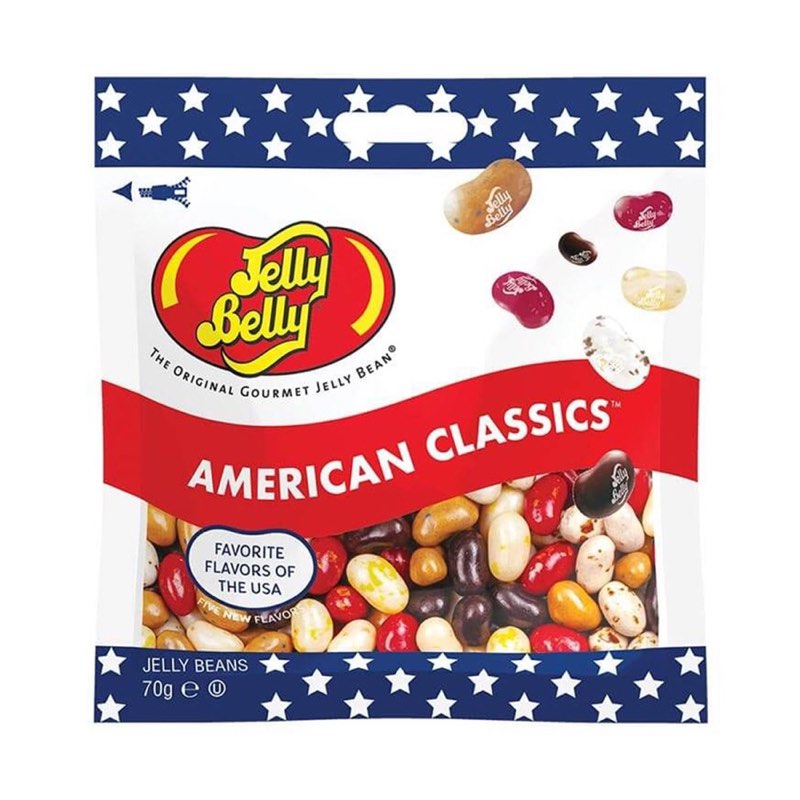
The assortment reads as a spread of colours rather than a theme you can name at a glance. Some will be pale, some deep, some speckled or two-toned depending on what is in the mix, and the visual variety is doing a job: with a bean this size and this hard, colour is the only clue you get before you commit. That matters more than it sounds and it comes up again further down, because with an assortment your eyes are effectively the menu.
The two-stage eat: shell first, then centre
Every hard-shelled bean has two textures and the whole pleasure of the format is the transition between them.
The shell goes first. It is thin, brittle and dry, and it cracks rather than yields. The sound is a small, clean snap that you feel in the jaw more than hear, and it happens fast — there is no gradual softening and no period of working at it. One bite and the shell has done its bit.
Then the centre, which is a completely different material: dense, slightly chewy, closer to a firm jelly than to anything soft. It holds together through several chews rather than dissolving, and it is where all the flavour is stored. Unlike a gummy, it does not spring back. Unlike a taffy chew, it does not stretch. It compacts, and then it goes.
The whole thing is over in fifteen to twenty seconds. That is fast by the standards of the shop — a wrapped chew will keep you busy for two minutes — and it defines what a bean is good for. It is a sweet you eat in ones and twos, repeatedly, over a long period, rather than a sweet you sit down with. Beans are a rhythm, not an event. A bag of them lasts a film, a train journey or a working afternoon, not because there are many of them but because the eating time per bean is short enough that you never feel you are settling in.
Flavour arrives almost immediately. The shell releases a little, the centre releases all of it, and by about second three you have the full impression. There is no build. There is no development. Beans are one of the few confectionery formats that gives you everything at once and then stops, which is precisely why they work as an assortment — you get a complete impression of one flavour before you take the next, with no overlap.
Eating an assortment properly
There is a right way to eat a mixed bag and most people never find it, which is a shame because it takes no effort.
One at a time, and pause between them. This is the whole technique. A bean gives its full flavour in three seconds and is gone in fifteen, and if you put the next one in immediately you are tasting it against the residue of the last. Two beans back to back blur. Two beans thirty seconds apart do not.
Do not eat by the handful. Tempting with something this small, and it wastes the assortment entirely — a handful of mixed beans produces a muddled, generic sweetness in which no individual flavour survives. If you want a sweet you can graze by the fistful, buy one designed for it. Maoam Pinballs in the 140g bag at £1.99 are made for exactly that, and buying the right format for the right behaviour is cheaper than forcing this one to do a job it is not built for.
Sort them first if you are that way inclined. Plenty of people do, and it is not silly. Tipping the bag out and grouping by colour turns an assortment into something you can actually navigate, and it makes it obvious which colours you have several of and which are one-offs. It also makes a bag last considerably longer, because sorting imposes a pause before anyone has eaten anything.
Try the two-bean trick. Because beans are small and self-contained, you can eat two together deliberately and get something that is not simply the average of both. This is not a gimmick — it is how a lot of people find their favourite combination in a mixed bag, and it is a genuine reason to buy an assortment over a single-flavour bag. More on why it works in the next section.
What this bag does and does not tell you
Worth being straight about this. American Classics is the name of the assortment. It is a product name, chosen to describe a mood and a style of mix, and it is not a statement about where anything is made — we do not hold that information for this line and so we do not claim it. Treat the name as a signal about the character of the assortment, the same way "Ice Cream Mix" or "Very Cherry" signals the character of the bags beside it on the shelf.
We also do not list the individual flavours in this bag here, for the simple reason that we do not have a verified flavour list to publish, and a guessed list is worse than none. The bag itself carries that information and it is the authority — read the pack when it arrives. If knowing every flavour in advance is important to you, the sibling bags on the same shelf are more explicit about what they are, and several of them are linked further down this page.
What we can tell you is everything about the format, the eating experience, how to use it, what it costs and what to put with it — which is most of what actually determines whether you enjoy a bag of beans.
How a flavour gets built into a bean
A jelly bean is an unusually demanding thing to flavour, and understanding why makes an assortment far more interesting to eat.
The shell has one job, and it is not flavour
Start with the structure. A bean is a centre with a shell built up around it, and the two parts are doing entirely different work. The centre is the flavour reservoir. The shell is a barrier — it keeps the centre from drying out, keeps beans from sticking to each other, and gives the sweet the hard, dry, pourable quality that makes it possible to sell loose from a jar in the first place.
That division has a consequence you can taste. Because the flavour lives in the centre and the shell arrives first, there is always a very brief moment at the start of a bean where you are tasting almost nothing — a fraction of a second of neutral sweetness before the centre opens up. It is short enough that most people never notice it consciously, but it is why a bean feels like it "arrives" rather than simply being there, and it is the closest thing a fifteen-second sweet has to a first act.
It also means the shell has to be flavour-neutral, or nearly so, across every bean in an assortment. Twenty different flavours cannot each have their own shell character or the bag would taste chaotic. So the shell is deliberately quiet, and all the differentiation is loaded into the centre. That is why beans can carry more distinct flavours in one bag than almost any other format — the shared part is silent, so the different parts do not interfere.
Calibrating an assortment so no two beans collide
The genuinely hard part of building a mixed bag is not making each flavour good. It is making each flavour distinguishable from the others when they are eaten in a random order by someone who is not concentrating.
Think about what that requires. Any two fruit notes that sit close together in the same family will blur — a cherry and a strawberry, a lemon and a lime, two red berries. So either you include one and not the other, or you push them apart deliberately: one gets more acid, one gets more of a jammy body, one gets a green top note the other does not have. Across a whole assortment that is a large amount of small adjustment, and the quality of a mixed bag is essentially the quality of that adjustment.
The second requirement is spacing across categories. A good assortment does not consist of twenty fruits. It has fruit, it has something creamy or dessert-like, it has something drink-flavoured, it has something confectionery-referential that is not pretending to be food at all. The categories keep each other honest, and eating across them is what stops a bag going monotonous in the middle. You can test this yourself against the single-flavour bags on the same shelf: the Very Cherry bag at the same £2.40 is one note explored repeatedly, and eating that alongside an assortment shows you exactly what variety is worth and what it costs you.
Why some flavours need two beans
Here is the most interesting thing about the format. Because each bean delivers a complete, self-contained flavour impression in three seconds, you can combine two of them in your mouth at once and get a result that is genuinely a new thing rather than a muddle.
This works because of how flavour perception handles simultaneity. Two notes arriving at the same moment, in the same place, at similar intensity, get processed as one composite — the way a chord is heard as a chord rather than as separate notes. Two notes arriving three seconds apart do not; those are heard in sequence. So the difference between eating two beans together and eating them one after another is not a matter of degree, it is a different perceptual event entirely.
Practically, some combinations work and some do not, and the rule of thumb is that they should come from different categories rather than the same one. Two fruits together usually just make a vaguer fruit. A fruit with a creamy note, or a fruit with a drink note, or a sharp note with a round one, tends to produce something that reads as a third thing. This is the single best reason to buy a mixed bag over a single-flavour one, and it is entirely free entertainment.
The colour contract
Last piece of the construction. Colour in confectionery is not decoration — it is a promise, and your brain treats it as information before anything reaches your tongue. A pale yellow bean primes you for something citrus or creamy. A deep red primes you for a red fruit. When the colour and the flavour agree, the flavour reads as stronger and clearer than it really is, because your expectation is doing half the identification work.
That is why the visual variety in an assortment matters so much. With a fifteen-second sweet there is no time to work out what you are eating from taste alone; the colour has to start the process before the shell has even cracked. It is also why blind tasting a mixed bag is much harder than people expect, and why doing it is such a good party trick. Take the colour away and a surprising proportion of confectionery flavour identification simply stops working.
If you want to see this taken to its logical extreme, the Bean Boozled box at £2.99 is built entirely on breaking the colour contract — two beans that look identical and are not — and it only works as a game because the contract is normally so reliable. The Bean Boozled Spinner at £11.99 turns the same idea into a proper boxed game with a spinner to decide who takes what, which is the version to buy if you want an evening's entertainment rather than a single round.
Which sweet counter the bean belongs to
Beans have been through more reinventions than almost any other sweet, and the small, hard, named-flavour bean is the most recent of them.
From the quarter-pound bag to the named flavour
For most of the twentieth century a jelly bean was a bulk sweet and nothing more. It came out of a jar, it was sold by weight, it was cheap, it came in the standard sweet-shop colour palette, and nobody pretended that the orange one tasted specifically of orange. It tasted of orange the colour, which is its own kind of flavour and one that a lot of people are still quietly fond of. Beans in that era were filler — the thing that bulked out a bag of mixed sweets, the reliable, unexciting line that every shop carried.
The shift to small, precise, named-flavour beans changed what the sweet was for. Once a bean was expected to taste convincingly of a specific thing, it stopped being filler and became something you chose, and the whole retail context changed with it: smaller bags, higher prices per gram, flavour names printed on the front, assortments sold as collections rather than as mixtures. A 70g bag at £2.40 is a direct product of that shift. Nobody would have sold 70g of beans as a considered purchase in the jar era.
The older tradition has not vanished, and you can still buy sweets the old way — by weight, from a jar, with no concept attached. An Aniseed Balls sweet jar at £16.99 is about as pure a survival of that world as we stock, and it is a genuinely instructive contrast: one flavour, one enormous jar, sold on familiarity rather than on variety.
The desk jar, and the sweet that is allowed at work
There is a particular era of memory attached to small hard beans that has nothing to do with childhood: the desk. Small, dry, unmessy, odourless and quiet, beans are one of the very few sweets that can be eaten in a shared office, a meeting, a library or a car without annoying anyone or leaving evidence. That practicality gave them a second life as an adult sweet, and for a lot of people the association is not the sweet shop at all — it is a bowl on a colleague's desk, or a jar in a reception area.
That association is worth knowing because it tells you who this bag suits. A 70g bag of hard beans is a considerably more grown-up purchase than a bag of gummies, not because it is sophisticated but because it fits into adult life without causing problems.
The cinema shelf, and what each generation expects
The third context is the screen. Beans sit alongside a whole family of sweets that exist mainly to be eaten in the dark, quietly, over two hours — the boxed formats, the hard-shelled formats, the ones that come in a shape designed to be held in one hand. If that is the world you want, Milk Duds at £2.99 and Junior Mints at £2.59 are the two most recognisable neighbours on that shelf, and the Airheads 6 Bar Theatre Box at £2.49 is the same idea in a long-chew format for people who would rather have four bars over a film than forty beans.
Across generations, what people expect from a bean varies more than you would think. Older buyers often expect the jar bean — broad colours, simple sweetness — and are surprised by how specific a modern assortment is. Middle-aged buyers tend to have grown up with the transition and treat named flavours as normal. Younger buyers arrive with a completely different reference point: for them, beans mean a game, because that is what a bean was in the videos they watched. Put a mixed bag in front of three generations and you will get three quite different sets of expectations, which is a good reason to have one on a table when a family is in the room.
Who a 70g bag actually suits
It suits one person more than it suits a group. Seventy grams shared between four people is a couple of beans each and then a bag that is gone before anyone has worked out what they liked. Bought for yourself, or for one other person, it is exactly the right size.
It suits people who like variety more than they like any one flavour. If you already know you want cherry, buy cherry. An assortment is for people who enjoy the not-knowing and who will genuinely take the trouble to notice what they are eating.
It suits carrying around. Hard shells, no melt, no dust, no mess, small bag. It survives a coat pocket, a rucksack and a hot car far better than almost anything else at this price.
It suits desks, cinemas, trains and any context where a sweet has to be discreet. Nothing crinkles for long, nothing smells, nothing sticks to fingers, and nothing needs a napkin.
It suits hampers and gift boxes as a component rather than as the main event — £2.40 buys you a recognisable branded item with visual appeal, which is exactly what a hamper needs in the gaps between the bigger things.
It suits less well anyone feeding a party, anyone who wants a sweet to last, and anyone who dislikes hard textures. If any of those is the requirement, you want a different shelf entirely, and the full shop is the place to start over.
Building something around a small bag of beans
Because 70g is small, the mix question here is not "what goes in the bowl with it" so much as "what is this the accent to".
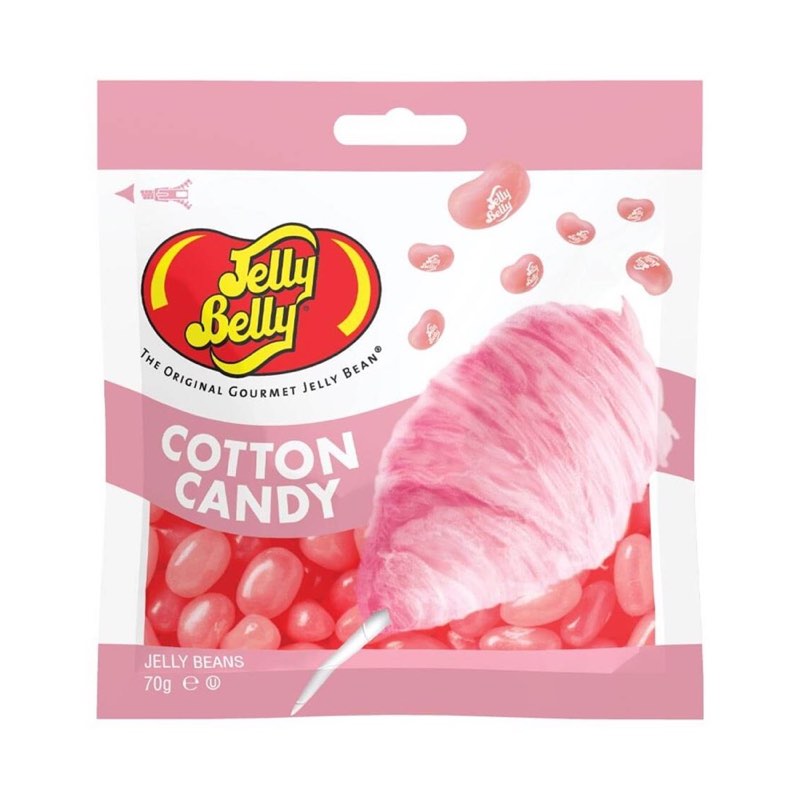
The most natural companions are the other 70g bags on the same shelf, all at the same price, because buying two or three turns a small bag into a genuine tasting set. The 20 Assorted Flavour Mix is the broadest of them and the obvious partner to any themed assortment, since it gives you the widest possible reference spread to compare against. The Ice Cream Mix pulls in a completely different direction — dessert and creamy notes rather than fruit — which is precisely the category contrast described earlier, and it is the single best bag to pair with any fruit-led mix for two-bean combinations. The Cotton Candy bag, also £2.40, is the confectionery-referential one: a flavour of a sweet rather than a flavour of a food, and a useful palate outlier in any tasting.
Three bags at £2.40 comes to £7.20 and gives you a far better afternoon than one bag at £2.40 does. That is the honest recommendation for anyone buying beans for the pleasure of the format rather than as a snack.
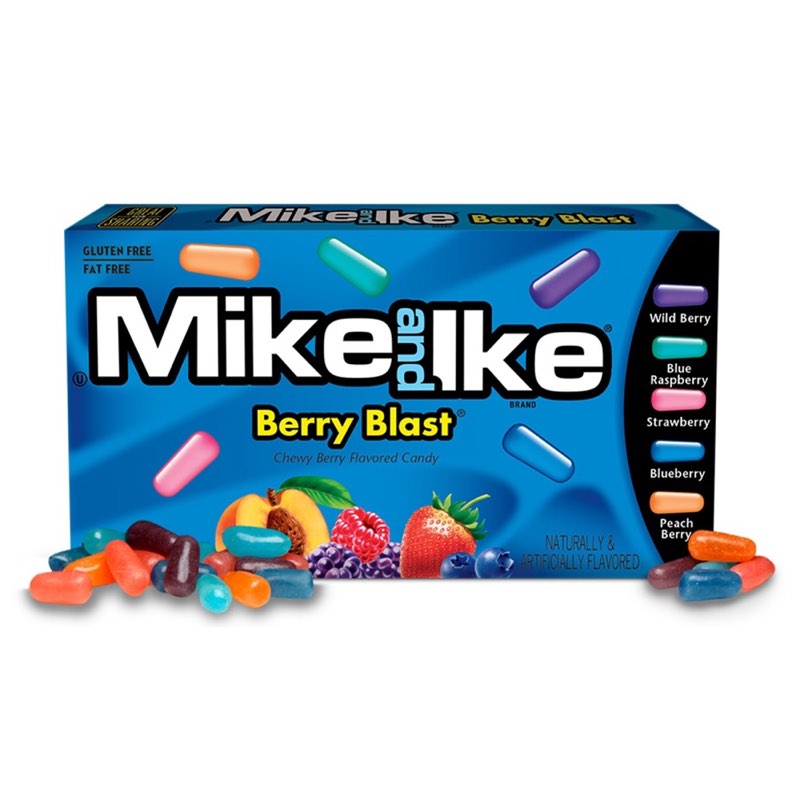
If you are building an actual spread and the beans are one item on it, they need a soft counterpart and something with bulk. The Mike & Ike Berry Blast theatre box at £2.25 is the closest thing to a chewy equivalent at a similar price and sits beside beans without either one dominating. For a sharp reset, Nerds Grape & Strawberry at £1.49 is the cheapest jolt on the shelf, and the Seriously Giant Vimto Spray at £1.89 is the novelty version of the same job for a table where something needs to make people laugh.
For the chocolate corner that most spreads need, Reese's Dipped Pretzels at £5.29 bring salt into the equation, which is the one thing a table of beans genuinely lacks. And for pure spun-sugar contrast, Charms Fluffy Stuff Cotton Candy at £2.49 is about as far from a hard shell as confectionery gets.
If you would rather build the whole thing yourself by weight instead of buying bags, our Pick & Mix lets you set the ratios, and the loose sweets shelf is where the weigh-out lines live.
Occasions where 70g is the right amount
The cinema. Quiet once the bag is open, no smell, no mess, and small enough to go in a pocket. The bag itself is the only noisy part, so open it before the film starts.
Travel. Trains, planes, long drives. Hard-shelled beans are among the most travel-proof sweets there are and 70g will see you through several hours if you eat them at the proper pace.
Desk and work. Discreet, tidy, shareable in ones. The format's second home.
Hampers and gift boxes. A branded, colourful, sensibly priced component that fills space attractively. At £2.40 you can include two or three different bags without moving the budget much.
Stockings and small gifts. The right size and the right price for a stocking, and unlike chocolate it will not be ruined if the room is warm.
Tasting games. Blind identification with a mixed bag is a genuinely good ten minutes with a group, and it costs almost nothing. It is also, as covered above, much harder than anyone expects.
Children, with the usual care. Sweets are a treat, and small hard sweets are a choking risk for young children and should be eaten with adult supervision. Anyone with an allergy should read the manufacturer's packaging on arrival before eating anything from the bag.
£2.40 for 70g, assessed honestly
£2.40 for 70g is about £3.43 per 100g, which places this at the upper end of the shop by weight. It is a small bag at a not-small per-gram price and there is no point pretending otherwise.
| Measure | Figure |
|---|---|
| Bag price | £2.40 |
| Bag weight | 70g |
| Cost per 100g | about £3.43 |
| Roughly per 25g portion | about £0.86 |
| Realistic servings | one person over an evening, or two people briefly |
| Sizes available | one |
What you are paying for is precision rather than volume. A bean of this type is a small, individually flavoured, shelled object, and an assortment is a set of them calibrated against each other — that is a different manufacturing proposition from a tub of one thing, and the price follows. Whether it is worth it depends entirely on whether you eat them attentively. Eaten one at a time with a pause, a 70g bag is a genuinely interesting hour and good value. Eaten by the handful in front of a screen, it is an expensive way to have some sugar and you would be better served by a big cheap bag.
The other thing the price buys is consistency across the shelf: every 70g bag in this range is the same £2.40, so choosing between assortments is purely a matter of what you want to taste. That is worth a lot when you are buying two or three, because you can pick on curiosity alone.
Storage, where dryness is the whole story
Hard-shelled beans are the least demanding thing we sell, with one exception.
Keep them dry. This is the entire brief. The shell is what makes a bean a bean, and damp softens it — a bean that has picked up moisture goes slightly tacky on the surface and loses the clean crack that gives the format its character. A sealed bag in a dry cupboard holds condition for a very long time.
Keep the bag closed. Once opened, clip it, roll it, or tip the contents into a jar with a lid. Beans left open in a bowl for a day or two are the main way people ruin them without noticing.
No fridge. Fridges are humid, which is exactly wrong for a shell. A cold bean also gives up its flavour more slowly, blunting the fast, clean hit that is the point of the format.
Out of direct sunlight. Not a spoilage issue so much as a colour one. Bright light dulls the colours over weeks, and since colour is doing real work in an assortment, faded beans are genuinely less enjoyable.
Heat is not a problem, within reason. There is nothing here to melt, which is why beans travel so well in summer. A hot car will not ruin them the way it ruins chocolate.
One size, and the rest of the shelf
This comes in a single size — the 70g bag at £2.40 — so there is no size decision to make, only a quantity one and a flavour one.
The flavour decision is where the shelf comes in. The Jelly Belly shelf carries eight lines in total, and they divide cleanly into three groups. There are the single-note bags, where one flavour is explored repeatedly and you know exactly what you are getting. There are the assortments, of which this is one, where the pleasure is in the variety and the combinations. And there are the games, where the whole premise is that you cannot tell what you are about to eat. Those three groups suit completely different moods, and most people who like beans end up owning something from at least two of them.
If you are choosing between assortments specifically, the practical distinction is category breadth. A broad mix gives you fruit, dessert and drink notes in one bag. A themed mix stays within a narrower band and goes deeper. Neither is better; the broad one is more interesting for a tasting, the themed one is more satisfying if you already know what you like.
Finding related things on the site
Two shelves carry this bag. The candy and chocolate section at 26 lines is the broad one, and it is where most of the boxed and bagged imported-style lines sit together, which makes it a good place to browse if this bag appealed for its style as much as its contents. The brand shelf, linked above, is the narrow one.
Beyond those, the two hub shelves worth knowing are our Haribo section, which is where to go for the soft, chewy counterpart to everything about this format, and the Kingsway shelf, which carries more of the traditional weigh-out lines that the jar-era part of this page was about. The pick and mix hub and the loose sweets shelf, both linked earlier, are the routes to building your own bag rather than buying one.
Questions worth asking before you add it
What flavours are in the bag?
We do not publish a flavour list for this line because we do not hold a verified one, and a guessed list would be worse than none. The pack itself carries that detail and it is the authority — read it when it arrives. If a known flavour list matters to you before you order, the single-flavour bags on the same shelf are explicit about what they are, and they are the same price.
Does "American Classics" mean it comes from America?
It is the name of the assortment, not a statement about origin, and we do not make origin claims we cannot verify. Read it as a description of the style and mood of the mix, in the same way that the ice cream mix and the cotton candy bag on the same shelf are named for the character of what is inside rather than for a place.
How many beans are in 70g?
Enough for one person over an evening, or two people for a short while. We do not count them and bean weights vary, so any number we gave you would be invented. Think of it as two decent handfuls, which is the useful measure anyway.
Is this good value?
At roughly £3.43 per 100g it is at the upper end of the shop by weight. It is good value if you eat beans one at a time and pay attention, because then a small bag is an hour of genuine variety. It is poor value if you eat them by the handful in front of a screen, in which case a large cheap bag of something else will serve you better and cost less.
Can I eat two together?
Yes, and it is one of the best reasons to buy an assortment. Two beans eaten simultaneously combine into a single composite impression rather than reading as two flavours in sequence. Combinations across categories work best — a fruit with a creamy note, or a sharp one with a round one. Two similar fruits usually just produce a vaguer version of both.
Will they melt in a warm bag or car?
No. There is nothing here to melt, which is why hard-shelled beans are one of the best sweets to carry in summer or to post. The thing that actually damages them is damp, not heat — keep the bag sealed and dry and it will be fine.
Are they suitable for children?
Sweets are a treat, and small hard sweets are a choking risk for young children and should always be eaten with adult supervision. For older children a small bag works well, though bear in mind that 70g does not go far between several people. Anyone with an allergy should check the manufacturer's packaging on arrival before eating.
How do I stop the bag disappearing in ten minutes?
Sort them by colour before anyone eats anything. It sounds like a joke and it is not — sorting imposes a pause, turns the bag into something you navigate rather than graze, and reliably makes 70g last several times longer. The alternative is to decant a portion into a small dish and put the bag away.
Is there a bigger bag?
Not in this line. One size, 70g, £2.40. If you need more, buy more bags, or buy two or three different assortments at the same price and turn it into a tasting rather than a snack.
What goes well with them on a table?
Something soft to contrast with the hard shell, something salty to break up the sugar, and something cheap in quantity so the interesting things are not gone in the first twenty minutes. Beans are an accent item at this size, not the centrepiece.
Why do they taste less distinct when I eat several quickly?
Because a bean gives its whole flavour in about three seconds, and if the next one arrives before the last has cleared you are tasting a blend rather than a sequence. Leave a gap. It is the single change that most improves a bag of assorted beans and it costs nothing.
Which bag should I buy alongside this one?
Pick one from a different category. If this is your fruit-leaning bag, take a dessert-leaning one; if you want a palate outlier, take the confectionery-flavoured one. Everything in the 70g range is the same price, so the decision is purely about contrast — and contrast is what makes two bags better than one.
Where that leaves it
A small, tidy, travel-proof bag of hard-shelled beans at £2.40, sold on variety rather than volume, and best treated as something to taste rather than something to snack on. Eat them one at a time with a gap, try two together at least once, keep the bag dry and sealed, and if you are buying at all, buy two different assortments rather than one — at this price the second bag costs almost nothing and doubles what you get out of the first.
More from Jelly Belly
More candy & chocolate sweets



Where this sits
Jelly Belly American Classics Jelly Beans Bag 70g appears on these shelves. Browse them, or jump to something nearby.
You might also like