Home / Candy & Chocolate / Sweet Taste of the USA Clear Cup 200g
USA · 200g
Read the full guide
Sweet Taste of the USA Clear Cup 200g
£3.99
✔ In stock — ready to ship
Fresh stock
Free over £20
Same-day dispatch
Secure checkout
Start with the numbers, because this is a product where the numbers are the argument. The Sweet Taste of the USA Clear Cup 200g is £3.99 for 200g in a single sealed cup. That is a meaningful amount of sweets — twice the weight of a standard sharing bag, comfortably more than a theatre box, and enough to fill a decent bowl rather than half of one.
Translated into portions, 200g is roughly seven or eight generous adult handfuls, or a dozen small servings if you are dividing it into pots for children. On a table of four or five people it is the main sweet bowl rather than a side dish. For one person it is not a sitting — it is a cup that lives on a shelf and gets gone back to, which is exactly what the resealable-style cup format is built for.
The full guide to Sweet Taste of the USA Clear Cup 200g
5,022 words on how it eats, who it suits, how to serve it and what to put beside it.
What £3.99 and 200 grams gets you
Set against the alternatives on the site, the value case is about breadth rather than bulk. You could spend £3.99 on one and a half theatre boxes, or on two small bags, and end up with one or two things. You could spend a great deal more on a large jar and end up with one thing in quantity — Aniseed Balls Sweet Jar at £16.99 is the far end of that approach, and a very good buy if you know precisely what you want and want a lot of it. This cup sits in the opposite corner: a moderate amount of several things for under four pounds. Which of those is better value depends entirely on whether you are buying for certainty or for variety.
The other thing 200g buys is a gift that does not look cheap. There is a threshold in gifting below which a sweet purchase reads as a token and above which it reads as an item, and it has more to do with volume and presentation than with price. A filled clear cup crosses that line at a price point where most single bars and bags do not. That is the whole commercial logic of the format, and it is why these cups turn up in hampers far more often than their cost would suggest.
On cost per gram, the honest position is that you can do better by weight if you buy from the loose sweets counter and fill your own bag. What you cannot do is get the cup, the seal, the presentation and the surprise for that price. You are paying a small premium for a finished object rather than a scoop, and whether that premium is worth it depends on whether the sweets are for eating or for giving.
The cup itself
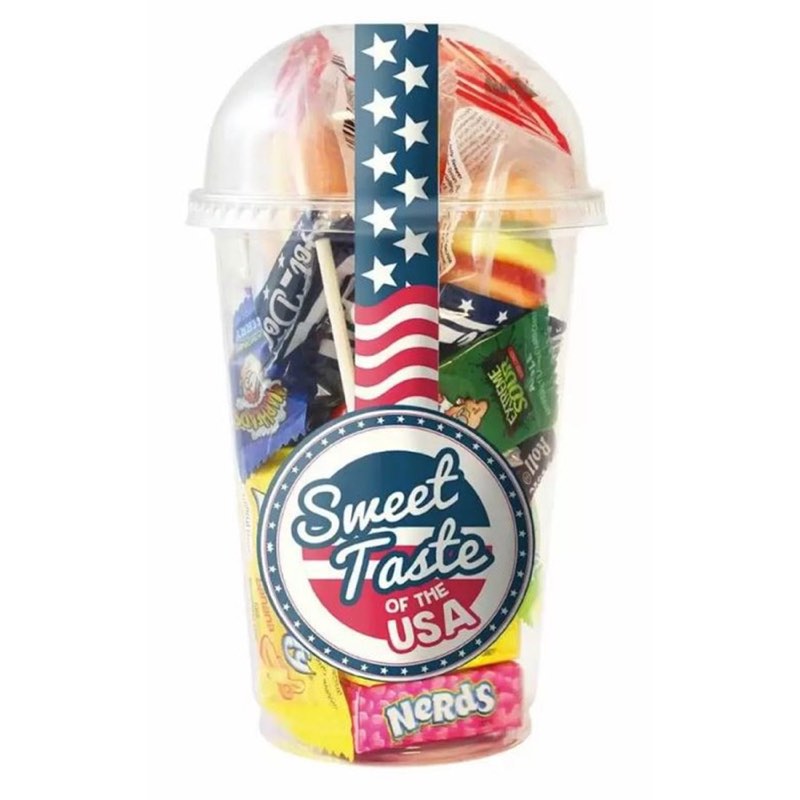
It is worth describing the object, because the object is most of what you are choosing when you buy this. A clear cup is a rigid, transparent tub with a sealed lid — the shape of a tall takeaway pot, tapering slightly towards the base, flat-bottomed enough to stand on a shelf without tipping. It holds 200g and it is full, so it has weight in the hand.
Transparency is doing the work. You can see what you have bought before you open it, which changes the way a mixed cup reads on a shelf or in a hamper: it is not a sealed mystery box but a display. The contents stack and layer against the sides, and because a mixed selection is made of different shapes and colours, the sides of the cup show bands and patches rather than one flat colour. That is why it photographs well and why it makes a better centrepiece for a small hamper than an opaque tub of the same size.
Practically, the rigid walls matter more than the transparency. A cup does not crush, does not fold, and does not let its contents compress into a slab the way a soft bag will when something heavy sits on it. In a parcel, in a hamper, in a rucksack for a journey, a rigid container is the item that protects everything around it. That is a genuine advantage over any bagged sweet at a similar price.
The lid is the other practical point. A sealed cup goes back on a shelf after you have taken some, which is the difference between a treat that lasts a fortnight and a bag that gets finished because there is no sensible way to put it down. If you are buying for a household that grazes rather than sits down, that reseal is worth real money.
What we can tell you about what is inside, and what we cannot
We are going to be straight about this, because it is the question everyone has. We do not publish a piece-by-piece contents list for this cup, and we are not going to invent one. What the product page tells you is the format, the weight and the price: a 200g clear cup, £3.99, one size, themed around American sweets. That is what we know and that is what we will assert.
So buy it the way you would buy any selection: for the idea and the format rather than for one specific sweet you have your heart set on. If there is a particular line you want guaranteed to be in the room, buy that line separately and put it next to the cup. That is genuinely the right approach with any assortment, and it takes the disappointment out of the whole category. If your child has to have a specific thing, a £1.49 bag of Nerds Grape & Strawberry alongside the cup costs almost nothing and removes the risk entirely.
The same applies to anything dietary. We hold no verified ingredient, nutrition or allergen information for the contents of this cup. We will not tell you what it contains, and we will certainly not tell you what it is free from. If anybody eating from it has an allergy or intolerance, read the manufacturer's packaging when the order arrives, before anybody opens anything. For a mixed selection that means checking each item, not just the outer cup. That is not us being cautious for the sake of it — it is the only responsible way to handle an assortment.
What we can talk about, at length and usefully, is what the format is good for. That is the rest of this page.
Opening a mixed cup, and how people eat one
There is a predictable sequence to opening a filled selection, and it is half the pleasure of buying one.
First there is the look through the side, which happens before the lid is off — people turn the cup, work out what they can identify from the edges, and start forming a preference. Then the lid comes off and the contents get tipped or spread, because nobody eats a mixed selection out of the container. It goes into a bowl, or onto a table, or into a lid used as a tray. Then comes the sorting, which is the bit that makes a mixed cup a social object: people separate what they want from what they do not, trade, claim things in advance, and negotiate. A cup of one thing gets eaten. A cup of several things gets discussed.
Eating pace is different too. With a single-line bag, you settle into a rhythm and the bag empties steadily. With an assortment, you slow down, because each choice is a decision, and you stop sooner, because variety satisfies faster than quantity. That is a well-observed thing about mixed selections generally and it is the reason a 200g cup lasts longer than 200g of one sweet. If you want sweets to go further in a household, buying variety rather than volume is the practical lever.
The textures in an American-themed selection tend to run wide — chewy, crunchy, chocolate-coated, spun, boxed — and that spread is the point. A wide selection gives everyone at a table a landing spot, so nobody has to eat something they do not like out of politeness. Whether you get any particular one of those textures in a given cup is not something we can promise, which brings us back to the honest position above: buy the format, not the inventory.
Why a filled cup is the most useful thing in a hamper
Gifting is where this product earns its keep, so it is worth going through properly rather than in a line.
Hampers. The problem with assembling a hamper is structure. A box of loose items settles in transit, and what looked full on the kitchen table arrives looking like it has been rummaged through. Rigid items are what hold a hamper's shape, and a tall clear cup is the best kind of rigid item because it earns its space twice — it braces the softer things around it and it is visually the most interesting object in the box, because you can see into it. Put the cup slightly off-centre, stand a couple of flat boxes upright behind it, and lay the soft bags in front. That is a hamper that survives a car journey and still looks composed when the lid comes off.
Themed hampers. If you are building around an American theme, this cup is the anchor and everything else hangs off it. A chocolate-and-salt element such as Reese's Dipped Pretzels 120g at £5.29 covers the sweet-savoury corner that British selections usually lack. Milk Duds at £2.99 bring a boxed chocolate-caramel format. Junior Mints at £2.59 give you the mint-and-chocolate note, which is a much bigger flavour in American confectionery than it is here. Add Jelly Belly American Classics Jelly Beans Bag 70g at £2.40 for the small-piece element, and you have a hamper that covers four distinct categories for well under twenty pounds, with the cup carrying the middle.
Letterbox and posted gifts. Here the cup has a limitation worth stating: it is tall, so it is a parcel rather than a letterbox item. If what you need is something that goes through a door without anybody being home, flat boxes are the format — Airheads 6 Bar Theatre Box 93.6g at £2.49 and Mike & Ike Berry Blast Theatre Box 120g at £2.25 both lie flat and post well. Save the cup for a parcel where it will be the thing that holds the box's shape and gets seen first when it opens.
Teacher gifts and end-of-term thank-yous. The difficulty with this category is pitch. Too small and it disappears into a pile of similar gifts; too elaborate and it becomes awkward. A filled 200g cup at £3.99 is almost perfectly calibrated: it looks like a considered object, it is obviously shareable in a staff room, and it commits nobody to anything. If you want to lift it slightly without changing the price bracket, tie a ribbon round the cup and add one small boxed item. Two objects always read as a gift; one object reads as a thing you picked up.
Care parcels. Students, someone working away, a friend having a rough stretch, a relative in for a long hospital stay. The requirements for a good care parcel are consistent: nothing fragile, nothing that has to be eaten all at once, nothing needing a plate or cutlery, and enough variety that the recipient gets to choose rather than to accept. A sealed, rigid, resealable cup of mixed sweets ticks every one of those, and the transparency means it does not look like an anonymous tub. If the parcel is going to somebody who will share it with others — a student house, a ward, an office — variety matters even more, because it is the only way one item can suit several people.
Housewarmings, host gifts and apologies. A cup of sweets is a low-pressure gift. It does not need to be liked as much as a bottle does, it does not have to match anyone's taste the way chocolate does, and it can be put on a counter and dipped into by whoever is around. For a host gift, pair it with something soft and colourful such as Charms Fluffy Stuff Cotton Candy 71g at £2.49, which is pure theatre and takes up no useful space.
Children's gifts. For a child, a cup they can see into is significantly better than a box they cannot, because the anticipation starts on the way home rather than at the moment of opening. It is also a better shape to hand over than a bag, and it survives being carried around by somebody who is not thinking about carrying it carefully.
Presentation notes. Do not wrap a clear cup in opaque paper, which defeats the only thing the format does that a box cannot. Cellophane and a ribbon, or a bag with the cup standing up and the top folded rather than sealed, both keep the contents visible. And if you are giving several items, give them in a single container rather than separately — a gift that arrives as one object reads as planned, and the same items handed over loose read as a shop trip.
A mixed cup in a mixed order: the builder's view
The other way to think about this product is as a component rather than a gift, and if you are putting together a larger order it behaves quite differently from everything else in it.
It is a shortcut, not a scoop. When you fill a bag from pick and mix you are making a series of decisions and living with the results. The cup makes several of those decisions for you at once. That is either a relief or an annoyance depending on your temperament, but it has one clear practical use: it covers breadth cheaply while you spend your own choosing effort on the things you actually care about. Buy the cup for coverage, and weigh out exactly the two or three lines you know you want.
It does not contaminate. A sealed rigid cup keeps its contents to itself. This matters more than people expect in a mixed order, because loose sweets in a shared bag transfer flavour and coating to each other — dusted, sour and strongly flavoured sweets are the usual offenders, and mint is the worst of all, since a mint note gets into everything soft that touches it. If your order includes anything minty, the contained format is the one item you do not have to think about.
It is the crush-proof element. Every order needs something that holds its shape. Pack the cup at the bottom, put boxes around it, and let the bags sit on top. The reverse arrangement — soft bags at the bottom under a rigid cup — is how people end up with a flattened bag of chews.
What to buy alongside it. Because the cup covers breadth, the right companions are depth: one thing in quantity that you know will be eaten. A big bag of chewy pieces such as Maoam Pinballs Bag 140g at £1.99 is the cheapest way to do that, and it is a reliable crowd-pleaser that nobody has to be convinced about. Then one thing that is a talking point rather than a staple. Then, if the order is for a table rather than a cupboard, one large single-line jar for visual weight.
Ratio. For a table, a rough split that works is half volume, a quarter variety and a quarter novelty. The cup is your variety quarter in one purchase. Going much beyond that — two or three assortments in the same order — produces a spread with no anchor, where nothing is present in enough quantity for anybody to settle into. Assortments are a seasoning, not a base.
What not to pair it with. Another mixed selection, for the reason above. And anything so strongly flavoured that it defines the whole table; if you want a very strong single note in the order, give it its own bowl at a distance rather than letting it sit beside a selection where people are already making choices.
The American shelf, and what the theme actually signals
An American-themed selection is a recognisable idea in a British sweet shop, and it is worth unpacking what the theme signals to the person receiving it, because that is what you are really buying.
Broadly, the American confectionery tradition leans in directions that British sweets do not. Chocolate and salt together is normal there and still faintly novel here. Mint and chocolate is a mainstream combination rather than an after-dinner one. Peanut and chocolate is a whole category rather than a single product. Colours run brighter, boxes run bigger, and the sweet-and-savoury boundary is drawn in a different place. None of that is a claim about this particular cup — it is the reason the theme exists and the reason people find a themed selection interesting rather than just a bag of sweets.
If you want to lean into that properly, the pieces are on the site. The mint-chocolate corner is covered by a box of Junior Mints at £2.59. The chocolate-caramel corner by the £2.99 box of Milk Duds. The sweet-savoury crossover, which is the most distinctively American of the lot, by the 120g bag of dipped pretzels. The bright, small-piece end by grape and strawberry Nerds at £1.49, and the taffy-style chew end by the six-bar Airheads box at £2.49. Spun sugar in a tub — the 71g tub of spun cotton candy — is the fairground element that most people associate with the theme before anything else.
For a tasting-style arrangement rather than a bowl, the American Classics bean bag at £2.40 is the one that gets people talking, because small identical-looking pieces with different flavours turn eating into a guessing game. Set that at one end of the table and the cup in the middle and you have an evening's worth of a theme for the price of a round of drinks.
Where the theme works best: a film night built round an American film, a Super Bowl or baseball-watching evening, a themed birthday for an older child, a leaving gift for somebody heading to the States, a welcome basket for somebody arriving from there. Where it works less well: as a subtle gift. A themed selection is not subtle, and that is fine, but it is a loud present rather than a quiet one.
Who should buy it, and who should buy something else
Buy it if you want one object that covers several people's tastes. That is its central use and it does it better than anything else at the price.
Buy it if you are assembling a gift and need something with shape. The rigid cup is the structural element that makes a hamper look like a hamper.
Buy it if you like the surprise. Some people genuinely enjoy not knowing exactly what is in a selection, and for them an assortment is more fun than a known quantity.
Buy something else if you want a specific sweet. An assortment is the wrong purchase for a definite craving, and the fix is simple — buy the specific line on its own from the Candy & Chocolate shelf, where the individual American lines are listed and you can see exactly what you are getting.
Buy something else if you are catering for a strict requirement. When you need to know what is in something before it is eaten, a single clearly labelled line is a more comfortable purchase than a mixed cup, because there is one pack to read rather than several.
Buy something else if you need volume for a crowd. 200g does not feed a party on its own. For a room full of people the cup is a feature on the table and the bulk comes from elsewhere — the sweets sold by weight are the cheaper way to fill the other bowls.
Occasions this cup suits
Film nights. The mixed contents do the job that cinema pick-and-mix does: everybody gets to choose, nobody negotiates over one bag. Tip it into a bowl before the film starts rather than passing the cup round in the dark, since sorting through an assortment is a visual activity and it does not work with the lights off.
Sleepovers and older children's parties. A cup each is a better arrangement than a shared bowl for this age group, because the sorting and trading is the entertainment. At £3.99 that is a realistic per-head spend for a small group.
Journeys. The rigid container survives a bag and the lid means it can be closed after twenty minutes rather than finished. For a long drive, an assortment beats a single line because it keeps the interest up, which is genuinely the only reason anybody eats sweets three hours into a motorway.
Christmas and seasonal tables. A clear cup stands on a sideboard and gets picked at through a day, and because you can see the level going down it acts as its own indicator of when to top it up. It also works as a stocking item, where the height is a virtue rather than a problem.
Office and staff rooms. Open cup, lid off, on a shared surface. The variety means it does not get ignored by the third day the way a single flavour does, and the lid means whatever is left keeps until the following week.
Reward jars and treat shelves. For a household that runs sweets on a portion basis rather than a free-for-all, a sealed cup on a high shelf is the practical format — it does not tear, it does not spill, and a handful out of it is a self-evident portion.
Keeping a mixed selection well
Mixed selections need slightly more care than single lines, for one reason: different sweets want different conditions, and in a shared container they all get the same one.
The general rule covers most of it. Cool, dry, dark, lid on. Not a windowsill, not above a radiator, not in a car. Warmth is the main risk with any assortment, because anything chocolate-based in a mix is the first thing to suffer and it takes the rest of the cup down with it if it softens against them.
Do not refrigerate as a matter of routine. Fridges are damp, and damp is bad for anything with a coating or a dusting; it also dulls flavour and can bloom chocolate surfaces. The exception is a genuinely hot spell, in which case a sealed cup in the coolest part of the house is better than the fridge, and if you do chill it, bring it back to room temperature still sealed so condensation forms outside the cup rather than on the sweets.
Keep the lid on between servings rather than leaving the cup open on a table all afternoon. Air is what turns crisp things soft and soft things tough, and in a mixed cup you notice it sooner because you are comparing pieces against each other.
If the cup has been opened and is going to be around for weeks, splitting it is sensible — put what you will get through soon in a bowl and keep the rest sealed. And check the dates on the manufacturer's packaging of the items inside when it arrives, since in an assortment they will not necessarily all be the same, and that packaging is the only authority on the specific cup you have.
One size, and how many to buy
This is listed at one size, 200g at £3.99, so the only decision is how many. A rough guide:
- One cup for a gift, a hamper centrepiece, a film night for two or three, or a treat shelf that will be rationed.
- Two for a small party alongside other sweets, or for two children who will each want their own to sort through rather than sharing one.
- Three or four if you are giving them individually — teacher gifts, a set of small thank-yous, party prizes — where the per-head cost matters more than the total volume.
- One cup plus bulk for anything bigger. The cup is the interesting bowl; the volume comes from weighed sweets and larger bags.
Buying several identical assortments for one table is the one combination to avoid. Two cups on the same table give you the same variety twice, which reads as less varied than one cup plus one large single-line bowl, and costs the same. Variety in a selection does not multiply — it repeats.
Where it sits on the site
This one lives on the sweets and chocolate hub, which is where the branded boxes, bars and imported lines are gathered. That is the right shelf to browse if you are building an American-themed spread, because most of the individual lines you would want alongside the cup are on the same page and you can see prices side by side.
From there, building your own mix is the route to take if you want to add weighed sweets to the order, and the by-weight listings are where the scoop-your-own lines sit if you would rather choose everything yourself. Everything on the site is the full catalogue if you are browsing without a plan, though for a themed buy it is usually faster to start from the themed shelf and work outwards.
Worth a look while you are here, if the cup is going into a gift: the 140g Pinballs bag as the cheap volume item, and the £16.99 jar of aniseed balls if what you actually want is the opposite of an assortment — one traditional sweet, in quantity, in a jar that looks like something.
Common questions
What exactly is in the cup?
We do not publish a piece-by-piece contents list for this line, and we would rather say so than guess. What we can confirm is the format and the size: a 200g sealed clear cup of American-themed sweets at £3.99, listed in one size. If there is a specific sweet you need to be certain of having, buy that line separately and treat the cup as the variety element.
Can you tell me the ingredients or allergens?
No. We hold no verified ingredient, nutrition or allergen data for the items in this cup, and we will not tell you it is free from anything. If anybody eating from it has an allergy or an intolerance, read the manufacturer's packaging when the order arrives — and with an assortment that means every item inside, not just the outer cup.
How many people does 200g serve?
Roughly seven or eight generous adult handfuls, or about a dozen smaller portions. On a table of four or five it works as the main sweet bowl; for a bigger group treat it as the interesting bowl and get your volume from weighed sweets or larger bags.
Is it good value compared with filling my own bag?
By weight alone, filling your own bag is cheaper. What the cup adds is the container, the seal, the presentation and the fact that somebody else made the selection. If the sweets are for eating at home, buy by weight. If they are going into a gift or a hamper, the cup is the better buy and it is not close.
Does it fit through a letterbox?
No — it is a tall rigid cup, so it needs a parcel. If you specifically need something that posts flat, the theatre boxes on the site are the format for that. The cup's advantage is the opposite situation: in a parcel it holds the shape of the box and protects the softer items packed around it.
Is it suitable for children?
Sweets are a treat rather than a food, and small hard sweets and whole gummies are a choking risk for young children, so little ones should be supervised while eating them. With an assortment that is worth a bit more attention than usual, since you will not necessarily know in advance what shapes and sizes are in the cup.
Can I reseal it?
The lid goes back on, which is most of the point of a cup over a bag. Keep it closed between servings, somewhere cool and dry, and it will hold up far better than an opened bag left folded over. If it is going to be around for weeks, decant what you are eating soon and keep the rest sealed.
Will the chocolate items melt?
Anything chocolate-based in any mixed selection is the first thing to suffer in heat, and in a shared container softening affects its neighbours too. Keep the cup out of the sun, out of hot cars and away from radiators. Do not use the fridge as a default — damp does its own damage — but in a genuine heatwave, a sealed cup somewhere cool is sensible.
Is this a good gift on its own?
Yes, for the thank-you and small-gift bracket, and it looks more substantial than its price because the cup is full and you can see into it. To lift it into proper gift territory, add one boxed item and present the two together — two objects read as a gift, one reads as something picked up on the way.
What should I put with it for an American-themed table?
Cover the corners that British selections usually miss: a chocolate-and-salt item, a mint-and-chocolate box, a chocolate-caramel box, and something bright and small-pieced. All four are on the site at modest prices, and with the cup in the middle you have a themed table for well under twenty pounds.
Why is the brand listed as USA rather than a manufacturer?
Because it is a themed selection rather than a single maker's product, so the listing describes the theme. That is also why the page talks about format and occasion rather than a recipe — we will describe what we can see and what it is for, and we leave the specifics of the contents to the packaging inside.
Do two cups have the same contents?
We cannot promise you that either way, which is a good reason not to buy two for the same table. If you want twice as many sweets, buy the cup plus something different in quantity — you will get more variety on the table and the same weight for your money.
The short version
A 200g clear cup at £3.99 that is bought for the format as much as the flavour: it stands up, it seals, it shows what it holds, it protects whatever is packed around it, and it covers several people's tastes in one object. Buy it as the centre of a hamper, the interesting bowl on a themed table, or the variety element in a bigger order — and if there is one particular sweet you have to have, buy that one alongside it rather than hoping.
More candy & chocolate sweets
Where this sits
Sweet Taste of the USA Clear Cup 200g appears on these shelves. Browse them, or jump to something nearby.
You might also like