Home / Loose Sweets / McAdams England World Cup Football Wheel Lollipop
Mcadams · 50g
Read the full guide
McAdams England World Cup Football Wheel Lollipop
£1.99
✔ In stock — ready to ship
Fresh stock
Free over £20
Same-day dispatch
Secure checkout
There is a particular kind of shopper this one is built for, and it is worth naming them straight away, because the McAdams England World Cup Football Wheel Lollipop is not a sweet that everybody needs. It is a sweet that certain people need very specifically, and when it fits, nothing else quite does the same job.
The first is the parent assembling a tournament-afternoon spread. There is a match on, there are children in the front room who care more about the crisps than the football, and you want something on the table that belongs to the occasion without being fussy. A red, football-themed wheel lollipop at £1.99 does that in a way a handful of unbranded jellies never will. It looks like it was chosen. It photographs well on a plate. It gives every child at the gathering the same object, which quietly removes about half the arguments you would otherwise be refereeing.
The full guide to McAdams England World Cup Football Wheel Lollipop
5,515 words on how it eats, who it suits, how to serve it and what to put beside it.
Who picks up a football wheel lollipop
The second is the person who buys for party bags and school fairs, and who has learned the hard way that a bag needs one hero item. Fill a bag with five small anonymous sweets and it reads as filler. Put one 50g themed lollipop in, add two small things around it, and the bag has a shape. The lollipop is the thing the child pulls out first and the thing they still have in their hand twenty minutes later, which, in party-bag economics, is the whole point.
The third is the collector, and we will come back to them properly further down, because the collector's relationship with a sweet like this is genuinely different from everybody else's. Themed, seasonal, event-shaped confectionery gets made in runs and then it stops getting made. People who notice that buy differently.
The fourth is the simplest and probably the largest: somebody who just wants a lollipop. A big one. One that lasts. Hard boiled sweets on a stick are one of the oldest formats in the shop for a reason — they are slow, they are cheap, they do not melt on your fingers, and they occupy a hand and a mouth for a long stretch of a car journey, a long queue, or a long wait for something to start. The football design is a bonus rather than the reason.
One honest note before anything else, because we would rather say it than let the packaging imply it. This is a themed novelty sweet. The football design and the tournament styling are decoration on a lollipop — treat it as a bit of fun for a match day, not as official merchandise, and not as something connected to any football association, governing body or competition. Nobody has ever bought a wheel lollipop expecting a certificate of authenticity, but it is worth being clear rather than coy.
The object itself: 50 grams of red on a stick
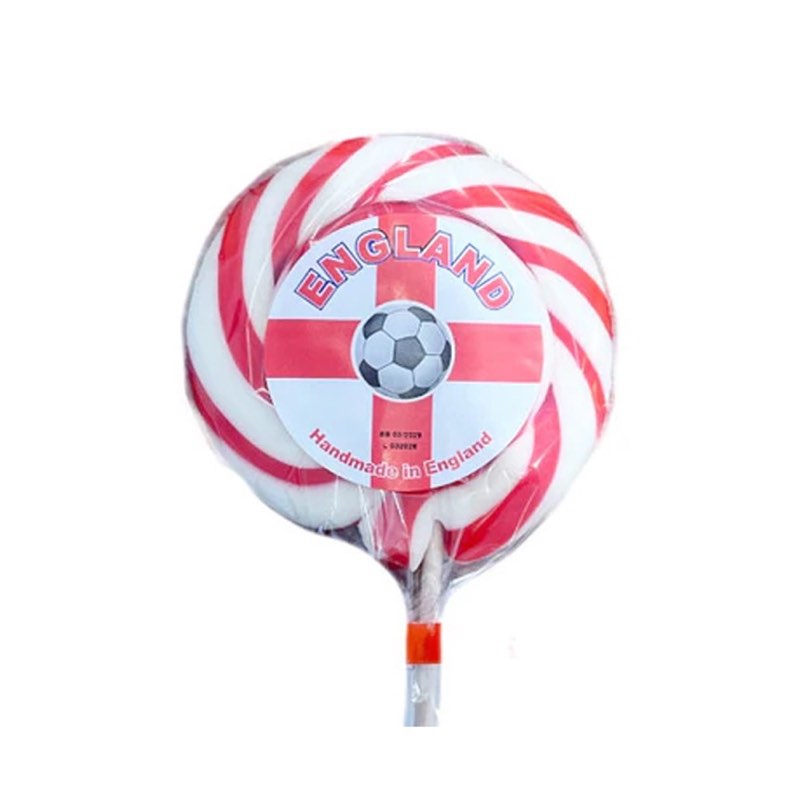
Take it out of the bag and the first thing you register is scale. Fifty grams of boiled sugar formed into a wheel is a proper handful — it is not one of the little flat discs that disappears in four minutes. Held at the stick, it has enough weight that a small child will tend to support it with a second hand, and enough diameter that it covers a decent part of a face in any photograph you take of them eating it. That is either a feature or a warning, depending on your relationship with the carpet.
The colour listed for this line is red, and red is the right call for the theme. It reads instantly across a room, it sits well against a white plate or a paper tablecloth, and it has that slightly glassy depth that only hard boiled sugar gets — light goes into it and comes back out a shade warmer than it went in. Held up to a window it glows. Children discover this within about eight seconds of unwrapping and will show it to you at least twice.
The wheel construction is the interesting bit. A wheel lollipop is a spiral — a coil of boiled sweet wound round itself and set flat, so you get concentric bands rather than a single solid slab. The practical effect is that the surface has ridges and seams rather than being perfectly smooth, which changes how it eats. A flat-faced lollipop is licked evenly and wears down into a thinner and thinner disc. A wheel wears from the outside in and along the seams, so it loses its edges first and then narrows towards the centre, which is why the last third of a wheel lollipop is nearly always the fastest part.
How it eats, minute by minute
The first thirty seconds are all surface. Boiled sugar is dense and non-porous, so the flavour does not flood in — it arrives at the tip of the tongue as a clean sweetness with the fruit note sitting just behind it, and it stays at roughly that level. There is no ramp. This is one of the things that separates a boiled sweet from a chew or a jelly: the intensity you get in the first ten seconds is broadly the intensity you get in the tenth minute. That steadiness is exactly why boiled sweets suit long occupations.
Somewhere in the first few minutes the edges start to round off and the ridges soften. This is the stage where a wheel is most satisfying, because the ridges give you something to work against — there is a mild texture, a slight catch, a sense that you are getting somewhere. A smooth lollipop offers none of that feedback.
The middle stretch is the long one. Left to dissolve properly, a 50g boiled lollipop is a twenty-minute-plus proposition, and considerably more if the person eating it is distracted by a television. Anyone who bites it will of course finish far sooner, and it will shatter into sharp-edged shards when they do — which is the first practical reason to keep an eye on younger children with it, and we will come back to the safety point properly below.
The final stage is the thin disc on the stick. This is where wheel lollipops occasionally part company with their sticks, so the last minute is best supervised over a plate rather than over a sofa. It is also the stage most people crunch, because the remaining sweet has gone thin enough to give.
The fruit flavour is worth describing honestly: it is the broad, bright, general fruit character that boiled sweets have always run on — sweet-led, clean, more of a bright impression than a specific named fruit, and it fades gradually rather than dropping away. It does not leave a heavy coating on the palate, which is part of why hard fruit sweets sit so comfortably next to savoury food at a party while a caramel or a chocolate would not.
The collector's view: why themed sweets behave differently
Most of the shop is permanent. The big jars on the weigh-out shelf are there in January and they are there in November, and if you find a favourite you can reasonably expect to find it again. A small but genuinely interesting part of the shop is not like that at all, and a football-themed wheel lollipop tied to a tournament sits squarely in that second category. Understanding the difference changes how you shop.
Runs, not lines
A permanent line is made continuously. A themed novelty is made in a run — a quantity produced against an expected window of demand, shipped, sold, and then not repeated in the same form. When the window closes, what exists is what exists. This is not manufactured scarcity or a marketing device; it is just the reality of making decorated confectionery for an event. Nobody keeps a tournament-liveried mould running through the following spring.
The consequence for a shopper is simple: if you see a themed item in the shape you want, that is the moment. The version that reappears for the next event will be a new design with a new shape and new colours, and it will not be the one you saw. Collectors internalise this quickly, and it is why they buy two of things.
Shape as the collectable unit
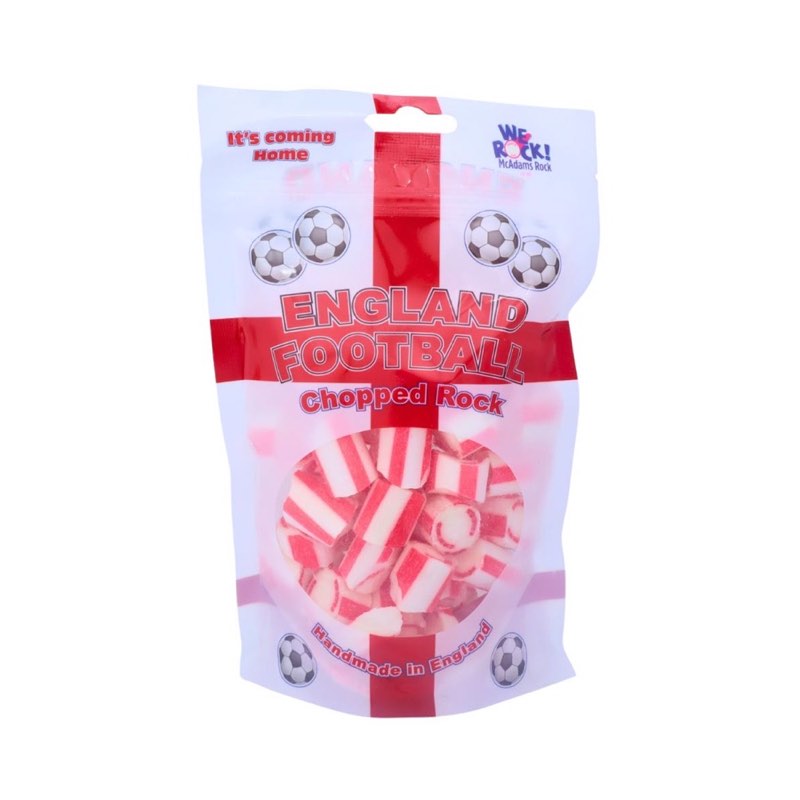
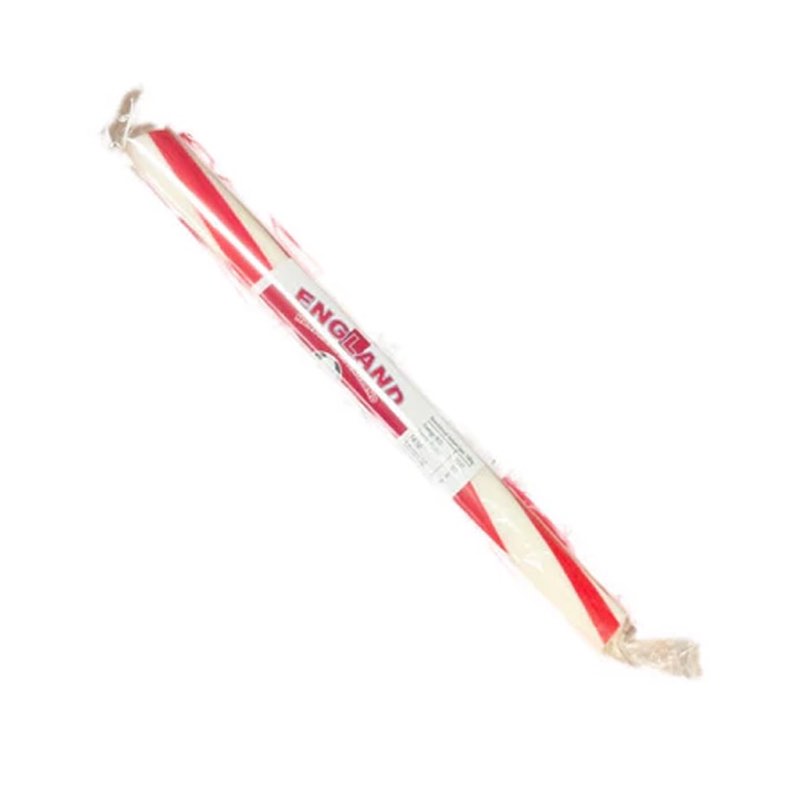
What collectors of novelty confectionery actually collect, in practice, is shapes and formats rather than flavours. The wheel is a format. The rock stick is a format. The chopped pouch is a format. Within our own McAdams football range you can see the logic working: this wheel lollipop at £1.99 sits alongside the £1.49 football rock stick, which gives you the same theme in a long straight format that travels flat in a bag, and McAdam's England Football Chopped Rock Pouch 150g, which takes the same idea and breaks it into shareable pieces in a resealable format. Three shapes, one theme. Somebody collecting the theme wants the set; somebody who simply wants sweets picks whichever format suits the occasion.
That is the useful distinction. The wheel is the display piece — it is the one that reads as an object. The rock stick is the pocket version. The pouch is the version you put in a bowl. If you are buying for a match-day table rather than a shelf, you may well want more than one of the three, and for different reasons.
Seasonal shapes beyond sport
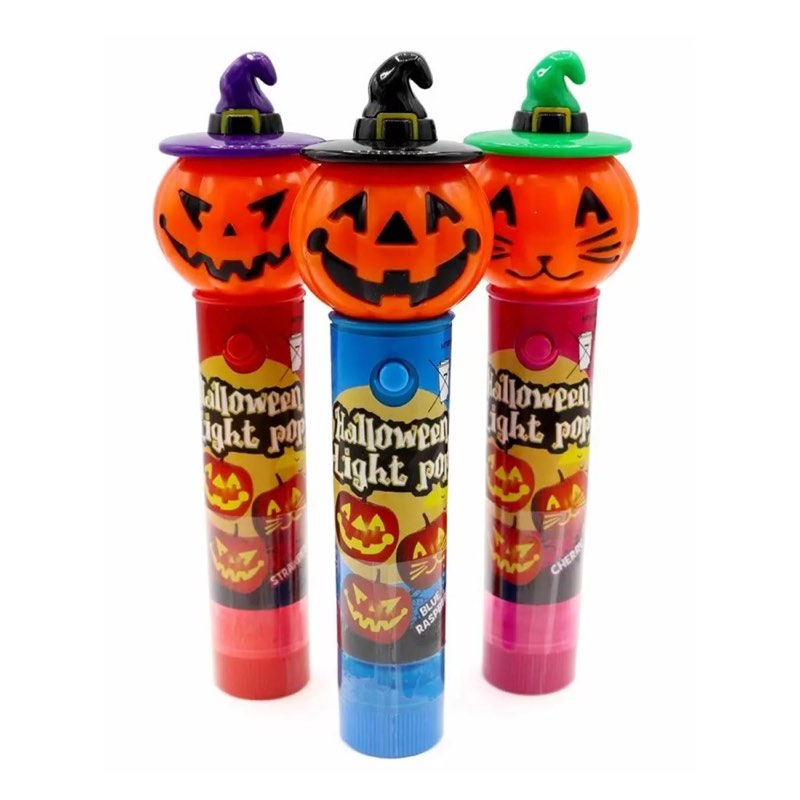
Football is one event. The same production logic produces the whole seasonal calendar, and if the collector's instinct is what draws you here, the seasonal shelf is where it gets fed most often. Candy Realms Halloween Pumpkin Light Pop 11g at £1.49 is a neat example of the type — a tiny 11g sweet attached to a novelty format, sold on the strength of the shape and the moment rather than on weight. Nobody buys an 11g pop for the sugar. They buy it because it is a pumpkin and it is October, and in three weeks it will not be on the table.
Put the pumpkin pop and the football wheel side by side and you can see the two ends of the novelty spectrum clearly. One is small, gimmick-forward and almost entirely about the format. The other is a large, substantial lollipop that happens to carry a theme. Both are event confectionery; they solve the event in different ways.
The condition problem
Here is the part collectors of novelty sweets learn late. Confectionery is not a stable collectable. Boiled sugar is hygroscopic — it takes on moisture from the air over time, and a lollipop kept unwrapped on a shelf will slowly go tacky and cloudy at the surface. A themed sweet kept as a keepsake needs its wrapper intact, needs a cool dark cupboard rather than a sunny windowsill, and still has a best-before date printed on it that it will eventually pass.
So the honest collector's advice is this: collect the experience and the photograph, not the object. Buy two, eat one on the day, keep the second sealed and cool if you want it for the memory, and accept that a sweet is a sweet. Anyone who wants a display piece that lasts is better served by keeping the wrapper flat in a scrapbook than by keeping the lollipop.
Where novelty sits against the everyday shelf
It is easy to treat novelty confectionery as a lesser category — decoration over substance. It is more accurate to say it does a different job. The everyday shelf answers the question "what do I fancy". Novelty answers the question "what does this occasion need". You do not put Swizzels Barley Sugar at £5.49 on a children's party table, even though it is an excellent, serious, long-lasting boiled sweet, because barley sugar is a grown-up's tin-in-the-glovebox sweet and a football wheel is a nine-year-old's afternoon. Both are boiled sweets. Neither substitutes for the other.
Equally, when the occasion is over, the novelty stops making sense and the everyday shelf takes over again. That is why most people's baskets end up mixed: one themed hero for the table, and a couple of proper weigh-out bags for the week. If you want to see the full spread of what the permanent shelf holds, the loose sweets counter is the place to start, and it runs to 356 lines.
The maths: what £1.99 and fifty grams actually buy you
We would rather be straightforward about price than lean on the word "value" without showing the working. Novelty confectionery is where shoppers most often feel uncertain about whether they have been sensible, so here is the arithmetic laid out plainly.
Cost per gram and per 100g
This lollipop is £1.99 for 50g. That is £3.98 per 100g, or a shade under 4p per gram. On its own the number means nothing; it only becomes useful when you put it next to things you might buy instead. Here is the same calculation run across a spread of lines we stock where the pack weight is stated on the product:
| Product | Price | Weight | Cost per 100g |
|---|---|---|---|
| McAdams England World Cup Football Wheel Lollipop | £1.99 | 50g | £3.98 |
| McAdam's England Football Chopped Rock Pouch | £1.99 | 150g | £1.33 |
| Warheads Blue Raspberry Cubes Bag | £2.49 | 99g | £2.52 |
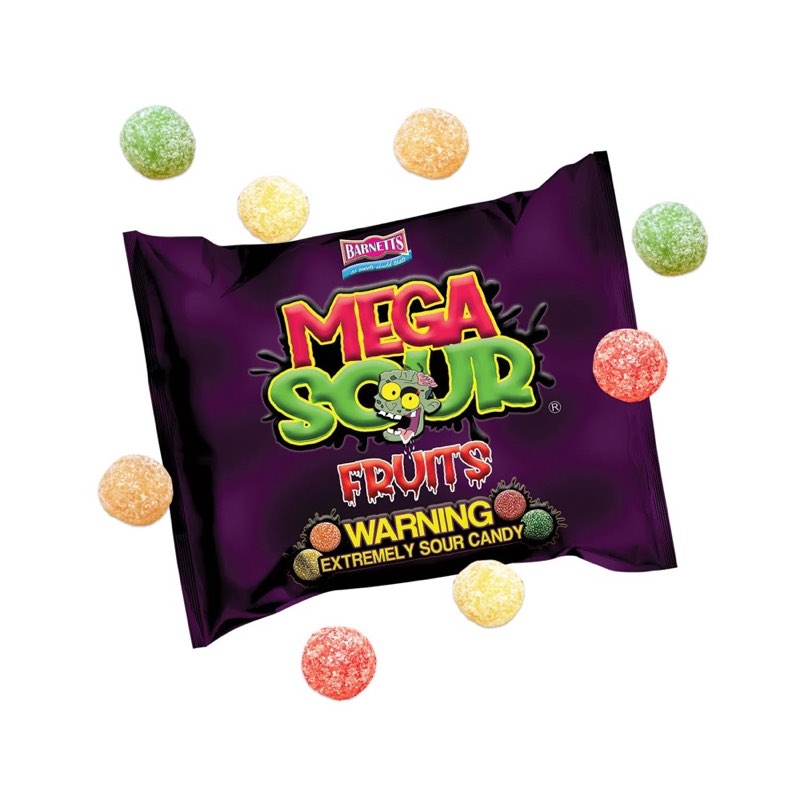
| Barnett's Mega Sour Fruits Candy Bags | £3.99 | 104g | £3.84 |
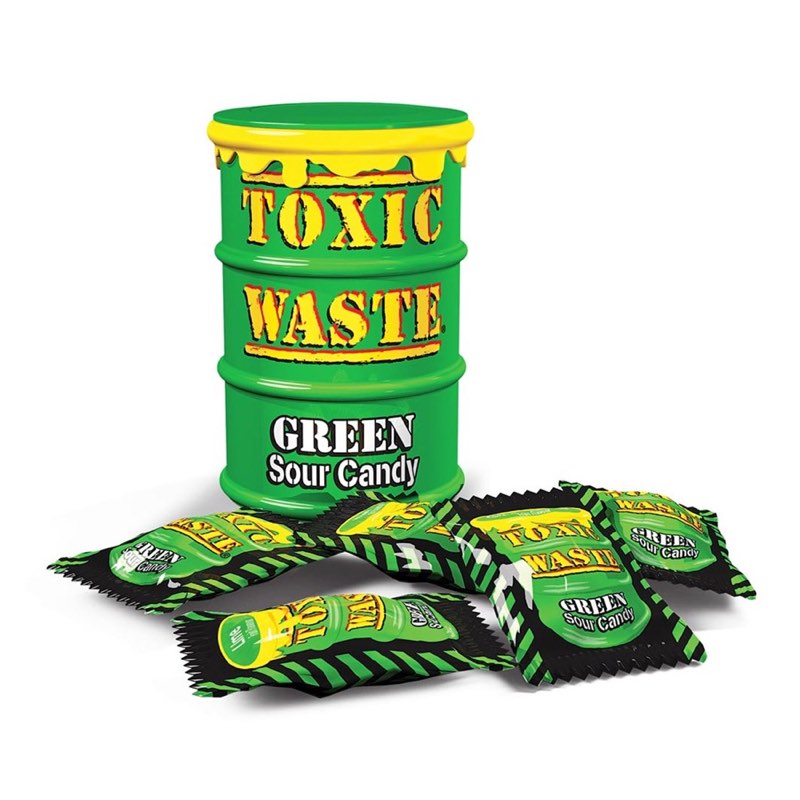
| Toxic Waste Green Drum | £1.99 | 42g | £4.74 |
| Candy Realms Halloween Pumpkin Light Pop | £1.49 | 11g | £13.55 |
Read that table properly and the picture is clear. At £3.98 per 100g the wheel lollipop sits in the middle of the novelty range — dearer than a plain pouch of the same theme, cheaper than a small sour drum, and a long way cheaper than a tiny gimmick pop. You are paying a premium over loose weight for the shape, the stick and the theme, and it is a modest premium rather than a silly one.
If pure weight is what you are after, the comparison is stark and we are not going to hide it. That same-theme 150g pouch is the identical £1.99 and gives you three times the sugar for the money, at £1.33 per 100g. It just does not give you a lollipop. Choose according to what you actually want the sweet to do.
Per handful, per guest
The more useful unit at a party is not grams, it is people. A wheel lollipop is one item for one person, and that is the whole of its portioning logic — there is no dividing it, no serving it into bowls, and no awkward moment where one child gets more than another. One each. That simplicity is worth real money when you are catering for a room.
Run the numbers for common group sizes and the picture stays comfortable:
- A family of four watching a match: £7.96, and 200g of sweets across the afternoon.
- Eight children round a table: £15.92, with every child holding an identical object.
- A class party of thirty: £59.70. That is the point at which most people switch to a mix rather than one lollipop each — but it is also the point at which a lollipop each genuinely solves a problem no bowl of loose sweets solves.
- Twelve party bags with one lollipop as the hero item: £23.88 on the hero, leaving budget for two smaller fillers per bag.
The party-bag case is where the maths gets interesting, because a party bag has a perceived value and an actual cost, and they are only loosely related. A themed lollipop sitting on top looks like the bag cost a lot more than it did. Add a small sour item like Toxic Waste Green Drum 42g at £1.99 for the older children who want a dare, and you are at under four pounds a bag with two items that both get talked about.
Time as a unit of value
There is a third measure and it is the one boiled sweets win on outright: minutes per pound. A chew is gone in ninety seconds. A jelly is gone as fast as somebody keeps picking them up. A 50g hard boiled lollipop, eaten properly rather than bitten, occupies somebody for a long stretch of an afternoon.
For a car journey, a long queue, a waiting room, or the ninety minutes of a match, that matters more than cost per gram. One £1.99 lollipop that lasts most of a first half is doing a different job from £1.99 of chews that vanish before the coach leaves the car park. If you want that same slow-release quality without the novelty shape, the boiled sweets shelf holds thirty lines built on the same principle.
Where the premium is and is not worth paying
Be honest with yourself about which of the three jobs you are buying for. If you want maximum sweets for minimum money, buy weight and skip the theme. If you want one object that makes an occasion feel considered, the theme is the entire point and the premium is trivial. If you want something that lasts, buy hard rather than soft and ignore both of the other calculations. Most baskets we see are doing at least two of those jobs at once, which is why a themed lollipop and a big weigh-out bag so often go in together.
Fruit, as a flavour family
"Fruit" is the flavour listed for this line, and it is worth spending a moment on what that means in confectionery, because it is one of the broadest and most useful families we stock — 161 lines sit under our fruit flavour shelf, and they behave very differently from one another.
In a hard boiled sweet, fruit reads as brightness. The sugar carries it, the density slows it, and what you get is a clean, sweet, generally fruity impression that does not try to convince you it is any one particular fruit. That is not a failing. A general fruit character is what makes hard sweets so easy to put next to other things — it does not clash, it does not dominate, and it resets the palate rather than coating it.
Move the same flavour family into a chew and everything changes. Barratt Fruit Salad Chews at £5.49 are the classic demonstration: the flavour arrives all at once because the sweet gives way immediately, and it is gone within a minute. Chews are about impact. Boiled sweets are about duration. Putting both on a table gives people a choice between the two experiences, and they will self-select faster than you expect.
Push fruit into sour territory and you get a third thing again. Barnett's Mega Sour Fruits Candy Bags 104g at £3.99 and Warheads Blue Raspberry Cubes Bag 99g at £2.49 both lead with the sour hit and let the fruit follow behind it. Sour is a social sweet — it produces a reaction, which is why it gets passed round. A football wheel does not produce a reaction; it produces twenty quiet minutes. On a table that holds both, they do opposite and complementary jobs.
Then there is fruit crossed with something else entirely, which is where the family gets genuinely interesting. Stockley's Chocolate Flavoured Limes at £5.49 put a citrus and a chocolate note in the same hard sweet, and the name tells you exactly what the pairing is before you open the bag. It is the sort of thing that divides a room, in the good way.
Finally, fruit in a jelly. Kingsway Vegan Garden Fruits at £5.49 works the same family through a soft format, where the flavour is released by chewing rather than by dissolving. Soft formats give you variety within a single scoop in a way a single lollipop never can.
Building a mix around one lollipop
A single 50g lollipop is a centrepiece rather than a spread, so the interesting question is what goes with it. The principle we would suggest is contrast: the wheel is hard, slow, red, sweet and singular, so the things around it should be soft, fast, varied or sharp.
The match-day table
One lollipop per person as the hero, then two bowls. Make the first bowl sour, because sour sweets are what people reach for between goals and what they pass to the person next to them — the blue raspberry cubes are the easy pick at £2.49 for a 99g bag, since cubes scoop cleanly and do not stick together in a warm room. Make the second bowl soft and mild, so there is somewhere to go after the sour. BUBS Banana & Caramel Foam Sweets at £7.50 are the grown-up option here: foam sweets are light, the banana-and-caramel pairing is gentler than anything fruit-and-sour, and they clear a sour palate properly.
The children's party build
Here the wheel is the take-home and the rest is for the table. Go wide rather than deep — several small quantities of very different things beats a mountain of one. Pull from the pick and mix, add something with its own gimmick such as Swizzels Fruity Pops at £5.49 so the lollipop format is represented in a smaller size too, and keep one bowl deliberately plain for the child who does not like anything.
The all-hard build
If you are catering somewhere sticky fingers are a genuine problem — a car, a coach, a cinema, a church hall with a good carpet — build entirely from hard sweets and thank yourself later. The wheel leads, the football rock sticks travel flat at £1.49 each, and something like the barley sugar at £5.49 covers the adults. Nothing melts, nothing marks, nothing needs a napkin.
The grown-ups' bowl
Adults at a tournament gathering will eat sweets, but they will not eat a themed lollipop in front of each other. Give them their own bowl and they will empty it. The chocolate limes and the barley sugar both read as proper old-fashioned confectionery rather than as party food, and both hold up in an open bowl for hours. You can browse the whole of that register on the retro sweets shelf.
Occasions this actually suits
Tournament afternoons. The obvious one, and the one it was designed for. Put them out before kick-off rather than during — handing a lollipop to a child mid-match creates more disturbance than it solves.
Party bags. As covered above, one themed lollipop is worth three anonymous small items in perceived value, and it is the thing a child shows a parent in the car.
Sports clubs and end-of-season gatherings. A football-shaped sweet handed out at a junior club presentation costs under two pounds a head and fits the day without anybody having to organise anything. It is a decent, cheap gesture that does not pretend to be a trophy.
School fairs and tombolas. Wheel lollipops are visible from across a hall, which is exactly what a stall needs. They also price neatly at a round figure on a stall, and they do not need refrigeration or a serving implement.
Long journeys. Hard, slow, on a stick, and not remotely melty. One per child, over a plate or a napkin, and you have bought yourself a decent stretch of quiet. Pair with something from the full sweet shop for the return leg.
Hampers and sweet boxes. A wheel lollipop gives a hamper height and a focal point, which flat bags cannot. If you are assembling a box, put the lollipop in last and stand it up.
Reward jars and treat tins. The size works against weekly use — this is a Saturday sweet rather than a Tuesday one. Better used as the occasional big treat than as the regular one.
Seasonal tables. Any table that needs a theme rather than a flavour. The same logic that puts a football wheel on a match-day spread puts a pumpkin pop on an October one, and it is worth keeping a note of which events you cater for annually so you can buy the themed pieces when they appear rather than the week before.
Keeping it well
Hard boiled sweets are among the most forgiving things we sell, with one enemy: moisture. Sugar at this density will pull water out of humid air, and the result is a surface that first goes slightly tacky, then cloudy, and eventually sticks to its own wrapper.
The rules are short. Keep it wrapped until you eat it — the wrapper is doing real work, not just carrying the design. Store it somewhere cool, dry and dark: a cupboard, not a windowsill, and not the shelf above a kettle or a hob. Do not refrigerate it; a fridge is a damp environment and taking a cold sweet out into a warm room causes condensation on the surface, which is precisely the thing you were trying to avoid.
If you are buying several and keeping some back, an airtight tub or a resealable bag in a cupboard is ideal, and worth doing in a warm month. If a lollipop does go tacky it is a texture problem rather than anything worse, but it will never be as good as the day it arrived, so buy for the occasion you have rather than stockpiling.
Partly eaten is a different question. Realistically, a lollipop that has been in a mouth does not go back in a cupboard. If you need to pause one mid-way — a child loses interest, the match ends, dinner arrives — stand it in a glass on a plate for the rest of the evening and accept it as a same-day sweet. And do check the best-before date printed on the pack when it arrives.
Sizes, variants and the sensible warning
This line comes in one size only. There is no larger or smaller version of the wheel, no multipack, and no alternative colour listed — what you order is the 50g lollipop at £1.99, and the only decision is how many. It is in stock as we write.
If you want the same theme at a different size or format, the range gives you two other routes rather than two other sizes of the same thing: the rock stick at £1.49 is the cheaper, smaller, flatter option, and the 150g pouch at £1.99 is the bulk option. That is the whole football set.
The one genuine caution, and we will state it plainly: sweets are a treat, and small hard sweets, whole gummies and anything on a stick are a choking risk for young children, so keep little ones supervised while they eat. A hard boiled lollipop that gets bitten will break into sharp pieces, which is worth knowing before you hand one to a three-year-old. And if anyone in your household has an allergy, please check the manufacturer's own packaging when your order arrives, before anybody eats anything — the pack in your hand is always the authority on that.
Finding your way round the shop from here
This product sits on three shelves, and each one is a different way of arriving at it. It is on the loose sweets shelf, which at 356 lines is the biggest single section we run and the one most people browse first. It is filed under boiled along with twenty-nine other hard-sweet lines, which is the right shelf if what you actually want is duration rather than novelty. And it is in everything we file as fruit, a 161-line section that spans hard, soft, sour and chewy formats.
Beyond those, the hubs are the quickest way to move sideways. Browse the whole range if you are starting from nothing and want to see the shape of the shop. Go to pick and mix if you are building a spread rather than buying a single item. The candy and chocolate section is where to go if the table needs something richer than sugar-and-fruit, and the jelly and gummy aisle is the natural counterweight to a hard sweet like this one — soft, fast, varied, everything the wheel is not. If you are shopping for adults or for nostalgia, start instead with the retro section.
A practical browsing tip: if you know the flavour you want, use the flavour shelves. If you know the texture you want, use the type shelves. Most people shop by flavour and then find they were really shopping by texture — they wanted something to last, or something to chew, rather than something fruity in particular. Working out which one you are is the fastest way to a basket you are happy with.
Questions we get asked about this one
How long does a 50g wheel lollipop actually last?
Eaten properly — licked rather than bitten — a hard boiled lollipop of this size is a twenty-minute-plus sweet for most people, and longer for a child who keeps getting distracted. Adults tend to be faster because they apply more pressure and eventually crunch the last of it. If someone bites it from the start it will be gone in a couple of minutes and will break into sharp shards, which is worth discouraging for the youngest eaters.
Is this an official football product?
No. Treat it as a themed novelty sweet — a football-styled lollipop for a match-day table. We are not claiming any official connection, licence, endorsement or association with any football body, team or competition, and you should not buy it expecting one. Buy it because it is a big red lollipop that suits the occasion.
Can I get it in a different colour or size?
Not in this line. It is listed in red, in one size, at £1.99 for 50g. If you want the same football theme in another format, the rock stick at £1.49 and the 150g chopped rock pouch at £1.99 are the two alternatives, and both are on the site.
How many should I order for a children's party?
One per child, plus two or three spares — somebody always drops one and somebody's sibling always turns up. For twelve children that is fifteen lollipops, around £29.85, and it removes the entire question of who got more. If the budget is tighter, use the lollipop only in the take-home bags and fill the table itself from a weigh-out bag instead.
Does it melt if I post it or leave it in a car?
Hard boiled sweets are far more heat-stable than anything chocolate, so a warm car is not the disaster it would be with a chocolate bar. Sustained heat and humidity will still make the surface tacky over time, so do not leave one on a dashboard in July, and keep the wrapper on until it is being eaten.
What goes well with it on a party table?
Contrast beats more of the same. The lollipop is hard, slow and singular, so put something soft and something sour next to it — a bag of sour cubes for the reaction, a soft foam or jelly for the people who do not want sour, and you have covered most of a room. Keep one plain option for the fussiest guest.
Is it suitable for very young children?
Sweets are a treat rather than food, and small hard sweets and whole gummies are a choking risk for young children, so anybody little should be supervised while eating. A large lollipop on a stick needs particular attention because it can be bitten and broken into sharp pieces. Use your own judgement about age, and stay in the room.
Someone in the house has an allergy — what should I do?
Check the manufacturer's own packaging when the order arrives, before anybody eats anything. The printed pack that comes with your order is the authoritative source on what is in it, and we would always rather you read it than rely on a description online.
Will you have this again after the tournament?
Themed confectionery is made in runs against an event, so we would not promise it. What tends to happen is that a new design appears for the next occasion rather than the same one returning. If the shape matters to you, buy it while it is listed rather than waiting.
Is it better value than buying loose sweets by weight?
No, and we would not pretend otherwise. At £3.98 per 100g you are paying a premium over weight for the shape, the stick and the theme. The same-theme 150g pouch works out at £1.33 per 100g for the same £1.99. Buy the lollipop when the object is the point; buy weight when the sugar is the point.
Can I keep one as a souvenir?
You can keep it sealed in a cool dark cupboard, but be realistic — sweets have a best-before date and boiled sugar slowly takes on moisture from the air, going tacky and cloudy over months. If you want a keepsake, the wrapper flattened into a scrapbook will outlast the sweet by years. Buy two: keep one for a while, eat one on the day.
What is the difference between a wheel lollipop and a flat one?
A wheel is a coiled spiral set flat, so it has concentric bands, ridges and seams. A flat lollipop is a smooth disc. The wheel wears from the edges inwards and along the seams, which gives you a bit of texture to work against while you eat it, and it is usually the more substantial of the two in the hand.
In short
A big red football-themed wheel lollipop, 50g for £1.99, that does exactly one thing and does it well: it gives one person a slow, bright, hard fruit sweet and gives an occasion a focal point. It is not the cheapest sugar in the shop by weight, and it does not pretend to be official anything. It is a novelty done at a sensible size and a sensible price, and on the right afternoon that is precisely what a table needs. Add one per guest, put a bowl of something soft beside it, and the rest looks after itself.
More from Mcadams
More boiled sweets
More fruit sweets


Where this sits
McAdams England World Cup Football Wheel Lollipop appears on these shelves. Browse them, or jump to something nearby.
You might also like