
Home / Loose Sweets / Hi-Chew Tropical Mix Bag 80g
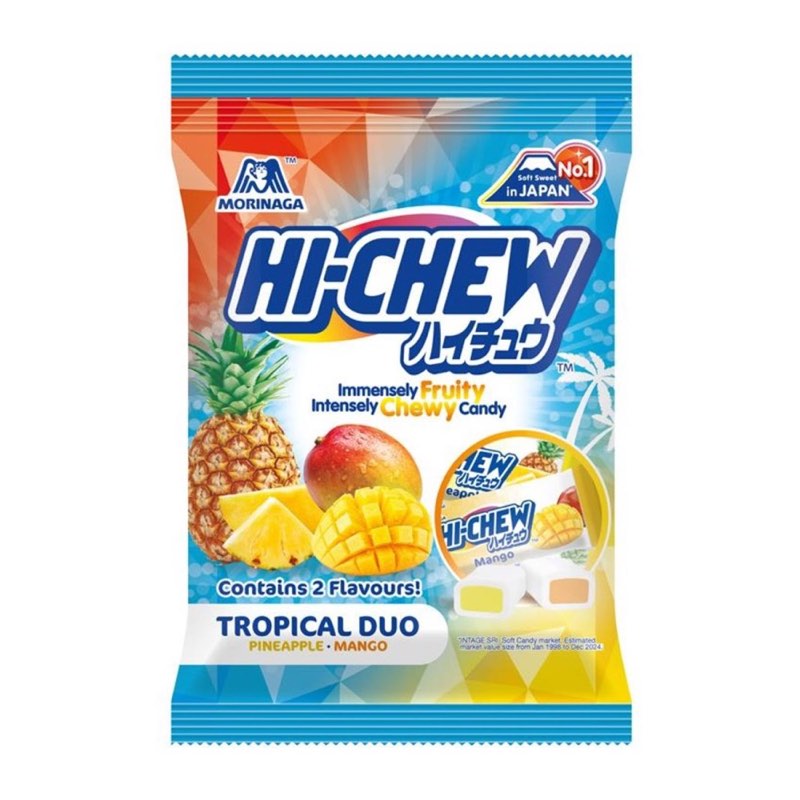
Hi-chew · 80g
Read the full guide
Hi-Chew Tropical Mix Bag 80g
£1.99
✔ In stock — ready to ship
Fresh stock
Free over £20
Same-day dispatch
Secure checkout
There is a particular kind of sweet buyer who walks past the jars, past the chocolate, past the sour section, and goes straight to the chews. If that is you, the Hi-Chew Tropical Mix Bag needs very little selling. It is 80g at £1.99, it is a bag of chews, and the two flavours on file are mango and pineapple. That is the whole proposition, and the people it suits fall into a handful of recognisable types.
The first is the slow eater — or rather, the person who wishes they were one. A chew is the slowest sugar in any sweet shop. It cannot be crunched through, it does not dissolve on the tongue, and it will not be hurried. If your problem with confectionery is that a bag vanishes in four minutes and you barely noticed eating it, a chew fixes that structurally rather than through willpower. Your jaw sets the pace, and it is a much slower pace than your hand would set. People who buy chews habitually usually know this about themselves. If you have never thought about it, it is worth noticing next time.
The full guide to Hi-Chew Tropical Mix Bag 80g
5,824 words on how it eats, who it suits, how to serve it and what to put beside it.
The shopper this bag was made for
The second is the tropical-flavour person, and this is a smaller and more specific group than the fruit-sweet population as a whole. Mango and pineapple are not default British sweetshop flavours. The default is strawberry, then cherry, then lemon and orange. Tropical fruit sits slightly outside that, and the people who reach for it tend to be reaching deliberately — they have had enough of red fruit, or they want the sweet equivalent of a holiday flavour, or they simply prefer fruit that is heavier and rounder than a berry. Our mango flavour shelf is one of the smaller ones on the site for exactly this reason, which makes it worth knowing about if mango is your thing; there is not a great deal of it about.
The third is the sharer. Eighty grams is a hand-round quantity. That is a different job from a pocket pack and a different job again from a tub. It is enough to go round a car, an office desk cluster, a sofa's worth of people or a small table, with each person getting a piece or two, and it does not demand a bowl to work. It also does not demand a plate, a napkin or a serving spoon, which quietly rules in a lot of situations where sweets are otherwise more trouble than they are worth.
The fourth is the person who wants a sweet that behaves itself. Chews do not melt the way chocolate does, they do not shed powder the way sour sweets do, and they do not leave a bowl sticky the way some jellies can. In a car, in a bag, at a desk or in a coat pocket, that matters far more than any flavour consideration. A lot of confectionery is bought on flavour and abandoned on practicality; this is the other way round.
And the fifth is the parent or grandparent buying something recognisably a sweet rather than a novelty. No lights, no sour powder, no gimmick, no tray — fruit chews in a bag. There is a lot to be said for that, and we say more about it below. The only caution we would give is the standard one: whole chewy sweets are a choking risk for young children and should be supervised, so use judgement about age.
Eighty grams, and the first piece out of the bag
Eighty grams is a genuinely useful size and an underrated one. It is twice the weight of the small pocket packs that dominate the impulse end of a sweet shop, and a fraction of the weight of anything sold to fill a bowl. It sits in the gap where a bag is enough to share but not enough to become a project — a quantity that gets finished rather than half-forgotten at the back of a cupboard.
In the hand, a single chew has a firm, slightly cool feel, with a small amount of give if you press it. That give is your temperature check, and it is worth paying attention to before you eat rather than after. A piece that has been somewhere cold will be stiff and will fight you for the first few seconds. A piece that has been somewhere warm will give way almost immediately. Neither is wrong, but they are noticeably different sweets, and if you have a strong preference it is worth learning which one you like and storing the bag accordingly.
The important structural point is that this is a bag of separate pieces rather than a single mass. Nothing has to be broken, torn or divided. Each piece is a complete unit, which means you can share exactly, count out portions for a party bag, or simply stop after one without any of the "well, I have opened it now" logic that empties bags of loose sweets. Combine that with the sheer duration of a chew and you get a bag that outlasts its weight by a considerable margin.
The listing is one size, £1.99. There is no larger bag or multipack here, so the only real decisions are how many bags you want and whether you also want the Hi-Chew Berry Mix Bag 80g, which is the same size and the same price in a completely different fruit direction.
Which era of the sweet counter this belongs to
Every sweet on a shelf belongs to a moment, and part of the pleasure of a sweet shop is that several moments are on display at once. You can stand in front of a well-stocked counter and read four generations of British sweet-buying off it without anybody explaining anything. This bag belongs to one of those moments very clearly, and knowing which one tells you something real about how it will be received.
Start at the oldest end. There is the jar counter — the wall of glass, the scoop, the paper bag, the quarter. That is the sweet shop of memory for a great many people, and the lines that live there are the boiled sweets, the toffees, the mints and the traditional chews. If you want that part of the counter, you want something like Gray's Traditional Teacakes at £6.49 or the Buchanan's Highland Toffee carton at £3.49 — items whose whole character is that they have not changed, and whose appeal is partly that you remember them. Our retro shelf is that counter, gathered into one place.
Then there is the pocket-money counter — the low shelf near the till, the chew bar, the penny sweet, the thing a child could afford without asking an adult. This is a different kind of memory and a more democratic one, because it was the part of the shop children actually controlled. Drumstick Chew Bars in a ten pack at £2.50 are the purest surviving example: small, unfussy, and priced so that a handful is not an event. Barratt Black Jack Chews at £5.49 come from the same shelf and the same instinct — a small chew, bought by the handful, eaten one at a time.
Then there is the supermarket-confectionery era, when the sweet stopped being weighed out and started being a branded bag with a printed front. This is the point at which sweets became things you recognised from packaging rather than from the jar they lived in, and it is the era most of the confectionery in any modern shop belongs to.
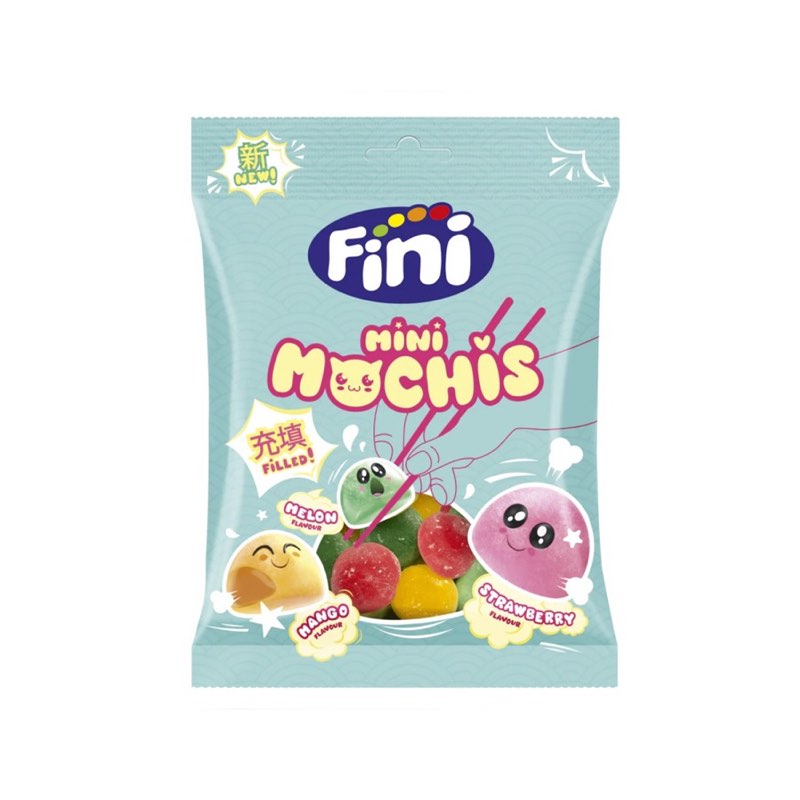
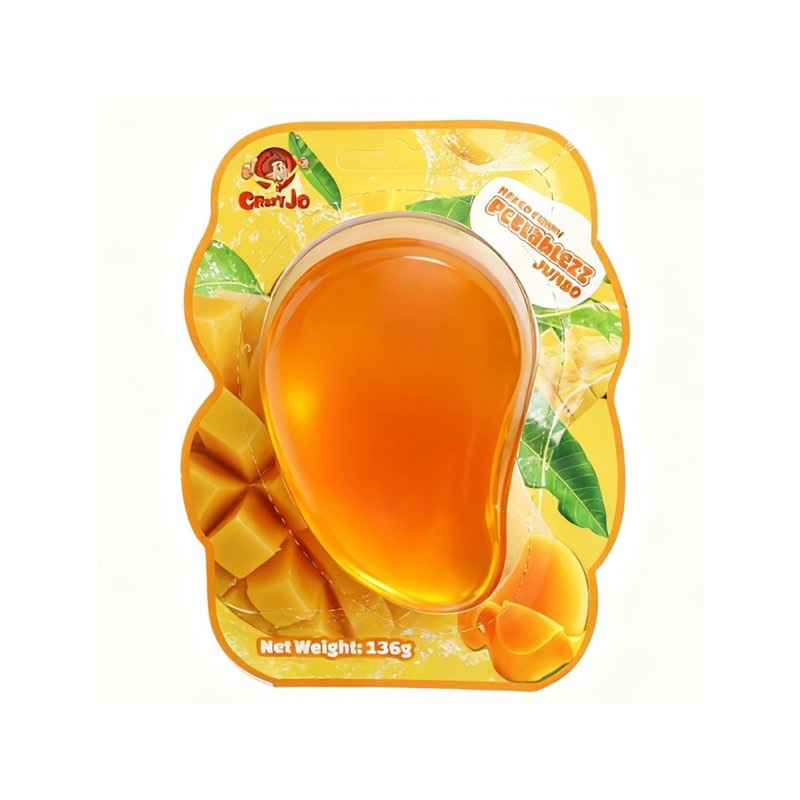
And then there is the shelf this bag sits on: the modern import shelf. This is the newest part of the counter and the one that has changed fastest. It is where flavours that were never standard in British sweetshops turn up as a matter of routine — tropical fruit, bubble tea, dessert flavours, textures that British confectionery never really developed. The Jelly Belly Bubble Tea bag at £1.09 illustrates what this shelf does: it takes a flavour idea that did not exist on a sweet counter within living memory for most adults and puts it in a bag next to the toffees. The Fini Mini Mochis bag at £1.35 does the same with texture rather than flavour, offering a chew format that was simply not part of the British vocabulary a generation ago. The Crazy Jo Peelablezz Jumbo Mango Gummy at £2.99 for 136g takes the same mango idea this bag uses and turns it into a novelty format, which is the other thing the modern shelf does constantly — it plays with shape as much as with taste.
Here is why this matters practically rather than just historically. Generational memory determines how a sweet is received. Put a traditional toffee in front of someone who grew up with the jar counter and you get recognition rather than judgement — they are not tasting it fresh, they are tasting it against decades of the same thing. Put a tropical chew in front of the same person and you get an actual opinion, because there is nothing to measure it against. Neither reaction is better, but they are different experiences, and if you are buying for a mixed group it is worth having both on the table. A spread that is entirely nostalgic feels like a museum. A spread that is entirely modern feels like it is trying too hard. The good version has some of each, and people gravitate towards whichever counter they grew up in front of.
There is also something worth saying about what does not date. The fruit chew, as a format, has been a fixture of every one of those eras. The flavours change, the brands change, the packaging changes, but the basic object — a small, chewy, fruit-flavoured sweet that you eat one at a time — has survived every shift in how Britain buys sweets. That is a fairly strong argument that the format is doing something right, and it is why a bag like this is an easy thing to put in front of almost anyone, whichever counter they remember.
How the chew behaves, and how mango and pineapple arrive
The eating experience splits into a first ten seconds and a long middle, and it is the long middle where a chew justifies itself.
The first ten seconds are mostly texture. A chew of this kind starts firm and needs a couple of proper bites to break down — it does not dissolve and it does not crumble, it compresses and then begins to stretch. This is the phase where temperature matters most. Cold, the piece is stubborn and the flavour is slow to appear. At room temperature it gives way cleanly. Warm, it goes soft almost immediately and you lose some of the satisfying resistance that is half the point of buying a chew in the first place.
Then the flavour opens. In a chew, flavour release is gradual and mechanical — the more you break the piece down and the warmer it gets, the more comes out. So the arc really is an arc: a quiet start, a broad middle where the fruit is at its fullest, and a long tail where sweetness remains after the fruit has mostly gone. This is the opposite of a sour sweet, which front-loads everything and then flattens.
Mango in a chew is a rounder, heavier note than anything in the berry family. It sits lower, it is less sharp, and it has a faintly perfumed quality at the top that is the giveaway — that slightly floral edge is what separates mango from a generic sweet-fruit note. It also has real staying power in a chew, because the character of mango lives in the round, persistent part of the flavour rather than in a bright spike. Of the two flavours here, mango is the one that lingers.
Pineapple does the opposite. It is the brighter and more angular of the pair, with a natural tang that gives a chew some lift. Even with no added sourness, a pineapple note reads as sharper than a mango one simply because of where its characteristic notes sit. In practice this means the two flavours do genuinely different jobs: pineapple wakes the palate up, mango settles it. Alternating between them is more interesting than eating either on its own, which is the whole argument for a mix bag over a single flavour.
One practical note on eating order. If you have mango first and pineapple second, the pineapple tastes sharper than it really is, because your palate has adapted to something round and sweet. Reverse the order and the mango tastes richer. Neither is more correct, but it is worth knowing that a mix bag gives you a choice most sweets do not.
Building a tropical fruit note that people recognise
Rendering fruit as a sweet is a translation problem, and some fruits translate far more easily than others. Strawberry, lemon and orange are easy — they have one or two dominant characteristic notes and everybody's memory of them is stable. Tropical fruits are hard, and it is worth understanding why, because it explains a great deal about why tropical sweets vary so wildly.
The first problem is that most British people's memory of mango is not of a single thing. Some know mango primarily as a ripe fresh fruit, fragrant and soft. Others know it mainly as a juice, or from a dessert, or from a dried slice, and those are noticeably different flavour experiences. Anyone building a mango sweet has to pick a target. Aim at the fresh fruit and some people will say it tastes floral or soapy. Aim at the juice and others will say it tastes generic. Aim at the dried version and you get something deeper and less obviously mango. There is no single correct answer, only a choice — and that choice is why two mango sweets from different makers can taste like different fruits entirely.
The second problem is that the notes which make mango recognisable are subtle, and they sit uncomfortably close to notes that read as unpleasant if pushed too far. The perfumed quality that says "mango" at the right level says "soap" if it is overdone. The safe response is to under-dose it and let general sweetness carry the rest, which is why so many mango sweets taste like a vague fruit with a hint of something floral rather than like mango specifically. Getting it right is a matter of nerve as much as skill: you have to push the characteristic note far enough to be unmistakable and stop just before it tips.
Pineapple has the opposite difficulty. Its characteristic notes are strong and easy to hit, so a pineapple sweet almost always reads as pineapple. The challenge there is balance rather than recognition. Pineapple carries a natural sharpness, and in a sweet that sharpness has to be dialled to sit comfortably alongside a lot of sugar. Too little and the result is flat and syrupy; too much and it reads as a sour sweet, which changes the category of thing you have made.
Now consider what happens when you put the two in one bag. A mix is not simply two sweets sharing a packet — the pairing has to work as a pairing. Mango and pineapple fit naturally because they cover different parts of the same territory: one round and persistent, one bright and immediate. They also read as belonging together, which matters more than people think. A bag of mango and liquorice would be two perfectly good sweets that make no sense side by side. A bag of mango and pineapple reads as one idea with two expressions, and a shopper picking it up knows immediately what kind of thing they are buying.
The format constrains all of this. In a chew, flavour has to survive being released slowly over a minute or more, which rules out anything depending on a sharp opening hit. Sour coatings do not work in a chew, because there is no exposed surface to carry them. Fizz does not work, because there is no dissolution to drive it. What does work is a flavour that holds up while being broken down and does not turn unpleasant as it thins out — and tropical fruit, with its heavier and rounder profile, holds up rather better in a chew than a delicate berry does. There is a reason mango and pineapple chews are common and mango and pineapple hard sweets are not.
This is also why the two bags in this line taste like different products rather than recolourings of one another. The berry mix at the same £1.99 is solving a completely different construction problem: berry notes are bright, light and fast, they sit high rather than low, and they have to be carried differently in a slow-release chew than tropical fruit does. If you want to understand what a chew format does to a flavour, buying both bags and tasting them back to back is the clearest lesson available for under four pounds.
Mango and pineapple: where they sit in a sweet range
Tropical flavours occupy a specific niche in a British sweet range, and it helps to know what that niche is before you build a selection around it.
They are the contrast flavours. In a range dominated by red fruit, a mango note is a change of direction rather than a variation, and that is genuinely useful when you are putting several sweets in front of people at once. Three strawberry-family items on a table and the third one tastes like the first two. Put a tropical chew among them and it resets the palate much as a sour sweet would, but without the aggression.
They are also the grown-up-tasting ones, for reasons that have nothing to do with sweetness levels. Tropical fruit notes are more complex than berry notes — there is more going on at the edges, and complexity reads as maturity. A bag of mango and pineapple chews will very often appeal to an adult who claims to have gone off sweets, precisely because it does not taste like the sweets they went off.
Within our range, the mango direction shows up in a few very different formats, and format changes the flavour experience more than people expect. The jumbo peelable mango gummy at £2.99 is the same fruit in a completely different physical register — a large gummy with a peeling novelty attached, which turns eating it into an activity rather than a snack. Set that beside a small chew and you have two sweets that share a flavour family and share almost nothing else. Both belong on the short list of mango lines we carry, which is worth a look precisely because it is short — five lines is a shortlist, not a browse.
Pineapple, meanwhile, is one of those flavours that turns up inside mixed products far more often than it headlines one. A tutti frutti mix almost always has a pineapple note somewhere in it, which is one reason the Candy Realms Tutti Frutti Tubes tub at £7.99 sits well alongside this bag on a table: overlapping flavour territory, completely different format, completely different scale.
Where a bag like this earns its place
In the car. This is the chew's home ground. Nothing melts, nothing crumbles into a seat, nothing needs a bowl, and a single piece lasts long enough to matter on a dull stretch of motorway. An 80g bag in a glovebox is one of the more sensible confectionery purchases available.
At a desk. A chew is a discreet sweet. It is quiet to eat, it does not require you to stop what you are doing, and because a piece occupies a minute or more, one is often genuinely enough. A bag in a drawer lasts a long time on that basis.
On a shared table. Eighty grams is a hand-round rather than a bowl-filler, but it works well as one element of a larger spread. Tipped into a dish, the pieces sit happily among other sweets while staying visually distinct, and they are the item people come back to when everything else on the table has been sharp or rich.
Party bags. Separate pieces are the easiest confectionery to divide, because you are counting objects rather than weighing sugar. Two or three pieces per bag goes further than you would expect from 80g, and there is no scooping or repackaging involved.
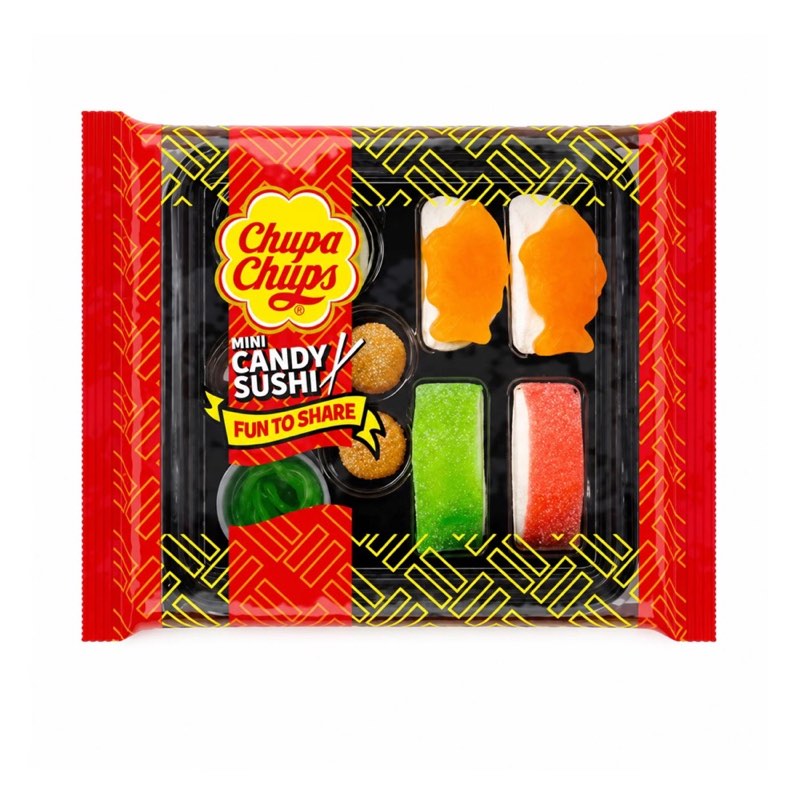
Film nights and long journeys. The slow chew is the whole point. A sweet that occupies a minute rather than five seconds is the right tool when the job is to make something last. Put something fast-eating next to it so there is a choice of pace — the Chupa Chups Mini Candy Sushi tray at £2.99 is our usual suggestion, partly because the tray arrives already presented and partly because small novelty pieces eat at the opposite rhythm to a chew.
Hampers and gift boxes. A named bag with two flavours in it is a better hamper item than a single-flavour pack of the same size, because it adds variety without adding another object to fit in. Buying this alongside its red-fruit counterpart in the same line gives you a matched pair that looks deliberate in a box, for under four pounds.
Building a selection around a fruit chew
If this bag is going to be part of a bigger spread, the useful question is what it does not provide, because that is what you need to buy alongside it.
It provides slow eating, clean fruit flavour, portability and a degree of built-in portion control. It does not provide volume, it does not provide richness, it does not provide sharpness, and it does not provide anything much to look at. So a selection built around it wants at least three more components.
Volume is the first gap and the biggest. Eighty grams will not feed a room. If the spread has to serve more than a handful of people, the bulk has to come from somewhere else, and by-weight lines are the sensible answer. Our loose sweets range is the largest part of the shop and exists for exactly this — two scooped lines will do more for a party table than six small bags.
Richness is the second. Fruit chews are bright and clean, and after a while a table of nothing but fruit starts to feel thin. Something caramel, toffee or dairy-flavoured fixes it immediately. Bristow's Traditional Salted Caramel Bon Bons at £5.49 are the standard recommendation, and salted caramel against tropical fruit is a genuinely good pairing rather than merely a contrasting one.
Texture variety is the third. Everything on a table being chewy is as monotonous as everything being one flavour. The obvious counterweight is something springy and glossy from the jelly and gummy shelf, or something that shatters. Mixing chew and jelly on one board is the easiest way to make a modest spread feel varied.
A talking point is optional but effective. Something people comment on gets a table talking, and the bubble tea bag mentioned earlier does that for barely over a pound. Anything with an unexpected format will do the same job.
If you would rather build the whole thing yourself by weight instead of by bag, the pick and mix section is set up for exactly that, and it lets you control the ratios rather than accepting whatever proportions somebody else chose. For a chocolate element alongside all of the above, the candy and chocolate shelf is the place to go — though we would keep chocolate to a minority on any table that is mostly fruit chews, because the two do not flatter one another in quantity.
What £1.99 for 80g actually gets you
This is one of the better-value small bags in the shop, and it is worth being specific about why rather than simply asserting it.
Eighty grams at £1.99 is roughly double the weight of the typical small pocket pack at a similar price. More importantly, the eating rate is slow. The same 80g of loose gummies would be gone in one sitting for most people; 80g of chews typically spans several. Value in confectionery is not only grams per pound, it is how long the purchase actually lasts, and a slow format stretches a small bag a long way.
For planning purposes, treat it as roughly a week of one-or-two-a-day for a single person, an evening for a couple sharing, a hand-round for a small group, or a couple of pieces each across a set of party bags. It is not a table-filler and should not be bought as one.
Against the rest of our range, the comparison worth making is with the by-weight lines that sit around the £5.49 mark. Those buy volume. This buys convenience, pace and portability. If you are feeding people, go for weight. If you are carrying sweets about, go for a bag like this. Most households that get through a fair amount of confectionery want some of each, and there is no contradiction in ordering both.
Storing chews properly
Chews are among the most forgiving confectionery we stock, but they are not indestructible, and three things will spoil them.
Heat is the first. A warm environment softens a chew until it loses its structure, and soft pieces in a bag will press together. In bad cases they fuse, which is irritating rather than harmful but does make them less pleasant to eat and cannot be fully undone. A glovebox in high summer, a windowsill in direct sun, or a bag left near a radiator will all do it. A cupboard at room temperature is all that is required. If pieces have gone soft, half an hour somewhere cool will firm them up again.
Air is the second. Once a bag is open, chews dry from the outside in. They do not spoil quickly, but they toughen, and a toughened chew has a shorter flavour release and a harder bite. Fold the bag over firmly and clip it, or decant what is left into a small airtight tub, and the problem disappears.
Cold is the least obvious. Chews kept in the fridge become very firm and release their flavour noticeably more slowly. Some people genuinely prefer this and we have no argument with them — but do not refrigerate by default expecting it to preserve anything. Cold changes the eating experience rather than extending the life of the sweet.
Beyond that, keep the bag out of direct sunlight and somewhere it is not being crushed, and there is nothing else to think about. As with everything we sell, follow the date and storage guidance printed on the manufacturer's packaging, which is the authoritative source for the bag you have actually received. Sweets are a treat rather than an everyday food. Whole chewy pieces and small hard sweets are a choking risk for young children and should be supervised. And if anyone in the house has an allergy, check the manufacturer's packaging on arrival before eating.
Tropical or berry: choosing between the two bags
There is a single size in this listing — one size at £1.99 — so the only real decision is flavour direction, and the two bags in this line are a genuine choice rather than a pair of near-identical options.
Choose the tropical mix if you want the heavier, rounder fruit register; if you are bored of red-fruit sweets; if you want something that reads as slightly more grown-up; or if you want a sweet that will stand out on a table full of strawberry and cherry. Mango in particular is a flavour many people rarely meet in confectionery, which gives this bag a small novelty value that has nothing to do with gimmickry.
Choose the berry version of the same 80g bag if you are buying for children, for a crowd, or for anyone whose taste in sweets is settled. Berry flavours are the most universally accepted in British confectionery and the least likely to be handed back. It is also the safer choice for a party bag, where you are catering to unknown preferences and a familiar flavour is worth more than an interesting one.
Choose both if you are building a spread, a hamper or a comparison. Four flavour directions across two matched bags at £1.99 each is the most variety this format offers, and having both out lets people pick rather than accept.
Finding it on the site, and what is next to it
This bag is filed in three places. By texture it lives with the rest of our chewy sweets, a shelf of around seventy-eight lines spanning traditional toffee-shop chews, pocket-money chew bars and modern imports like this one. If chew is what you buy for, start there and ignore flavour altogether — you will find more of what you want that way.
By flavour it sits on the mango shelf, which is deliberately short. Five lines means you can read the whole thing in a minute, and if mango is a flavour you actively seek out, that is the fastest route to everything we have.
By type it also appears under the loose sweets listing, the biggest category on the site at over three hundred and fifty lines, and the right place to browse if you are stocking up rather than buying one thing.
The neighbouring shelves worth knowing: the retro section for the traditional end of the counter discussed above; the jelly and gummy section for the texture that contrasts best with a chew; candy and chocolate when a spread needs something richer; and pick and mix when you would rather assemble your own selection by hand. To see everything with no filter at all, the full shop is there for a proper browse.
Common questions about the tropical mix
How many chews are in an 80g bag?
We do not publish a piece count. Individual piece weights vary slightly and any figure we gave would be approximate, so we would rather tell you what we know: the bag is 80g of chews. In practice that is a hand-round for a small group, several days of one-or-two-a-day for one person, or a couple of pieces each across a set of party bags. If you need an exact count for catering, buy by weight and count them out yourself.
Are both flavours in every bag?
It is sold as a tropical mix with mango and pineapple listed as the flavours, so a bag contains both. We cannot promise a fixed ratio between them — mixed bags are filled by weight rather than counted by flavour, so the split will vary from bag to bag. If you want one flavour and not the other, a mix bag is the wrong purchase and you would be better off with a single-flavour line.
Is this sour?
No. It is a straightforward fruit chew. Pineapple naturally reads as brighter and slightly tangier than mango, so there is some variation in sharpness between the two flavours, but neither is a sour sweet and there is no sour coating — the chew format does not really allow for one. If sourness is what you are after, you want a coated or powdered sweet rather than a chew.
How does it compare with the berry mix?
Same format, same 80g size, same £1.99 price, but they taste like different categories of sweet. Tropical is rounder, heavier and slightly perfumed; berry is brighter, lighter and faster. Berry is the safer bet for children and for a crowd; tropical is the more interesting bet for an adult, or for a table that needs something other than red fruit. Buying both is the sensible move if you cannot decide.
Do the pieces stick together in the bag?
They can, if the bag gets warm. Chews soften in heat and softened pieces pressed together in a bag will cling. Keeping the bag somewhere cool avoids it almost entirely, and a short spell somewhere cool will firm up pieces that have already gone soft. Storing the bag flat rather than crushed at the bottom of a rucksack also helps more than people expect.
Will they be too hard to chew if they have been somewhere cold?
They will be firmer, yes. A chew that has been in a cold car or a fridge takes more work for the first few seconds and releases its flavour more slowly. Hold a piece in your hand for a minute before eating and it softens up. Some people prefer them firm, so it is worth trying both before deciding you have a problem.
Are they suitable for small children?
Sweets are a treat rather than an everyday food, and whole chewy pieces are a choking risk for young children, so they should be supervised and you should use judgement about age. Beyond that, anyone with an allergy in the household should check the manufacturer's packaging on arrival before eating — the pack carries the definitive information for the batch you have received.
What should I put with these on a party table?
Something with volume, something rich and something with a different texture. Volume comes from by-weight lines rather than small bags. For richness, a caramel or toffee item works well against tropical fruit. For texture, anything springy and glossy from the jelly side of the range will do. The Highland Toffee carton at £3.49 covers the rich and slow-eating slot in a single purchase, which makes it an efficient second item.
Is mango an unusual flavour to buy for a group?
It is less familiar than strawberry or cherry, which cuts both ways. For a group of adults it is often a positive — it stands out and does not taste like everything else on the table. For a group of young children, a familiar flavour usually goes down better and the berry version is the easier choice. Catering for a mixed group, put both out and let people pick.
Can I keep an opened bag?
Yes. Chews keep well as long as they are kept dry and cool. Fold the bag over firmly or tip the remainder into a small airtight tub, keep it out of heat and direct sunlight, and it will be fine for a good while — chews toughen slowly rather than spoiling quickly. Follow the date guidance printed on the manufacturer's packaging for the definitive answer on the bag you have.
Is there a bigger bag or a multipack?
Not in this listing — it is sold in one size, 80g at £1.99. If you want more, buy more bags, or look at the by-weight side of the shop where the lines are built for filling bowls rather than pockets. Buying the tropical and berry bags together is usually a better use of four pounds than buying two of the same.
What makes a chew last longer than other sweets?
Physics, mostly. A chew has to be broken down by your jaw rather than dissolved by your mouth, and that simply takes longer than a hard sweet or a jelly. Because each piece occupies a real stretch of time, the automatic handful habit that empties a bag of loose sweets never gets going — you are still working on the first one when you would otherwise have reached for the fifth.
The short version
A slow, portable fruit chew in a flavour direction most British sweet counters underuse. Mango gives it depth, pineapple gives it lift, and the pace of the format makes 80g go a great deal further than the number suggests. It belongs to the newest part of the sweet counter, which makes it a useful thing to have on a table alongside the older stuff. At £1.99 it is an easy thing to try, and if it lands, its berry counterpart is the obvious second purchase.
More chewy sweets
More mango sweets


More loose sweets sweets

Where this sits
Hi-Chew Tropical Mix Bag 80g appears on these shelves. Browse them, or jump to something nearby.
You might also like