Home / Candy & Chocolate / Mike & Ike Original Fruits Theatre Box 120g
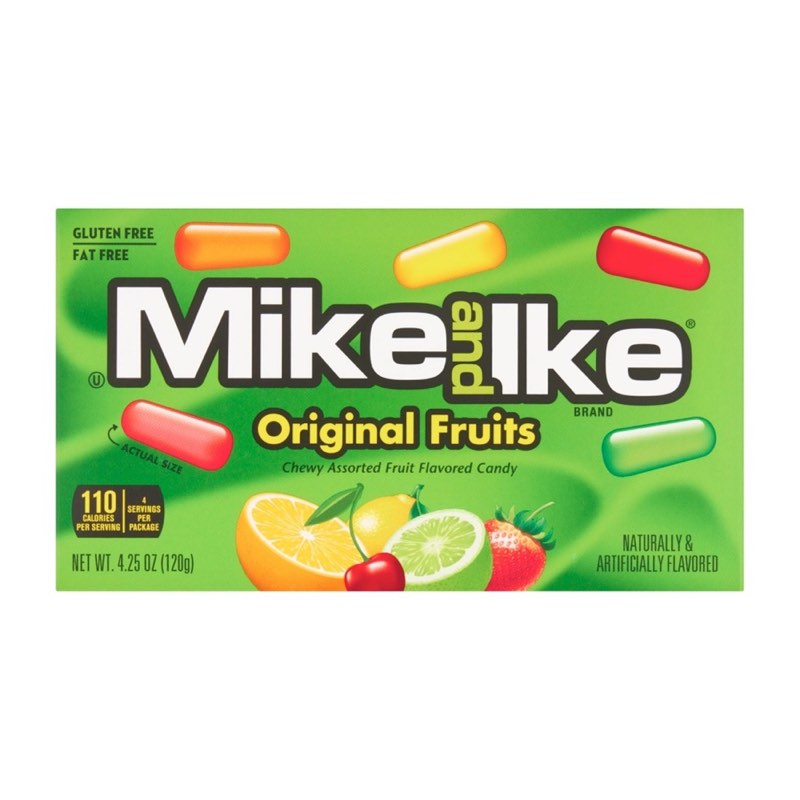
Mike & Ike · 120g
Read the full guide
Mike & Ike Original Fruits Theatre Box 120g
£2.25
✔ In stock — ready to ship
Fresh stock
Free over £20
Same-day dispatch
Secure checkout
There is a whole category of sweet defined not by what it tastes like but by where it is eaten, and the theatre box is the clearest example of it. The Mike & Ike Original Fruits Theatre Box 120g is shaped by its venue. Flat enough to go in a coat pocket, rigid enough to survive being sat on, tall enough to stand in a cup holder, quiet enough to open in a dark room without anybody turning round. Those are not incidental features. They are the reasons the format exists.
Start with the cinema, since the name points there. The problem with eating sweets during a film is noise and light: a crackling bag is an irritant, a wrapper opened during a quiet scene is worse, and anything that needs looking at is a distraction from the thing you paid to watch. A card box solves all three. It opens once, at the start, and after that you tip rather than rummage. You can do the whole evening without looking down.
The full guide to Mike & Ike Original Fruits Theatre Box 120g
5,662 words on how it eats, who it suits, how to serve it and what to put beside it.
The box you take to the pictures
Then the journeys. A flat box slides down the side of a car seat, into a rucksack pocket, into a coat, and comes out in the same shape it went in. On a train, a plane or a long drive it does the thing no bag does — it closes again. That is what turns 120g from a single sitting into three or four, which on a five-hour journey is the difference between a treat and a decision you regret an hour in.
Then the everyday slots. The desk drawer, where a box keeps far better than an opened bag. The lunchbox, where a small handful decanted on a Monday lasts the week. The cupboard shelf that gets raided on a Friday evening. The glovebox. The bottom of a school bag. The point about all of these is the same: this is a format for sweets that are not being eaten right now, and most bags are not.
And the social ones. Sleepovers, games nights, a film at home with the lights off, the back row of a coach on a school trip. At £2.25 for 120g, buying four boxes for a group is a realistic thing to do rather than an extravagance, and a box each avoids the whole business of a shared bowl that one person ends up sitting next to.
A rectangle of card and what it is for
It is worth looking at the object properly, because the object is a considerable part of what you are buying at this price.
A theatre box is rigid card, rectangular, flat-faced, with an opening at the top end and a flap that tucks back in. It stands up unaided. It stacks with others of its kind. It has a large flat front face, which is why these boxes are the most graphically bold things in any sweet shop — there is more printable area on the front of a theatre box than on almost any comparable sweet, and brands use all of it.
At 120g the box is properly filled rather than generously sized and half empty, which you can tell by shaking it. That matters for gifting and for the general feel of the thing: a box that sounds full feels like more than a bag that weighs the same.
The opening is the detail that separates a good box from a bad one. You tear or lift the flap at the end and you pour, and pouring is a different action from reaching in. It means the sweets come out in a group rather than one at a time, which is why boxed sweets are eaten in small handfuls. It also means nobody's fingers go inside the container, which is the single best argument for handing a box round a room rather than a bag.
The flap tucks back and holds well enough for a bag or a drawer, though not well enough to be called airtight. For a day or two that is fine; for longer, decanting is better, and there is more on that below.
What "original" signals in a range like this
Every confectionery range that runs to several flavours ends up with one that carries the word original, or classic, or plain, and that one has a specific job. It is the baseline. It is the version that exists so the others have something to be a variation on, and it is almost always the one that sells steadily while the interesting editions come and go.
In this range the positioning is easy to read off the shelf. There is a sour mixed edition, a single-flavour sour edition, a tropical edition, a berry edition and two different mixed editions. Against that lot, the original fruits box is the one with nothing added to the idea — no sour treatment, no narrowing to one corner of the fruit family, no novelty. Just the fruit line as the range presents it.
That sounds unexciting written down, and it is exactly why people buy it. The plain version is the one you get when you do not know who is eating, when the group is mixed, when a child is fussy, or when you have been burned before by buying something clever for somebody who wanted something normal. It is the safest box in the range and safety has real value when the sweets are a gift, a party item or a thing you are buying without the person present.
It is also the right starting point if you have not tried the range. Buy the plain one first, decide whether you like the format, and then work outwards to the variations. Doing it the other way round — starting with a novelty edition and judging the whole range on it — is how people write off things they would otherwise have liked.
One honest note about what we can tell you. The listing for this box gives us the name, the brand, the price, the weight and the fact that it comes in one size. It does not give us a flavour breakdown, a colour list or a texture classification, and we are not going to invent any of those. Fruit is in the name and that is as specific as we will get. If the precise line-up matters to you, the manufacturer's packaging that arrives with your order is the place it is written down.
Completing the set: how people collect a flavour range
There is a particular kind of shopper — and there are more of them than the confectionery trade lets on — who does not buy a sweet so much as a position in a range. Once a brand puts out six variations of the same box, a certain percentage of buyers stop choosing between them and start collecting them. It is worth understanding this behaviour, partly because it is interesting and partly because it is a genuinely sensible way to buy this particular product.
Why ranges invite completion. Identical format, identical price, different faces. When six boxes are the same shape and the same £2.25, choosing between them is not an economic decision, it is a preference decision, and preference decisions are easy to defer by buying all of them. The uniform format is doing the persuading: lined up on a shelf, six matching boxes in six different colourways look like a set, and a set with one missing looks like a set with one missing.
The collector's calculation. At this price the whole range is under fifteen pounds, which is less than a single premium box of chocolates. That is the number that makes completion viable here and not viable with, say, large tubs. Nobody collects the £16.99 jars — the Aniseed Balls Sweet Jar is a deliberate single purchase and always will be — but a range of cheap identical boxes is collectable almost by accident.
Editions and rotations. Ranges like this move. Variations appear, sit on shelves for a while and are replaced by other variations, and the plain original is usually the constant while the rest rotate around it. That is the rhythm of the category rather than a claim about any particular box's availability, and it is why people who like a specific variation tend to buy two when they see it and why the original is the one you can build a habit on.
Seasonal and novelty formats. The collecting instinct runs strongest at the novelty end of the shop, where the packaging is more of the product than the sweets are. A Seriously Giant Vimto Spray at £1.89 is bought for the object as much as the contents — a spray is a toy that happens to be edible. Charms Fluffy Stuff Cotton Candy 71g at £2.49 sells on format too: spun sugar in a tub is a fairground idea transplanted into a shop, and the tub is half the appeal. Neither of those is a set, but both are bought by the same instinct — the sweet as an object rather than as a quantity of food.
Boxes as display. Practically, if you are buying a range to display rather than to eat immediately, the theatre box is the best-behaved format in the shop. Boxes stand. They line up. They can be stood in a row on a shelf or laid in a grid in a hamper, and the flat front faces mean the arrangement reads clearly from across a room. The same six lines in bags would be a pile. If you have ever seen a sweet shop with a wall of identical boxes in different colours, you have seen the entire commercial logic of the format in one glance.
Comparison as entertainment. The other reason to buy several is that a range invites tasting side by side, and side-by-side comparison is much more fun with closely related products than with wildly different ones. Six variations of one idea give people something to rank and argue about. Six unrelated sweets just give them six sweets. Another boxed range on the shelf — Airheads 6 Bar Theatre Box 93.6g at £2.49 — sets up the same kind of comparison in bar form, and having two boxed ranges open at once is about as much structure as a casual tasting can take.
The honest caveat. Collecting a range is a good way to spend fifteen pounds and a bad way to choose a sweet you will actually eat regularly. Most people who buy the set end up with a favourite and buy that one from then on, which is exactly what you would expect and no bad thing. The set is the experiment; the repeat purchase is the answer.
Counters, kiosks and the seaside rack
The second thing worth talking about is where a box like this sits in the British way of buying sweets, because the geography of sweet shopping in this country has always been more interesting than the confectionery itself.
Historically there were two counters. Behind the shopkeeper was the jar shelf: unwrapped sweets sold by weight, in paper bags, chosen by pointing. That tradition still runs, and on this site it is the loose sweets counter, which is by some distance our biggest section. It is where the traditional hard sweets and the classic chews live, and the buying ritual — a little of this, a little of that — has not really changed.
In front of the shopkeeper was the other counter: the impulse rack. Pre-packed, fixed price, self-service, positioned at the till at exactly the height of a child's eyeline. That rack is where the boxed and bagged formats live, and it runs on completely different rules from the jar shelf. Jar sweets are chosen by flavour. Rack sweets are chosen by price and packaging, in about three seconds, usually with a fixed amount of money in hand.
The theatre box belongs to the rack tradition, and it carries all the rack characteristics. Fixed price rather than by weight. Bold flat front face designed to be read quickly from a distance. A price point set so that it is affordable on its own rather than as part of a shop. This is the format that pocket money was spent on, and the economics of that are still visible in the price: £2.25 is a single-purchase number, the kind of figure you can commit to without doing arithmetic.
The seaside version of the rack was the same idea with the volume turned up. Holiday sweet shops and kiosks lean harder on novelty, on souvenir formats and on things bought because of where you are rather than what you want. That is where the sprays, the tubs, the oversized formats and the sweets-as-objects do their best business, and it is the direct ancestor of the novelty end of a modern sweet shop.
The cinema kiosk was the third location, and it is the one this format is named for. Kiosk buying is the most constrained of all: you are in a queue, you have about ten seconds, and you are choosing between a dozen boxes at similar prices. Everything about a theatre box — the size, the shape, the bold face, the price bracket — is an answer to that specific ten seconds.
What is genuinely interesting is how much of that survives in an online shop, where none of the original constraints apply. You are not in a queue. You can read as long as you like. And yet the boxed format still sells, because the things it was designed to do — travel well, close again, hand round, stand up — turn out to be useful everywhere, not just at a till. The format outlived the counter it was invented for.
Alongside it on the modern version of that rack you will find the same mix of imported boxes and British staples the real thing always had. Junior Mints at £2.59 and Milk Duds at £2.99 are the boxed chocolate end of the same shelf. Nerds Grape & Strawberry at £1.49 is the cheapest thing on it and the most likely to be bought with actual pocket money. Maoam Pinballs Bag 140g at £1.99 is the bagged equivalent, which trades the box's rigidity for a bit more weight. And Reese's Dipped Pretzels 120g at £5.29 is the modern addition to the rack — the sweet-and-savoury idea that the traditional British counter never had at all.
Fruit as the safe flavour, and why that is a compliment
Fruit is the largest flavour family in confectionery and the least likely to offend anybody, and a box called original fruits is leaning on exactly that.
Think about what the alternatives ask of the eater. Mint divides a room. Aniseed divides it further. Liquorice is a genuine love-or-hate. Chocolate is universally liked but heavy, and it behaves badly in warm rooms and in bags. Sour asks the eater to enjoy a sensation as well as a flavour, which not everyone does. Fruit asks nothing. It is the flavour family you can put in front of a group of strangers with the highest confidence that nobody will be unhappy.
Within fruit there are still sub-families worth knowing. The berry end is the sweetest and softest in character and the most popular with younger eaters. The citrus and orchard end runs sharper and cleaner and tends to be the adult preference. The tropical end is the loudest and most perfumed and is the one that stands out on a mixed table. A box positioned as original fruits is generally sitting across the middle of all that rather than specialising, which again is the safe-choice logic.
For a table, the practical consequence is this: fruit is the base and everything else is a feature. Fill most of the bowls with fruit-flavoured things and use the strong flavours as accents at the edges. A table built the other way round — mostly mint and liquorice with a bowl of fruit in the corner — will leave most of itself uneaten.
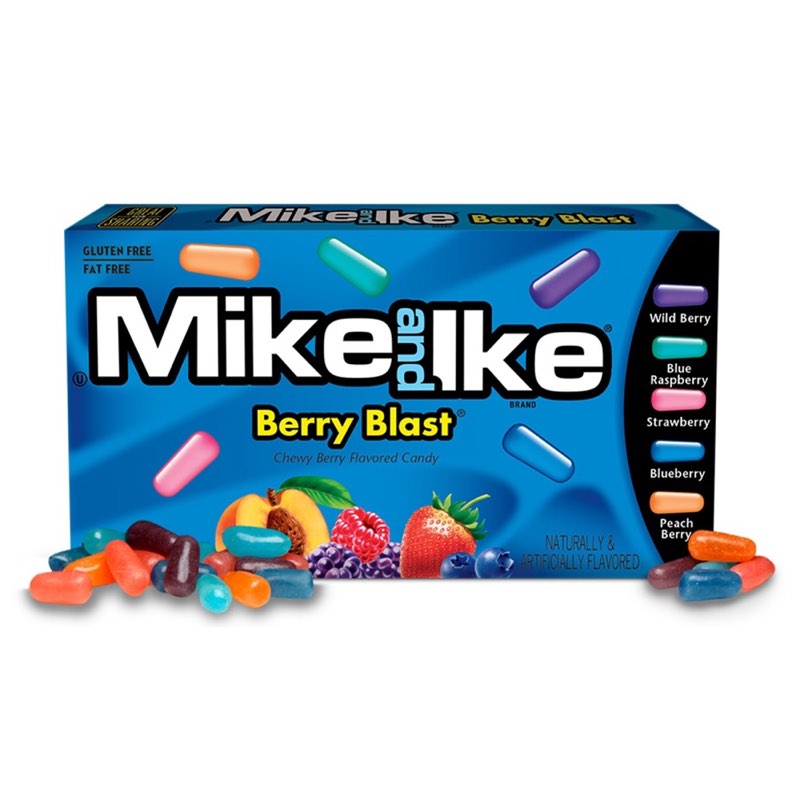
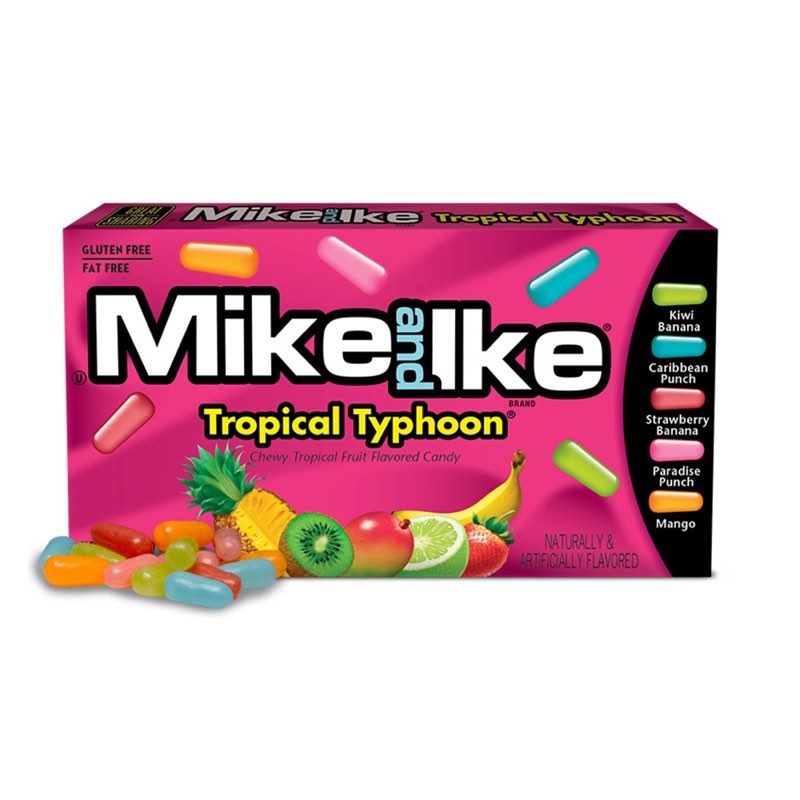
If you want to move within the family rather than away from it, the range gives you the moves. Mike & Ike Berry Blast Theatre Box 120g at £2.25 narrows to the berry corner, which is the crowd-pleasing end. Mike & Ike Tropical Typhoon Theatre Box 141g goes to the loud end and is the box to buy when you want one thing on the table that tastes noticeably different from everything else. Those three together — plain, berry, tropical — cover the fruit family properly for under seven pounds, which is a sensible way to buy for a group with unknown tastes.
Who the plain box is for
It is for anyone buying without the eater present. Gifts, party bags, lunchboxes, a treat brought home for somebody else — all situations where the plain version is the right risk profile.
It is for the fussy eater, and there is one in most households. Somebody who says they do not like sour, or does not like anything unusual, or has previously rejected a box on sight because of the picture on the front. The original is the box that does not trigger any of that.
It is for people who want a sweet in a container rather than a bag, for all the practical reasons covered above: travel, drawers, pockets, resealing, handing round.
It is for anyone starting with the range. Buy the baseline, then decide which direction you want to go in.
It is for the £2.25 purchase that is not really a decision — the thing added to an order to round it out, the small treat that does not need justifying, the item that goes in a card or on a desk.
It is less suited to somebody who specifically wants excitement from a sweet. If the person you are buying for enjoys strong sensations, the plain box will read as a bit safe and the sour end of the range is the better present. It is also not the right buy if you need volume for a crowd, where weighed sweets from the counter will always be cheaper per head than boxes.
Handing it round: pouring, pacing and the arithmetic of a box between two
A box gets eaten differently from a bag and it is worth planning for.
Pouring, not picking. Because the opening is at the end, the natural action is to tip a few into a hand. That has two effects. First, people eat in small groups of pieces rather than one at a time, so the box goes faster than the same weight in a bag would. Second, nobody's fingers go inside, which makes it a far more comfortable thing to share with people you do not know well. If you are handing sweets round an office, a coach or a waiting room, a box is socially easier than a bag by a clear margin.
Pacing. 120g between two people across a film is comfortable, with a little left. Between four it is a taste each, which is fine as a supplement and disappointing as the main event. If four people are going to be eating for two hours, that is two boxes minimum plus something else, or one box each if you want to avoid negotiation altogether.
Rationing. The single most useful trick with a box is to decant before you start rather than relying on willpower during. Tip half into a bowl, tuck the flap back in, and put the box somewhere that requires standing up. The box's own reseal makes this work in a way it does not with an open bag, which has no natural stopping point at all.
Mixing. If you want the box to be part of a spread rather than the whole of it, the pairing that works is one contained boxed item plus one open bowl of something quite different. Something soft and bagged such as the 140g bag of Pinballs at £1.99 covers the bowl, and the box stays as the thing people take a few of. Two boxes and no bowl makes a table feel oddly sparse; two bowls and no box makes everything communal, which is not always what you want.
The guessing game. For a group that wants the sweets to be an activity rather than a background, add a small-piece assortment where the fun is in identifying things — Jelly Belly American Classics Jelly Beans Bag 70g at £2.40 is the standard choice for that, and it works best alongside a plain, predictable box rather than instead of one. You want a reliable thing to go back to between rounds of the game.
Parties, lunchboxes, journeys and the gift shelf
Party bags. A box is the right size to be the headline item in a bag for an older child, and it looks like more than it costs because of the flat face and the weight. For younger children a box is often too much for one bag on its own, in which case it is better as a prize or a going-home item for a smaller number of guests.
Class treats and end-of-term. Boxes are easy to hand out, easy to count and easy to store in a cupboard until the day. The fixed price means working out a budget for thirty children takes one multiplication rather than a set of scales.
Lunchboxes. A whole box is too much for one lunch. Decanted into a small pot it is four or five days of a small treat, which is a better arrangement for most households and costs well under fifty pence a day.
Journeys. Covered above, but worth repeating the key point: the reseal is the feature. Sweets that can be put away halfway through are worth more on a long journey than sweets that cannot.
Film nights at home. This is the format's home ground and needs no adaptation. One box per person is the simplest arrangement and avoids the thing where one person ends up custodian of the bowl.
Small gifts and hampers. A single box is a gesture rather than a gift, but three or four presented together read as chosen, and because they are the same shape they present beautifully — a stack tied with a ribbon, or a row standing up in a box. If you are building a larger hamper, boxes are the structural items that hold everything else upright, so put them at the back and lay the bags in front. For a themed hamper, the boxed chocolate lines on the same shelf give you a second format without breaking the look.
Advent and countdown gifts. If you are filling numbered bags for a countdown, fixed-price boxes make the budgeting trivial and the flat shape fits in almost anything. Mix in a couple of weighed scoops from pick and mix so the run has some variety in format as well as flavour.
What £2.25 buys, and when to buy something else
120g for £2.25 puts this firmly in the impulse bracket, and the comparison worth making is not against other boxes — they are all the same price here — but against the other ways of spending a similar amount.
Against a cheaper bag: something at £1.49 or £1.99 gets you less weight or a less protective container, and for a cupboard that is often fine. The box's advantages are all about being carried and kept, so if the sweets are going straight into a bowl at home you are paying a small amount for packaging you will not use.
Against buying by weight: weighed sweets from the counter are cheaper per gram, especially in quantity, and for filling bowls at a party they win comfortably. What they cannot do is arrive as a self-contained, resealable, giftable object. That is the whole trade.
Against the rest of the range: identical. Every box here is £2.25, which means the decision between them costs nothing and you should choose purely on what suits the eater. It also means multi-buying is easy to reason about — four boxes is nine pounds, the whole range is under fifteen.
On servings: 120g is roughly four generous handfuls or five or six smaller portions. As a share for two at a film it is right. As a week of small daily treats decanted into a lunchbox it is also right. As the sweet element of a party for eight, it is one of several things rather than the answer.
One size is listed, so there is no larger version to weigh up. The only real question is how many boxes and which ones, and the range section below covers that.
Keeping a boxed sweet in good order
Card protects against crushing and light but not against air, so a box that has been opened needs a little management if it is not going to be finished quickly.
Tuck the flap back in properly each time rather than leaving the top open in a drawer. For anything beyond a couple of days, tip the contents into an airtight tub — sweets left in a part-open box in a kitchen will pick up moisture from the air, and the first thing that changes is the surface.
Store it cool, dark and dry. A cupboard or a drawer, away from the kettle, the hob and the window. Warm rooms are the main risk with any soft or chewy sweet, because warmth makes pieces press together where they touch; a box left in a sunny car in August will not be ruined but it will not be at its best either.
Do not use the fridge as a default. Fridges are damp and cold makes chewy sweets harder work than they should be. If the weather is genuinely hot, somewhere cool and sealed beats the fridge, and if you do chill something, let it come back to room temperature still closed so any condensation forms on the outside of the container rather than on the contents.
For a box going into a hamper or a parcel that will sit for a few weeks, keep it sealed and out of direct light, and check the date on the manufacturer's packaging when it arrives so you know what window you have. That packaging is the authority for the box you receive; this is general good practice for boxed sweets rather than anything specific to it.
Which box, and whether to buy the set
All six boxes we carry from this range are £2.25, which makes this a preference question rather than a price one.
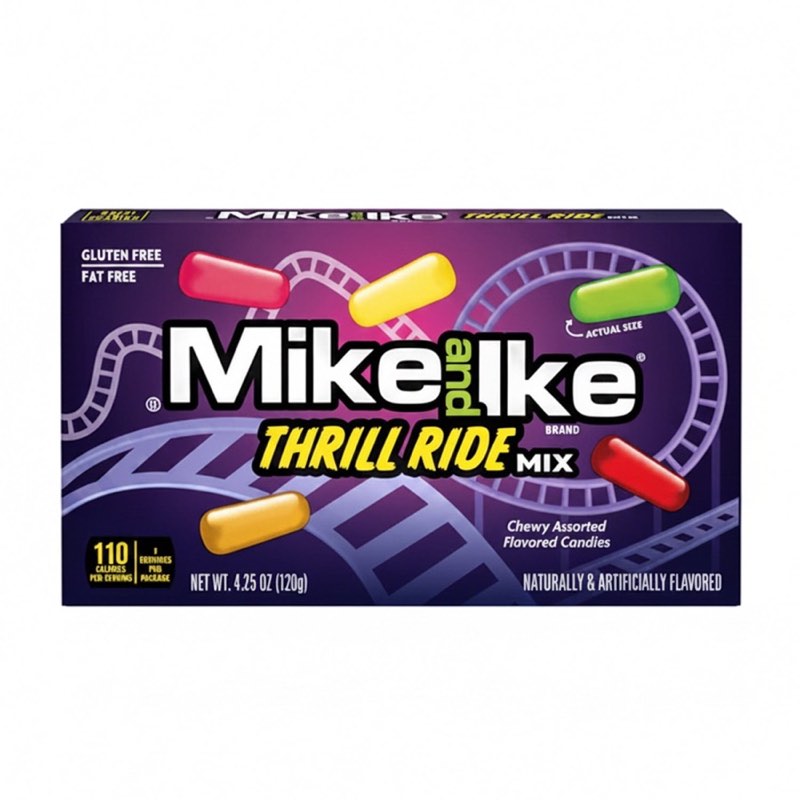
Mike & Ike Mega Mix Theatre Box 120g is the mixed version of the same idea, and it is the natural second box — more variety within one container, same safe territory. Mike & Ike Thrill Ride Mix Theatre Box 120g is the other mixed option, which is what to buy when you want a second mixed box without simply repeating the first.
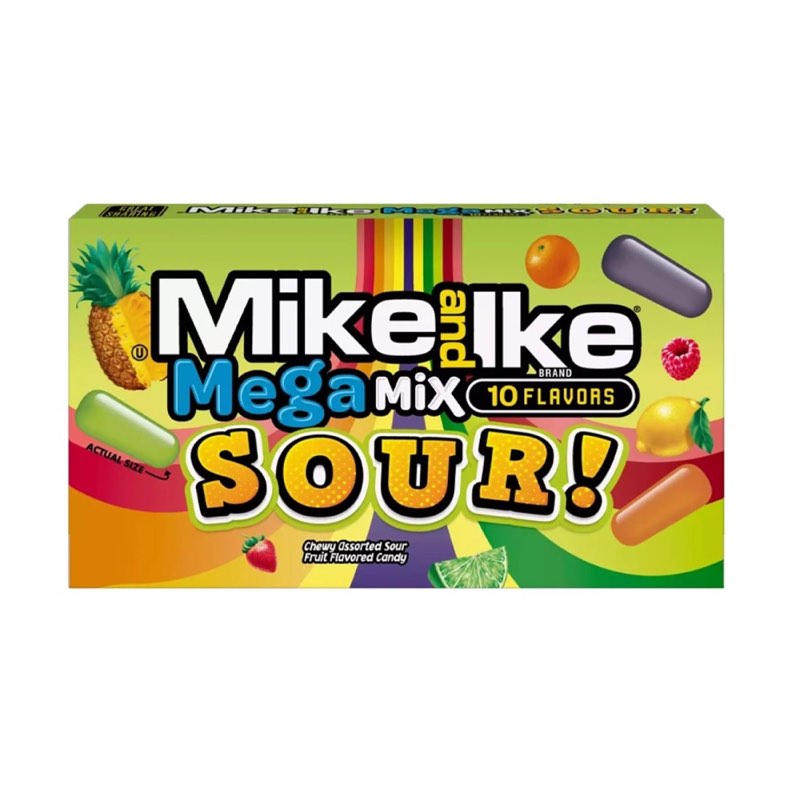
For sharpness, Mike & Ike Mega Mix Sour Theatre Box 120g is the mixed sour, and it is the best contrast to this one on a table — putting the plain box and the sour mixed box at £2.25 side by side gives people a direct comparison and covers both camps in a group. If you would rather have sour without the mixture, Mike & Ike Sour Watermelon Theatre Box 120g is the single-flavour option, which is more predictable and better if you already know it is liked.
For flavour direction, the berry box is the friendliest and the tropical box is the loudest, as covered above.
Should you buy the set? If it is for a group, yes — six boxes covers every preference in a room for under fifteen pounds and gives people something to compare. If it is for one person, no. Buy the plain one, find out whether the format suits, and then buy the variation that sounds most like them. You will end up with one box you reorder rather than five you do not.
To see them together before deciding, the Mike & Ike brand shelf lists everything we carry from the range on one page with the prices side by side, which is the quickest way to plan a set or a multi-buy.
Finding it on the site
This box files on the Candy & Chocolate shelf, which is where the branded boxes, bars and imported lines live — about two dozen lines, so it is browsable in a couple of minutes and it is the right page to have open if you are assembling a hamper or a themed table. It also sits on the brand shelf with its siblings.
From there the useful routes are: the counter of sweets sold by weight when you need volume rather than packaging, building a mix of your own when the answer is a little of several things, and the whole catalogue when you are browsing without a plan. If you are shopping by brand, the Kingsway shelf covers the fizzy and traditional British shapes and the Haribo shelf covers the familiar jelly formats that most mixed bowls are built on — both are good companions to a boxed item, since between them they give you the bowl to go with the box.
Worth a click while you are here: the sweets and chocolate hub also holds the American boxed lines mentioned above, and all ten lines we carry from the range are listed in one place if you want to see what else has come in.
Questions we are asked about this box
What flavours are in it?
The listing gives us the name, the brand, the weight and the price, and not a flavour breakdown, so we will not guess at one. Fruit is in the name, and the range's other boxes are positioned as variations on it — sour, berry, tropical and so on — which tells you this is the plain baseline. For the exact line-up, read the manufacturer's packaging when your order arrives.
How is it different from the Mega Mix box?
Both are £2.25 and both are 120g. This one is the range's original, the version everything else is a variation on; the Mega Mix is the mixed edition. If you are buying for somebody who prefers things plain and predictable, take this one. If you want more variety within a single box, take the mixed one — and if you cannot decide, at this price taking both is a reasonable answer.
Is it sour?
No — the sour editions in this range are labelled as such, and this is the plain original. If sharpness is what you want, the mixed sour box or the single-flavour sour watermelon box are the two to look at, and both sit at the same price as this one.
Can you tell me about ingredients or allergens?
We hold no verified ingredient, nutrition or allergen data for this line, so we will not tell you what it contains and we will certainly not tell you what it is free from. If you or anybody eating it has an allergy or an intolerance, read the manufacturer's packaging on arrival before anybody opens it. That pack is the only reliable source on the question.
Is it suitable for children?
Sweets are a treat rather than a food, and small sweets are a choking risk for young children, so little ones should be supervised while eating them. Beyond that, the plain fruit box is generally the easiest one in a range to buy for a child whose tastes you do not know, which is most of its appeal.
How many people does one box feed?
120g is roughly four generous handfuls. That is a comfortable share for two across a film, a week of small portions decanted into a lunchbox, or one element of a spread for a larger group. For four people eating for a couple of hours, plan on two boxes plus something else in a bowl.
Does the box close again?
The flap tucks back in, which holds fine for a bag, a drawer or a glovebox over a day or two. It is not airtight, so if you are keeping it open for longer, tip the contents into a sealed tub. The reseal is the main practical advantage of a box over a bag on a long journey.
Will it survive being posted?
The rigid card holds its shape well and the flat profile suits a letterbox parcel, which is more than can be said for most sweet formats. In a hamper it also works as a structural item — stand the boxes upright at the back and lay softer bags in front of them, and the whole thing arrives looking composed rather than settled.
Is it worth buying the whole range?
For a group, yes: six boxes is under fifteen pounds, covers most preferences and gives people something to compare and argue about. For one person, no — buy the plain one, work out whether the format suits you, then buy the variation that sounds most like your taste. Most people who buy a whole range end up repeat-buying one box from it.
Why is it called a theatre box?
It is the shape sweets take when they are sold at a kiosk and eaten in a dark room: flat, rigid, quiet to open, easy to pour without looking, and sized to stand in a cup holder or slide into a coat pocket. Those design decisions turn out to be useful well beyond a cinema, which is why the format is still everywhere.
What should I put with it on a table?
One open bowl of something soft and one contained box is a better combination than two boxes. Add a small-piece assortment if you want the sweets to be an activity, and keep any strong flavours — mint, liquorice, anything very sour — at the far end of the table, since they dominate everything eaten after them.
Is buying by weight cheaper?
Per gram, usually yes, and for filling bowls at a party the counter is the better buy. What weighing cannot give you is a sealed, rigid, giftable container that travels and closes again. Buy weighed for the bowl and boxed for the pocket, the parcel or the present.
In summary
The plain one, and that is the point. A £2.25 box of 120g that is designed around being carried, closed and handed round rather than around being clever, and the safest thing in its range to buy for somebody whose tastes you do not know. Buy one to find out whether the format suits you, buy three across the fruit family for a table of mixed preferences, or buy the set if you want an evening's worth of comparing — at this price all three are reasonable ways to go.
More from Mike & Ike
More candy & chocolate sweets

Where this sits
Mike & Ike Original Fruits Theatre Box 120g appears on these shelves. Browse them, or jump to something nearby.
You might also like