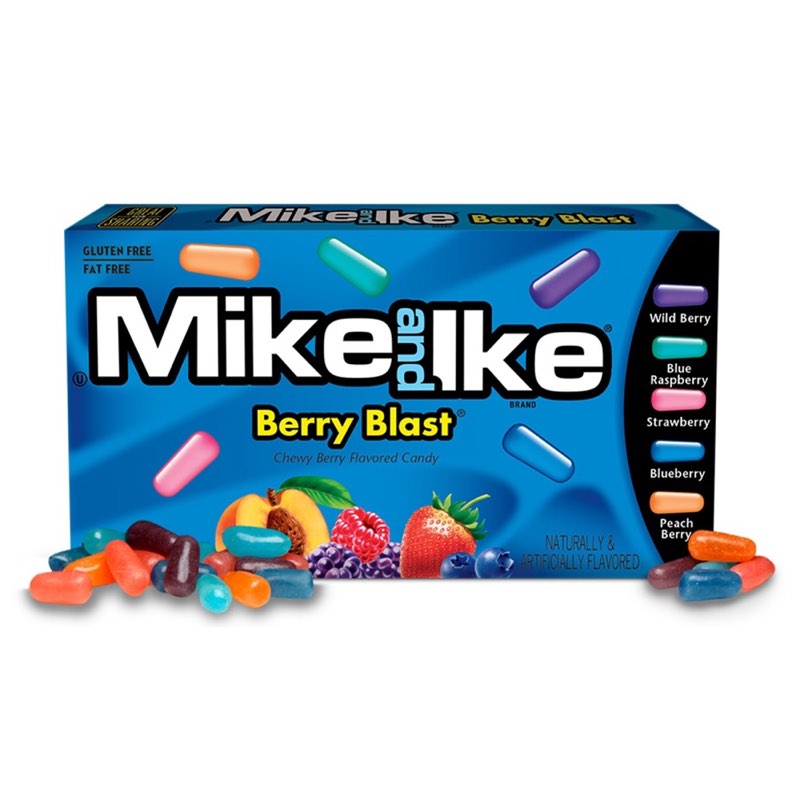
Home / Candy & Chocolate / Mike & Ike Tropical Typhoon Theatre Box 141g
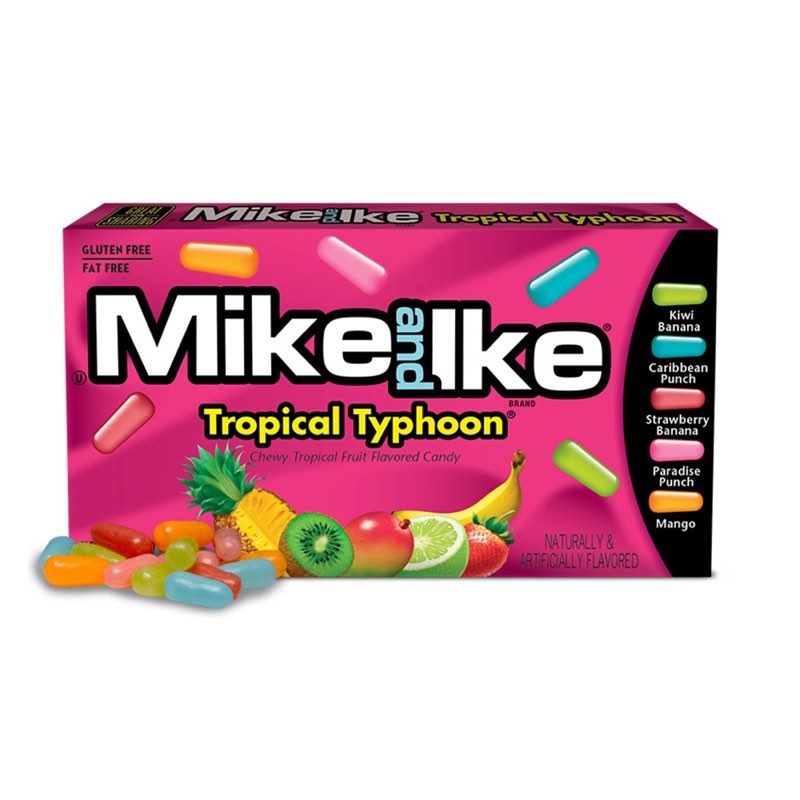
Mike & Ike · 141g
Read the full guide
Mike & Ike Tropical Typhoon Theatre Box 141g
£2.25
✔ In stock — ready to ship
Fresh stock
Free over £20
Same-day dispatch
Secure checkout
There is a particular shelf that exists in almost every small shop in the country, and once you notice it you cannot stop noticing it. It sits at eye level for a ten-year-old and waist level for everyone else, it is usually the width of an arm span, and it is stocked according to a logic nobody has ever written down. Cartons at the back because they stand up. Bags in the middle because they slump. Small single items at the front because they are the impulse. The Mike & Ike Tropical Typhoon Theatre Box is a back-of-the-shelf product in that layout, and understanding why tells you almost everything about what this box is for.
Cartons stand up. That sounds trivial and it is not. A rigid box holds its shape on a rack, faces forward, and keeps its printing readable from across a small shop. A bag has to be hung or heaped. This is why the carton format has survived in corner shops and seaside sweet shops for so long while other formats have come and gone — it is the only sweet packaging that works as its own display unit. A shopkeeper with three feet of shelf and no time can put out a row of cartons in twenty seconds and it will look deliberate.
The full guide to Mike & Ike Tropical Typhoon Theatre Box 141g
5,906 words on how it eats, who it suits, how to serve it and what to put beside it.
Corner shops, seaside racks, and where a carton like this belongs
The corner shop logic
Corner shops run on a very specific price psychology, and it is not the one supermarkets use. In a supermarket you are comparing — this bag against that bag, price per hundred grams, multibuys. In a corner shop you are not comparing anything. You have a certain amount of change in your hand or a certain amount of patience left, and you want the transaction to be quick and to feel like a good decision. That is why £2.25 is such a well-judged number for a product like this. It is comfortably inside the range where nobody does arithmetic. It is more than a single small item and less than a proper purchase. It is, in the oldest sense of the phrase, pocket money that has grown up.
The other corner-shop virtue of this box is that it is a complete decision. You do not need to buy anything alongside it for it to make sense. A single carton at 141 grams is an evening for one person or a passed-around item for four, and either way it has done its job on its own. Compare that with the way you would shop for a spread — anchor, filler, something sharp — which is a supermarket or online way of thinking. A carton is a one-decision purchase, and small shops live on one-decision purchases.
The seaside shop, which is a different animal entirely
The seaside sweet shop works on almost the opposite principle. Where the corner shop is about speed, the seaside shop is about dwelling. You go in without a plan, you walk slowly, you look at the jars, you pick up things you will not buy, and you leave having spent more than you meant to. The whole environment is built to slow you down: jars at head height so you have to look up, scoops and paper bags so the transaction takes time, and a counter positioned so that you walk past everything twice.
A carton like this occupies a strange and useful position in that shop. It is the thing you buy when the weighing-out has got out of hand and you want one fixed, knowable item to go with it. Or it is the thing a child picks because it is theirs, sealed, printed, not shared out of a communal bag. There is a real difference in a child's mind between a scoop of sweets from a jar and a box with their own name on the transaction, and any adult who has taken a group of children into a sweet shop has seen it play out.
Our nearest equivalent to that jar-and-scoop experience is a proper jar of aniseed balls at £16.99 — the format is the point as much as the contents, and a jar on a shelf does something to a room that a carton cannot. But the two are not competitors. They are the two halves of the same shop, and most people who love one also want the other. If you want the weighing-out experience without the jar, that is exactly what our loose sweets shelf exists to reproduce.
Why the tropical box in particular
Here is where this specific carton fits into that culture. Seaside and holiday shopping has always leaned towards the bright end of the flavour spectrum — the sharp, the fizzy, the fruit-forward, the things that taste like a warm afternoon rather than a winter evening. That is not marketing; it is genuinely how people shop when they are out of their routine. Rich and heavy sweets sell in cold months and in dark rooms. Bright ones sell when the sun is out and people are walking about.
A tropical mix is the most concentrated version of that instinct available in a carton. The name alone does a great deal of the work — Tropical Typhoon tells you the register before you have opened anything, and the register is: bright, loud, warm-weather, holiday. Set it next to a box of Milk Duds at £2.99 and you can see the two ends of the year in two cartons. One is a February sweet. This is a July one.
That seasonal skew is worth knowing if you are buying for an event. A tropical carton on a summer table reads correctly and disappears fast. The same carton on a Christmas table is fine but slightly out of key, and you will find it is the last thing to go. Sweets carry a season whether the packaging mentions one or not, and anybody who has run a stall or a party table for a few years develops an instinct for it.
If you want the whole single-brand row to choose from the way you would scan a corner-shop shelf, our Mike & Ike brand page lists ten lines in one place, and it is the closest thing on this site to standing in front of that rack.
Opening a Tropical Typhoon box for the first time
The carton comes to hand lighter than it looks. One hundred and forty-one grams inside a rigid box of this size means there is air in there, and there needs to be — small sweets need room to move or they arrive as a solid brick. Shake it gently and you get the sound that is the whole signature of this format: a fast, dry rattle, slightly higher-pitched than you expect. Anyone who grew up with cartons can tell a full box from a half-full one by sound alone, and it is one of the few genuinely useful pieces of knowledge sweets have given the world.
Opening is the part people get wrong. A theatre carton has a perforated tab at one end, and the temptation is to tear the whole top off so you can get a proper handful. Do not. The tab exists so the box can be closed again, and a carton you can close is a carton that survives a journey, a coat pocket and three days in a bag. Open it at one corner, wide enough to pour from and no wider. You will thank yourself later.
Size, and what it does to the pace
Tip a few into your palm and the first thing you register is how small each piece is relative to the box. These are multi-piece sweets in the truest sense — no single one is an event, and they are not meant to be. The unit of consumption is not the piece, it is the small handful, and the box is designed around that fact.
Firmness is the other thing you notice. There is enough structure in each piece that they hold their shape under a thumb rather than squashing, which is why they rattle rather than thud, and why a carton can sit at the bottom of a bag without the contents fusing into one lump. That firmness has a practical consequence: the pieces stay separate, so you can genuinely take two rather than accidentally taking six stuck together.
How the flavour arrives
Small sweets deliver flavour on a curve you can actually feel. The first second or two is mostly the surface — a quick, bright arrival that hits the front of the tongue. Then, as the piece gives way, the body of it comes through more slowly and settles further back. The whole arc takes perhaps fifteen to twenty seconds per small handful, and then it clears reasonably quickly rather than hanging around.
That short clearing time is the defining behaviour of this kind of sweet and the reason people eat far more of them than they intend to. A sweet that leaves a long finish tells you to stop. A sweet that clears fast keeps quietly inviting you back. If you want a box to last an evening rather than twenty minutes, the trick is not willpower, it is spacing — take a small handful, close the box, put it down, and only open it again during the next natural pause in whatever you are doing.
What a mixed box does that a single flavour cannot
A mixed carton has a property single-flavour products do not: sequence. Because you do not know which piece you are getting, each small handful is a slightly different combination from the last, and your palate never fully settles into a pattern. That is why mixed boxes hold attention for longer than their flavour intensity would suggest, and it is why almost every long-running carton range is a mix rather than a single note.
It also means you can play with it. Eat them one at a time and you get a sequence of distinct arrivals. Eat them three at a time and you get combinations — and because the combination is random, some will work better than others, which turns a box into a mild game. Children discover this on their own within about four minutes and will happily tell you which pairing is best.
The collector's shelf: runs, shapes and the urge to complete a set
There is a kind of sweet shopper who is not really buying sweets. They are buying positions in a set. If you have ever caught yourself thinking "I have four of the boxes, I may as well get the other two", you know exactly what this is, and it is worth understanding because it changes how you should shop.
Confectionery is unusually well suited to collecting, for three reasons. The units are cheap, so completing a set costs less than almost any other collectable category. The variants are visually distinct, so a row of them looks like a collection rather than a repetition. And they are consumable, which means the collection is permanently renewable — you can finish it, eat it, and start again, which is not something you can do with stamps.
The horizontal set: one format, many flavours
The most common collecting pattern is horizontal. You pick a format you like — in this case the theatre carton — and you work across the flavours. It is the easiest set to complete and the most satisfying to display, because every box is the same size and shape, so a row of them lines up properly on a shelf.
We stock enough of this range to make that a real proposition rather than a theoretical one. Alongside this tropical carton there is the Original Fruits box, also £2.25, which is the reference point everything else in the range is measured against; the Berry Blast carton at the same price, which takes the range towards the darker, deeper fruit end; and the Mega Mix box, which is the range's own attempt at a greatest-hits selection rather than a theme. Those three plus this one give you four clearly different positions for nine pounds, which is a remarkably cheap complete-looking set.
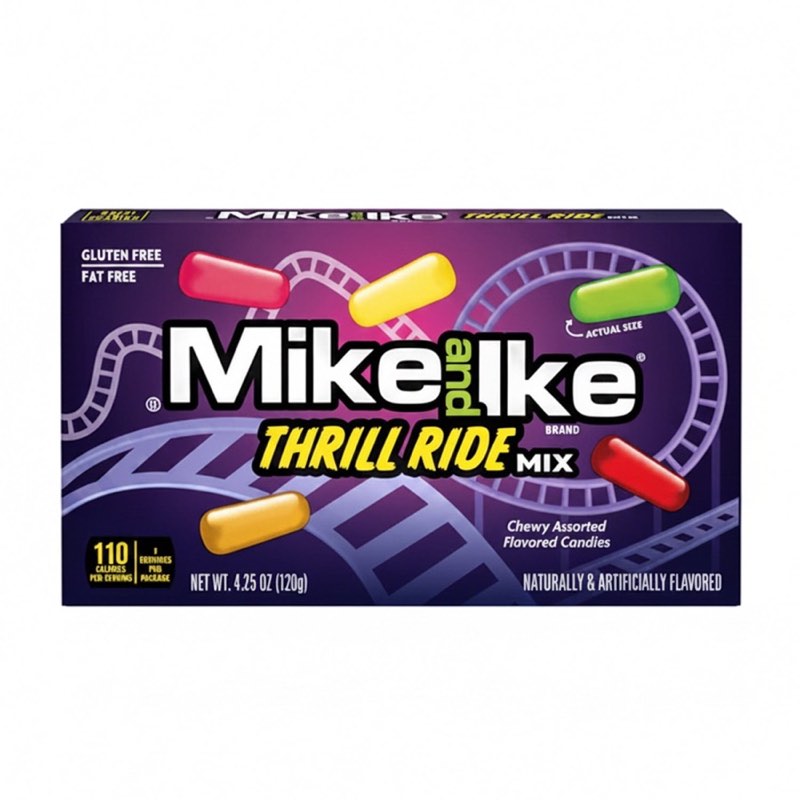
Then there is the sharp wing of the range, which is effectively a sub-collection of its own. The Mega Mix Sour carton is the sour counterpart to the standard mixed box — same £2.25, same format, opposite intent — and the Sour Watermelon box narrows that to a single idea. Collectors tend to buy these in pairs with their non-sour equivalents precisely because the comparison is the point. Side by side they tell you more about both than either does alone. And the Thrill Ride Mix carton sits slightly apart from all of them, which is exactly the sort of odd-one-out that completists find hardest to leave on the shelf.
The vertical set: one flavour idea, many formats
The less common pattern is vertical — you fix on an idea and collect it across formats. Tropical is a good idea to do this with, because it appears in almost every format confectionery has invented. You could put this carton next to a bagged item, a spun-sugar item, a spray, a jar, and a wrapped bar, and have six completely different physical answers to the same flavour brief.
That is a genuinely interesting thing to lay out on a table, and it makes a much better talking point than a row of identical boxes. Our complete sweet catalogue is the right page for that kind of hunting, because it puts every format side by side rather than grouping by brand.
Seasonal and shaped runs
The third collecting instinct is for shapes and seasons. Novelty-shaped sweets have a hold on people that flavour alone never achieves, because a shape is a joke or a picture as well as a food, and jokes are memorable in a way that flavours are not. Anyone who collects along these lines is not really comparing taste at all — they are comparing ideas.
If shapes are your thing, the single-brand shelves are the efficient route: the Kingsway brand page is worth a scroll for anybody who buys by maker rather than by flavour, and the Haribo shelf works the same way for a range most people already have opinions about. Both are organised so you can see a maker's whole approach in one go, which is how collectors actually browse.
A word of caution about completism
The trap with collecting sweets is that you end up with seven open boxes and none of them finished, which is the one way to make cheap confectionery expensive. If you are buying across a range, buy two or three at a time and actually finish them before adding more. A set you have eaten is a better set than a set you are storing badly. Cartons in particular do not improve for being opened and left — see the storage notes further down.
What "tropical" means as a flavour family
Tropical is the loosest flavour word in confectionery, and it is worth unpacking what it actually signals rather than treating it as a single taste. We do not list a flavour breakdown for this box, and the printed pack in your hands is the place to look for specifics — but the family itself has consistent behaviours worth knowing before you buy.
The first is brightness. Tropical flavours in sweets tend to arrive quickly and sit high on the palate rather than low. Compare that with the darker fruit register, which arrives more slowly and feels like it occupies the back of the mouth. This is why a tropical mix reads as energetic and a berry mix reads as comfortable, even at identical sweetness.
The second is width. Tropical is a category rather than a flavour, which means a tropical mix covers more ground than most themed mixes do. A berry mix is a family of close relatives. A tropical mix is a family of cousins — the pieces can be genuinely unlike each other, and that variety is what stops the box becoming monotonous. If you like mixes where every piece is a small surprise, this is the register that delivers it best.
The third is pairing behaviour. Bright, high flavours sit very well next to sharp things and rather badly next to rich ones. Put a tropical mix next to something acidic and both improve; put it next to something heavy and the tropical starts tasting thin. That single rule will save you a lot of disappointing tables. In practice it means this carton belongs beside the £1.49 box of Nerds or a Seriously Giant Vimto Spray at £1.89, and not beside the heavier items unless you are deliberately separating them on the table.
The fourth is seasonality, discussed above but worth restating as a buying rule: bright mixes move fastest between spring and early autumn, and on any occasion with an outdoor element. If you are stocking for a summer party, weight your order towards this end. If you are stocking for a winter film night, weight it the other way and keep one tropical item as a contrast rather than the centrepiece.
For a mixed-fruit alternative that spreads across a wider and less thematic set of positions, the 70 g bag of Jelly Belly American Classics at £2.40 is the obvious comparison: a bag rather than a carton, individual beans rather than a uniform piece, and a range that deliberately wanders rather than sticking to a theme.
Who ends up buying this one
The single-carton buyer. Somebody who wants one thing, has about two pounds of intent, and does not want to think about it further. This box is close to perfect for that, and it is the reason the format has outlived so many others.
The party-bag filler. At £2.25 a carton, a box per child is a fixed, sealed, identifiable unit that needs no weighing, no bagging and no arguments about who got more. It is more expensive per head than weighing out a mix, but it is dramatically less work, and it arrives looking like a proper present rather than a handful.
The variety-seeker who finds single-flavour sweets dull. A mixed box is a sequence rather than a flat line, and this is the brightest mixed box in the range. If your usual complaint is that a bag becomes boring by the halfway point, mixes solve that better than intensity does.
The collector, discussed at length above, who is really buying the sixth box rather than the first.
And, honestly, it is not for you if you want something slow. A carton of small sweets is a fast format. There is no single piece that occupies your attention for minutes, no unwrapping ritual, nothing to ration. If slow is what you want, a wrapped format like the Airheads six-bar box at £2.49 does exactly the opposite job — six separate decisions instead of one continuous stream — and it is the better tool for a long film.
Putting a carton to work in a mix
A theatre box is the easiest possible starting point for a spread because it needs no decanting to be useful and no bowl to look right. You can stand it upright on a table, open at the corner, and it functions as its own container. That alone makes it the low-effort component of any table.
The role it plays is the bright middle. It is not the cheap bulk and it is not the expensive anchor; it is the thing that keeps the table lively and gives people somewhere to go between heavier items. Build around it accordingly.
For bulk underneath it, Maoam Pinballs at £1.99 for 140 g is the most efficient filler on this page — a similar weight for less money, with a longer chew that slows people down and makes a bowl last. For the sharp corner, the Nerds or the Vimto spray mentioned earlier both work; the spray in particular is a novelty that children will queue for, which takes pressure off the food.
For contrast at the rich end, you want exactly one item and no more. The 120 g bag of Reese's Dipped Pretzels at £5.29 is the strongest option we stock for that role — considerably more expensive, entirely different in texture, and it stops a bright table feeling one-dimensional. Junior Mints at £2.59 do a smaller version of the same job with a cool note rather than a rich one, and they cost less than half as much.
For the wildcard, a 71 g bag of Charms Fluffy Stuff at £2.49 is the thing people pick up and ask about. Spun sugar has almost no flavour weight, which means it never fights with anything else on the table, and it occupies children for longer than its size suggests.
If you would rather weigh out your own proportions than buy fixed units, start on the pick and mix shelf and add one or two cartons on top as the branded anchors. That combination — weighed bulk plus a couple of recognisable boxes — is the most flexible way to build a table and usually the cheapest per head.
Days out, dark rooms and long car journeys
The car. This is the carton's home ground and the case where it beats every other format we stock. It closes. It does not need a bowl. It can be passed between seats without spilling. The pieces are firm enough that they do not fuse in a warm footwell, and small enough to eat without looking down. If you buy one box for one purpose, buy it for a journey.
The cinema and the sofa. The format is named for the first of these for good reason: a carton is quiet to hold, easy to share along a row, and re-closable if the film outlasts your appetite. The rattle is the only caveat — it is a loud format in a silent room, so open it during something noisy and then keep it in your lap rather than on a seat.
Summer parties and garden tables. The seasonal point from earlier applies directly. A bright mix outdoors in warm weather is exactly right, and cartons have the practical advantage of not blowing away or attracting attention from insects the way an open bowl does. Stand three or four upright in a row and they look like a display rather than an afterthought.
Party bags. One carton per bag, sealed, no weighing. The cost per head is higher than a weighed mix but the labour is close to zero and nothing arrives looking mean. If you want to spend less, put a smaller weighed mix in each bag and one carton in the bag of the birthday child only.
Gifts and hampers. A single carton is too small to be a gift on its own, but cartons are the best possible structure in a hamper. They are the only sweet format that stacks reliably, so two or three of them form the flat base layer that everything softer sits on top of. Building a parcel around a carton of the original mix and this tropical one gives you a matched pair at the bottom and a tidy-looking box.
Where it is not the answer. Formal occasions, anything where you want the sweets to look expensive, and anything where you want one sweet to last a long time. A carton is casual by design and there is no way to dress it up.
141 grams at £2.25, broken down
The per-gram figure is a shade under 1.6p, which puts this in the comfortable middle of our range — cheaper than most branded bags, dearer than the bulk chew options. But per-gram is the wrong measure for a carton, because nobody buys a carton by weight. They buy it as a unit.
The useful number is per head. Passed round a group of four, a 141 g carton gives everybody a genuine handful with a second round to follow, which is somewhere around 55p a head for a shared treat that requires no preparation whatsoever. Passed round six, it is under 40p each and still does not feel stingy, because small sweets go further in a shared setting than large ones — people take a pinch rather than a piece.
Kept for one person, 141 g is roughly a week of small evening portions if you are disciplined, and about two sittings if you are not. Most people land somewhere in between and get three or four days out of it.
Where it sits against its neighbours is instructive. It is 26p more than a near-identical weight of Pinballs, and the difference buys you the carton rather than the bag — closeable, stackable, standable. It is 24p less than the six-bar Airheads carton, which weighs a good deal less but gives you six discrete wrapped items instead of a loose stream. And it is less than half the price of the Reese's pretzel bag, which is a different kind of purchase entirely. Knowing those three comparisons tells you almost everything about where £2.25 sits.
A sensible ten-pound table built around this: this carton, a bag of Pinballs for bulk, a box of Nerds for the sharp corner, and a Vimto spray as the game. Four items, four completely different jobs, change from a ten-pound note, and enough to keep eight children occupied. You can price up your own version across the full range in a few minutes.
Keeping a carton in one piece
Cartons have one failure mode and it is mechanical rather than chemical. They get crushed. A cardboard box at the bottom of a shopping bag under a bottle will arrive dented, and a dented carton means the contents have been pressed together. The sweets are usually fine; the box will not close properly again. Carry it at the top of the bag or in a pocket, not at the bottom.
Once open, the closure is the whole game. If you have torn the top off completely, transfer the contents into a small airtight tub — a jam jar works fine — rather than trying to fold a ruined flap over. Small firm sweets left open to the air will pick up moisture, and moisture is what makes them start sticking to one another. A box that has gone sticky has not gone off; it has simply been left open too long, and it will be harder to pour and less pleasant to hold.
Warmth is the second factor. Keep the carton out of direct sun and away from anything that heats up — a car dashboard on a summer day is the classic mistake, and a box left there for an afternoon will come back as a single mass. If that has happened, a couple of hours somewhere cool will firm it up again, but it will have set as a clump and you will be breaking pieces apart rather than pouring them.
Do not refrigerate as a routine. Fridges are damp, and the cycle of cold box into warm room and back again produces condensation inside the carton, which is exactly the stickiness problem you are trying to avoid. A cool cupboard is better in every respect.
Lastly, go by the date printed on the manufacturer's packaging for shelf life rather than by feel. Firm small sweets can be perfectly edible well past the point where they have stopped being pleasant to eat, and they can also seem fine while being older than you would choose. The printed date is the only authority worth trusting.
Which box, if you are only buying one?
This carton comes in a single option — 141 g at £2.25 — so there is no size decision to make. The real decision is which box in the range to reach for, and since they are all the same price, it comes down entirely to register.
| If you want | The box to reach for |
|---|---|
| The brightest, warm-weather option | This tropical carton |
| The reference point, nothing clever | The Original Fruits carton |
| Something deeper and less summery | Berry Blast |
| The widest spread in one box | Mega Mix |
| The same spread, sharpened | Mega Mix Sour |
| One sharp idea, done single-mindedly | Sour Watermelon |
| The one that does not fit the pattern | Thrill Ride Mix |
If you are buying two, the most interesting pairing is not two similar boxes but a bright one and a sharp one, because the contrast keeps both of them tasting like themselves for longer. This carton with the sour mixed box is the pairing we would suggest to somebody who has never bought from the range before, since between them they map out most of what it does.
If you are buying for a group with a wide age range, weight towards the non-sour boxes. Sour is a taste people grow into and then grow out of again, and there is always somebody at a table who will not touch it. The berry-led carton and this one together cover almost everybody without asking anybody to be brave.
Where to go next on the site
This box lives on two shelves. The first is the brand page for this range, which holds ten lines and is the fastest way to see the whole family at once — the right page if you have decided on the maker and are choosing between flavours. The second is the Candy & Chocolate category, twenty-six lines deep, which is where the branded and boxed items sit together regardless of maker. That is the page to use when you have decided on a format or a price bracket rather than a brand.
From there, the two shelves that behave differently are worth knowing about. Our by-weight section is for people who want to control the exact composition of what they buy rather than accepting a fixed mix, and the pick and mix pages are organised around occasions — parties, tables, celebrations — rather than around products. Most large orders end up drawing from all three.
If you are hunting rather than deciding, the whole catalogue in one listing is the page to browse, and if you shop by maker, the single-brand shelves for Kingsway and Haribo work exactly the same way this range's page does. And for anything in the boxed-and-branded bracket generally, the main sweets and chocolate aisle will get you there in the fewest clicks.
Things shoppers ask before buying
Which flavours are actually in the box?
We do not publish a flavour breakdown for this line, and we would rather not guess at one than print something we cannot stand behind. The printed pack itself carries the details, and that is the source to trust. What we can tell you is the register: this is the bright, warm-weather end of the range, it is a mix rather than a single flavour, and the variety within it is wide enough that pieces are genuinely unlike one another rather than being close relatives.
Is it sour?
This is not one of the sour cartons in the range. If sharpness is what you are after, the range has two boxes built for it — the sour mixed box and the sour watermelon one — both at the same £2.25, and both an obvious pairing with this one if you want the contrast on the same table. Buying this expecting sour will disappoint; buying it as the bright counterweight to a sour box will not.
How many pieces are in a carton?
We do not list a piece count, because it varies from box to box and we have no verified figure to give you. The weight is 141 grams, which in practice is a decent handful for four people with a second round to follow, or several days of small portions for one. If you need exact counts for party bags, a weighed option from the loose sweets shelf gives you control that no sealed carton can.
Can the box be resealed?
Yes, if you open it carefully. The perforated tab is designed to fold back, and a carton opened at one corner rather than torn across the top will close well enough to survive a bag or a pocket for days. If you have already torn the top off, decant into a small airtight tub — it makes a bigger difference to how the sweets stay than most people expect.
Will it survive a hot car?
Not on a dashboard in direct sun, no. Firm small sweets left somewhere genuinely hot will soften and stick together, and while a few hours somewhere cool will firm them up again, they will have set as a clump. Inside a bag in a cool boot is fine. The glovebox is fine. The dashboard is where cartons go to die.
Is this suitable for young children?
Sweets are a treat and should be kept to that. Small sweets are a choking risk for young children and should be eaten under supervision — that applies to anything in this size range, including this carton. Beyond that, the format genuinely suits children well, because a child can hold the box, manage their own portion and close it again without an adult intervening.
What should I check when it arrives?
Check the manufacturer's packaging itself. We do not restate ingredient, nutrition or allergen details on our product pages, because the printed pack is the authoritative source and we would rather you read it than take our word for it. If anyone you are feeding has an allergy, read the packaging before eating and do not rely on anything written here. Also check the carton has not been crushed in transit.
Is it better value than a bag?
Per gram, no — a bagged chew at £1.99 for a similar weight is cheaper. What the extra buys is the carton itself: a box that stands up, closes, stacks and travels. If your sweets are going into a bowl at home, the bag is the better buy. If they are going into a car, a bag for life, a party bag or a hamper, the carton earns the difference several times over.
Can I use this in a pick and mix?
You can tip a carton into a mix, though most people find it more useful to keep it whole and let it sit beside the mix as a branded item. Small firm sweets do blend well into a weighed mix, but you lose the thing that makes a carton worth the money. A better approach is to build the mix from by-weight lines and stand a couple of cartons next to it.
Do you stock the whole range?
We list ten lines under this maker, including this carton and six other theatre boxes at the same £2.25. That is enough to build a complete-looking row on a shelf for under sixteen pounds if you are the sort of shopper who likes a full set. The brand page shows everything currently in stock in one place.
What goes best alongside it on a table?
Something sharp and something cheap. Bright mixes improve next to acidity and suffer next to richness, so a small dish of something tangy will do more for this carton than another sweet box will. Then add a bulk item so the table does not empty in ten minutes. Rich items are worth including but keep them to one, and put them at the other end of the table.
Is it a summer thing or can I buy it year round?
We stock it year round and there is no reason not to buy it in January. But be aware that bright mixes read as summery to most people, and on a winter table this will tend to be the last thing to go. That is not a flaw in the box, it is how people's appetites shift with the season. If you are buying for a cold-weather occasion, make this the contrast item rather than the centrepiece.
To sum up
A 141 g carton at £2.25 that does the oldest job in confectionery: one decision, one box, no preparation, and something bright to pass around. It belongs to the shelf you grew up walking past, it travels better than anything else we stock, and it sits at the warm-weather end of a range that is cheap enough to collect properly. Open it at the corner, keep it closed between rounds, and put something sharp next to it.
More from Mike & Ike
More candy & chocolate sweets


Where this sits
Mike & Ike Tropical Typhoon Theatre Box 141g appears on these shelves. Browse them, or jump to something nearby.
You might also like