Home / Loose Sweets / Swizzels Drumstick Squashies Rhubarb & Custard Flavour Bag 120g
Swizzels · 120g
Read the full guide
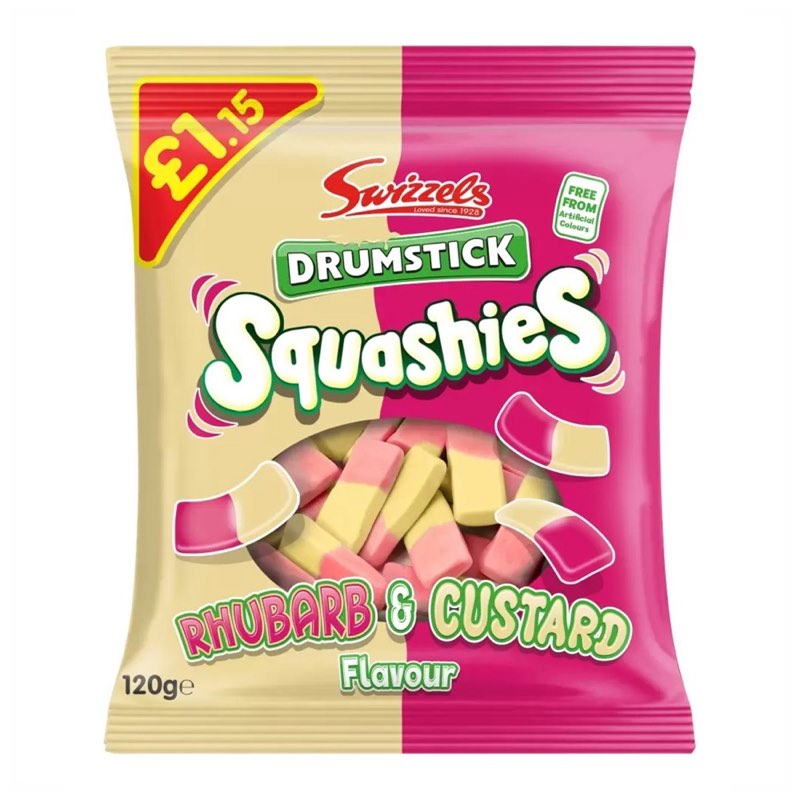
Swizzels Drumstick Squashies Rhubarb & Custard Flavour Bag 120g
£1.15
Currently out of stock
Fresh stock
Free over £20
Same-day dispatch
Secure checkout
Most sweet flavours are named after a thing you could go and buy in a greengrocer's. Strawberry, lemon, cherry, blackcurrant — one fruit, one name, one reference point. Rhubarb & Custard is not that. It is named after a pudding, which means the reference point is not a plant at all. It is a memory of two things served together in a bowl, and then a memory of the hard-boiled sweet somebody made to imitate that bowl, and by now, for most people, it is a memory of the sweet rather than of the pudding. Three removes from anything that ever grew.
That matters more than it sounds, because it changes what a confectioner is aiming at. With a strawberry sweet there is an external judge: people know roughly what strawberries are like, and a strawberry sweet that misses is described as not tasting of strawberry. With rhubarb and custard there is no such judge. The target is not a fruit and not a pudding but a consensus — a shared idea of what this flavour is, built up over generations of people eating the sweet-shop version and agreeing on it without ever discussing it. The flavour is correct when it matches the consensus, and the consensus lives entirely inside confectionery.
The full guide to Swizzels Drumstick Squashies Rhubarb & Custard Flavour Bag 120g
5,474 words on how it eats, who it suits, how to serve it and what to put beside it.
Where "rhubarb and custard" comes from as a flavour
This is why compound sweet flavours are so stable over time and so hard to reinvent. A maker can push a strawberry sweet in a new direction and defend it by pointing at an actual strawberry. Nobody can push rhubarb and custard anywhere, because there is nothing external to point at. The flavour is defined by its own history, and a version that strays is not adventurous, it is wrong. That constraint is the most interesting thing about it as a piece of design.
Two halves, built to be told apart
The flavour is a duet, and duets in confectionery only work when the two voices stay distinguishable. If the two halves merge into a single impression, you have not made rhubarb and custard, you have made a vague sweet thing. So the construction problem is separation: keeping two notes audible at once when they are physically in the same piece.
The two halves are chosen because they sit in opposition. One is sharp, thin and high — a bright, slightly green, slightly astringent note that arrives early and cuts. The other is soft, round and low — a warm, creamy, almost vanilla-adjacent impression with no edges on it at all. High against low, sharp against soft, fast against slow. You could hardly design a pair further apart, and that distance is exactly what keeps them legible when they arrive together.
The sequencing is the clever part. In a well-built version the sharp half leads, because sharp notes are fast and volatile and get to the front of the queue whatever you do. The creamy half is slower, heavier, and stays behind after the sharp note has gone — so the flavour has a shape to it: a bright opening, a broad middle where both are present at once, and a soft, lingering finish. That is a three-act structure in about eight seconds, and it is the reason this flavour holds attention better than a single-note fruit does. A single note is the same at the end as at the beginning. This one moves.
Get the balance wrong in either direction and you can taste it immediately. Too much of the sharp half and it reads as a generic sour fruit sweet with an odd aftertaste. Too much of the creamy half and it reads as a plain cream sweet that somebody has squeezed something into. The versions people love are the ones where neither half wins and both stay audible right through the chew.
What a foam texture does to a flavour
Texture is not a separate thing from flavour; it is a delivery mechanism, and changing it changes what you taste. The original rhubarb and custard sweet most people picture is a hard one, and a hard sweet delivers flavour slowly and continuously over several minutes as it dissolves — a long, even release with no real structure to it beyond gradual fading.
A foam sweet does the opposite. It is aerated, which means it is mostly air by volume, and air is the thing that carries aroma. When you compress a foam piece between your teeth you release everything held in that structure at once, in a rush, directly into the space at the back of your mouth where aroma is actually detected. The flavour arrives in one go rather than seeping out over minutes. For a two-part flavour this is a genuinely different experience: instead of the sharp and creamy halves arriving in slow sequence, they arrive almost together and then separate as the sharp one fades first.
The second thing foam does is chew time. A squashy foam gives way immediately, springs back a little, and is gone in a few seconds — so it is a sweet you eat several of rather than one of. That changes the pacing of a bag entirely. A bag of hard sweets is rationed by the sweets themselves; a bag of foam pieces is rationed only by your own restraint, which is why 120 g of foam disappears faster than 120 g of almost anything else.
The third thing is how it handles in a bowl. Foam pieces are light, they do not compact under their own weight, and they take up considerably more space per gram than a dense sweet does. A modest weight of foam fills a dish convincingly, which is a real advantage when you are laying a table and want things to look generous. It also means people misjudge quantity when they look at it — a bowl of foam looks like more than it weighs, and a bag of foam feels like less than it is.
The bag in the hand
A 120 g bag of foam sweets is a surprisingly bulky object for the weight. Pick it up and the first impression is of something underfilled, because the bag is large for the mass inside it — that is air doing its work again. Squeeze it and there is give across the whole bag with no hard points anywhere, which is a different handling feel to almost anything else on the shelf. You can tell a bag of foam from a bag of gums with your eyes shut.
Tip some into a hand and they land without a sound. That is the other giveaway. Most sweets announce themselves on the way out of a bag; these do not, and the silence is oddly pleasing. Individual pieces are light enough that they sit on the palm without pressing into it, and soft enough that holding one too firmly leaves a thumbprint.
The bite is the whole event. There is a fraction of a second of resistance, then the structure gives way completely and the piece compresses to a fraction of its size. There is no snapping, no tearing, no resistance in the jaw — it is one of the least effortful sweets to eat, which is precisely why it is easy to eat a lot of them. Chewy sweets impose a natural pace because you have to work at them. Foam does not impose anything.
The flavour arrives at the moment of compression rather than gradually, so the opening is bright and immediate. The sharp side of rhubarb & custard announces itself first, the creamy side broadens underneath it, and then the whole thing recedes fairly quickly because there is not much physical material left to carry it. The finish is soft and short. This is not a sweet that sits with you; it is a sweet that happens, pleasantly, and then makes room for the next one.
It is worth saying plainly what that means in practice: this is a moreish format rather than a satisfying one. A single piece does not settle the urge. Six do. That is a design characteristic rather than a flaw, and it is worth knowing when you decide how many bags to buy.
One standing note that belongs on every page like this. Sweets are a treat and not a staple. Small hard sweets and whole gummies are a choking risk for young children and should always be eaten with an adult nearby. If anyone eating them has an allergy, check the manufacturer's packaging on the bag itself when it arrives, before anything is opened — that pack is the only authority on what is in it.
Who buys this one
Three groups, and they want quite different things from it.
The first is the nostalgia buyer. Rhubarb and custard is an old British sweet-shop flavour, and people who grew up with the hard version have a strong attachment to the name. What they are buying is partly the flavour and partly the recognition, and the foam format gives them something familiar in an unfamiliar shape. Some of them prefer it; some decide firmly that the hard version is the proper one. Either way the flavour name is doing the selling before the texture gets a chance.
The second is the parent buying by the bag. At £1.15 this is one of the cheapest things in the shop, in a format that is soft, easy to eat and physically bulky for its weight. Those four facts together make it a natural party-table and lunchbox purchase, and the reason people buy four of them rather than one.
The third is the texture specialist. There is a definite population of people who choose sweets by feel rather than flavour, and for them foam is the category and everything else is a compromise. If that is you, the foam sweets shelf is where you should be starting — thirty-three lines, and the differences between them are entirely about density and spring rather than about fruit.
Who it is not for: anyone who wants a sweet to last. Foam is the shortest-lived format we sell, piece for piece, and if what you actually want is something that occupies you for several minutes, this is the wrong end of the shop. It is also not the right pick for a hot car or a beach bag, for reasons covered further down.
Planning a table: quantities, timing and what runs out first
This is the part most people get wrong, and it is the part nobody tells you. Laying out sweets for a group is a logistics problem with a few consistent rules, and once you know them you stop over-buying in the wrong places and under-buying in the right ones.
How much to buy per head
The number that works for a children's party where sweets are one part of the food, not all of it, is around 60–80 g per child on the table plus whatever goes into take-home bags. That sounds small and it is not; children graze rather than eat, and most of what disappears from a sweet table goes into pockets rather than mouths. For adults at an evening thing where sweets are a side act to drinks, 40–50 g a head covers it comfortably.
Against those numbers, a 120 g bag is roughly two children's portions or three adults'. That is the calculation that matters, and it is why single bags almost always disappoint at a party. For twelve children you are looking at six to eight bags of things in this size class, not two. The mistake is nearly always the same: people buy variety in single bags and end up with eight different things and not enough of any of them.
The fix is to split the budget deliberately. Roughly two-thirds of the weight should be a small number of high-volume items bought cheaply, and one-third should be variety. For the volume third, weight is what you are buying, and our loose sweets section — three hundred and fifty-six lines of it — is where the money goes furthest. For the variety third, small bags and novelties do the job. A bag at £1.15 is one of the rare items that can sit in either category, which is exactly why it is useful.
The order things run out in
Sweet tables empty in a reliable sequence, and you can plan around it.
- First to go: anything soft, sweet and easy. Foam, marshmallow-textured pieces and soft gums go fastest because they require no effort and no decision. This bag is squarely in this group. Assume it will be gone before anything else.
- Second: anything chocolate. Reliably popular but rationed by people themselves, because chocolate feels like a bigger commitment than a gummy does.
- Third: chewy items. Slower to go because each one occupies somebody for a while, which naturally throttles the rate.
- Fourth: sour and novelty items. These get picked up with enthusiasm and then only in ones and twos. A sour bowl is often still half full at the end of the night.
- Last, sometimes untouched: anything traditional or strongly flavoured. Liquorice, aniseed, mint. Buy these for the people who love them, not to fill space.
The practical consequence is that you should buy the top of that list in quantity and the bottom in small amounts, and most people do precisely the opposite because the bottom of the list looks more interesting on a shelf. If you are buying one thing in multiples, make it something from the first group. If you are buying one thing as a curiosity, make it something from the last.
Timing: when to put it out
Do not put everything out at the start. A sweet table that is full at the beginning and empty an hour later reads as a failure even if the quantity was right; the same quantity released in two waves reads as abundant the whole way through. Hold back a third of everything and refill visibly — the refill itself is an event, particularly with children.
Put the foam and soft items out last rather than first if you want them to survive past the first twenty minutes, because they are the ones that vanish on contact. Put the slower items out at the start so people have something to work on while the room fills up. And keep the bulk item topped up continuously rather than putting it all out at once, because a bowl that never looks empty stops people from hoarding, and hoarding is what empties a table fastest.
Bowl size is the quiet trick. Small bowls refilled often look better and last longer than large bowls filled once, because a small bowl full to the brim reads as generous while a large bowl a third full reads as picked over. Foam is the best format for this technique because its bulk fills a small bowl convincingly on very little weight.
The take-home bag problem
Take-home bags are where budgets get destroyed, because the number of bags is fixed by the guest list and the contents are chosen one item at a time. The workable structure is one "proper" branded item, two or three small things and something non-sweet, and the proper item is the one people actually notice. A 120 g bag is almost too generous for a single take-home — it is more sensible to divide larger bags between several take-homes and let the branded item be something smaller and self-contained.
If you would rather not assemble bags at all, weighing out to order is faster and cheaper than it looks. The pick and mix range lets you buy exactly the weight you need across a spread of types, and dividing one large quantity into twelve bags takes about ten minutes at a kitchen table. It also removes the single most common party-bag failure, which is one child getting the good item and eleven not.
The rhubarb and custard family
Four lines carry this flavour across the shop, which makes it a small but real category rather than a one-off. The versions differ mainly by format, and format is what decides how the two halves of the flavour reach you.
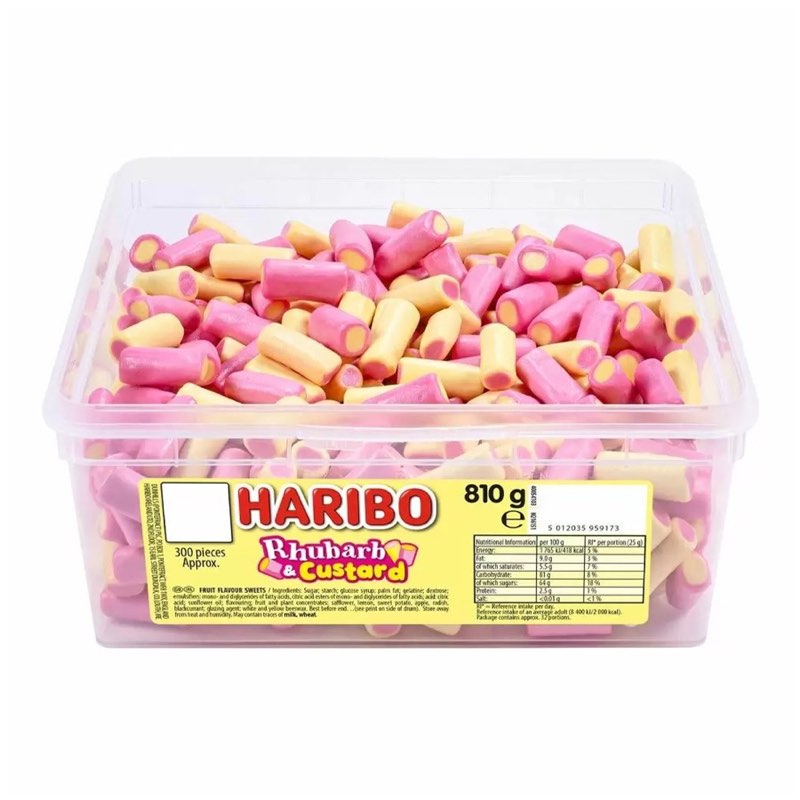
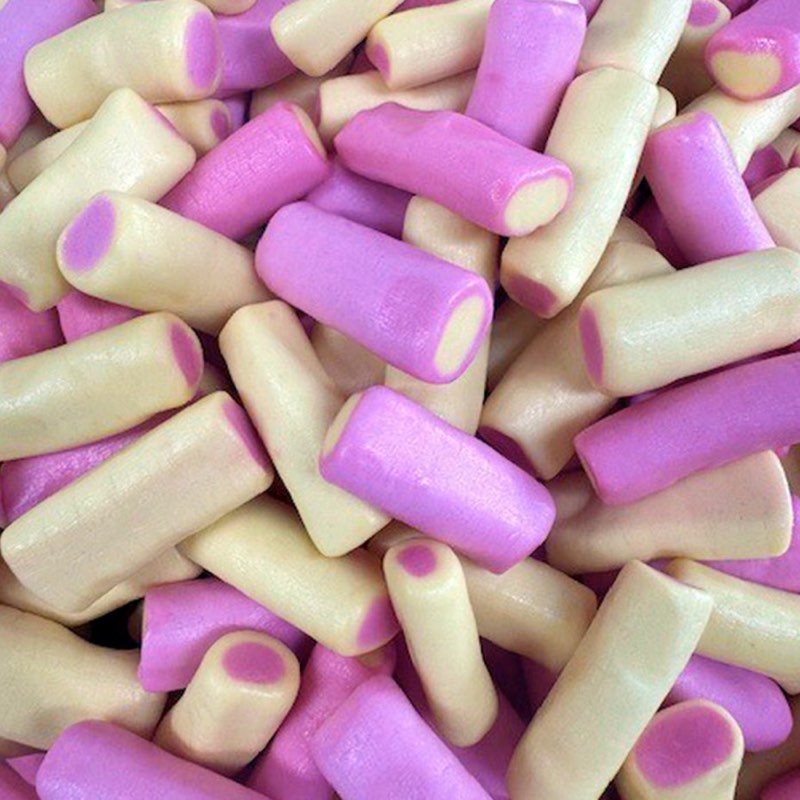
The foam version — this one — front-loads everything. Both halves arrive almost together, the sharp one fades first, and the whole thing is over in seconds. It is the most immediate version and the least contemplative.
A gummy version delivers the same flavour on a much longer chew, which stretches the sequence out and gives the creamy half considerably more time in the foreground. The Haribo rhubarb and custard line at £5.49 is the one to try if you want to hear the second half of the flavour properly, and buying it alongside this bag makes an unusually instructive pair — same flavour, two completely different shapes of experience for about £6.60 the pair.
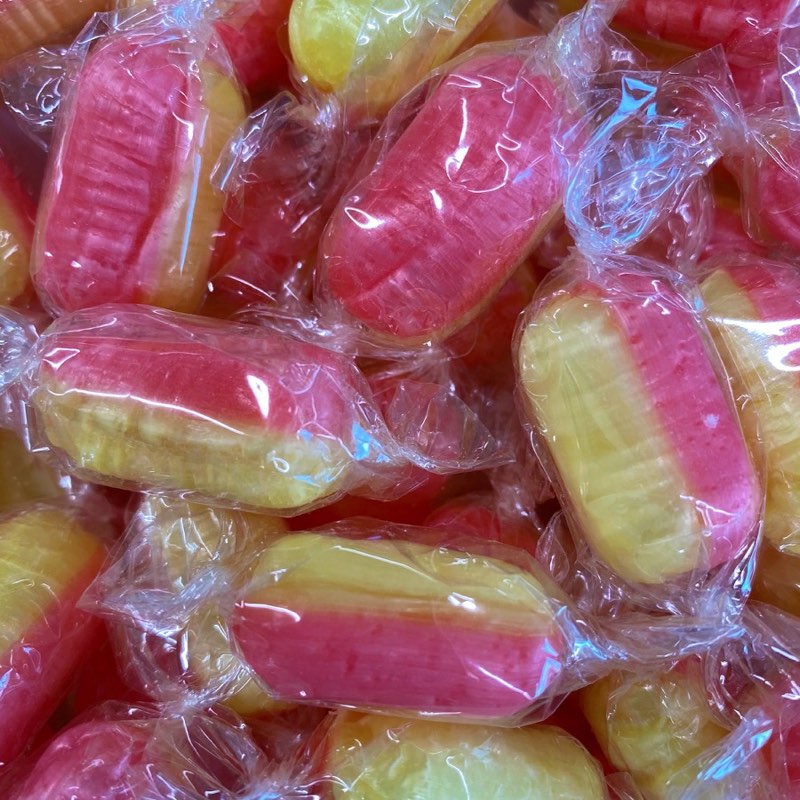
Hard versions sit at the far end, releasing slowly over minutes with no rush at all. They are the version most people picture when they hear the name, and they are also the version that reveals a badly balanced flavour most cruelly, because you have several minutes to notice. Browse the rhubarb and custard flavour shelf to see what we hold across the formats; four lines is few enough to read the whole shelf in a minute.
If you like this flavour, the adjacent thing to explore is not other fruits but other compound flavours — the pudding-and-sweet-shop family rather than the greengrocer family. Anything that pairs a sharp note with a creamy one is built on the same principle, and if the structure is what appeals to you rather than the specific notes, that is the thread to follow.
Building a mix around a 120 g bag
Foam is one of four textures worth having on a table, and it is the one most people already have covered. The interesting question is what the other three should be.
For a long chew, Kingsway Crocodiles at £5.49 give you a substantial gummy that takes real time to eat, which slows the table down in a useful way. Barratt Bumper Bananas at the same price are the classic soft-but-not-foam middle ground and a familiar shape that children recognise instantly.
For a sharp reset, Barnett's Mega Sour Apple Candy Bags 104g at £3.99 are the sensible pick, and they are particularly good next to this bag because sour and creamy are the two flavour directions furthest apart — going from one to the other resets your palate completely. The Sweetzone Fizzy Rings Tub 800g at £7.99 does the milder version of the same job while also solving the bulk problem, since 800 g in a tub is the kind of quantity a party actually needs.
For something rich, Dals Chocolate Covered Bears at £7.49 bring chocolate onto a table that is otherwise all fruit and foam, and they sit in the middle of the run-out order rather than the top, which means they survive longer than the soft items do.
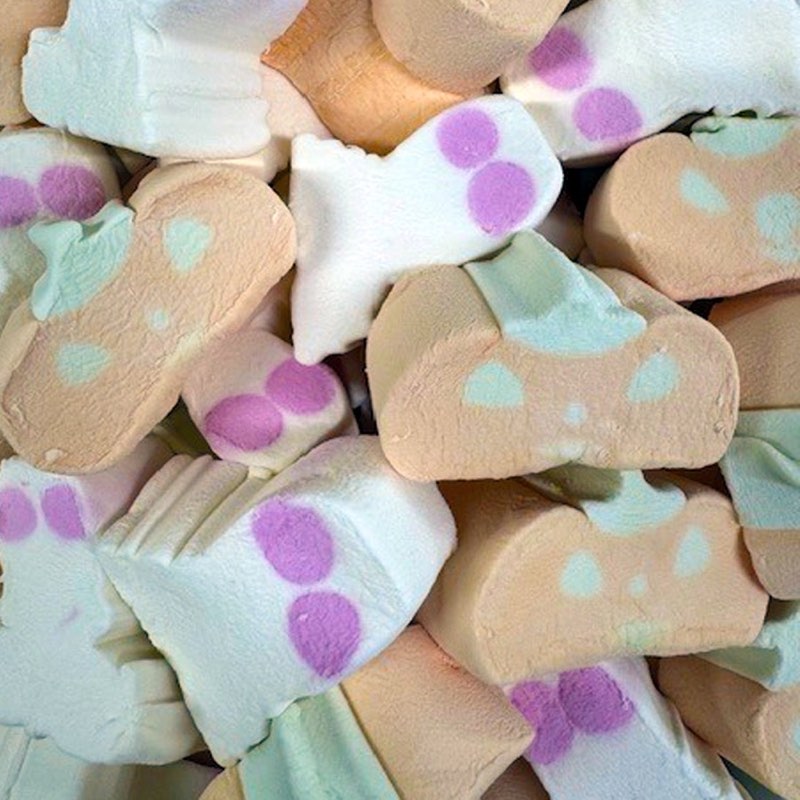
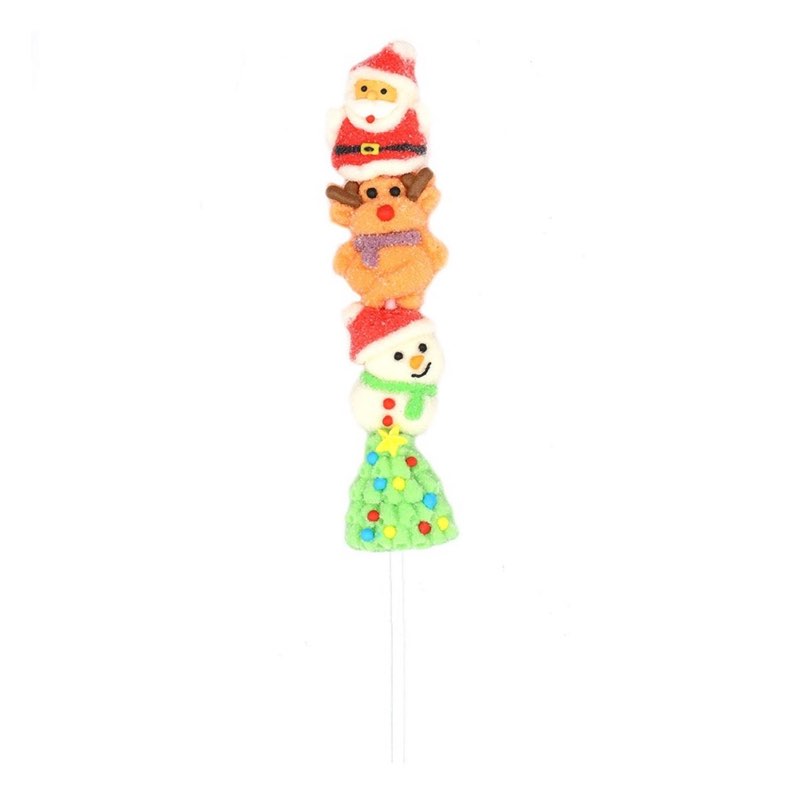
Staying inside the foam family is a legitimate choice too, if texture is what you are shopping for. BUBS Banana & Caramel Foam Sweets at £7.50 are another compound flavour built on the same sharp-against-creamy principle, which makes them the closest relative on the shelf in construction if not in taste. Vidal's foam jelly filled seashells in the 795 g tub at £7.99 combine foam with a jelly centre, so you get two textures in one piece — a good way to cover two table jobs with a single purchase. The Candy Realms Festive Mallow Stacker at £1.50 sits in the same low price bracket as this bag and is the one to add if you want a soft item that also looks like something on a table.
One deliberately odd suggestion: Briquette at £5.49 is the sort of traditional line that sits at the bottom of the run-out order, and a table with nothing from that end of the shop on it feels slightly juvenile. One bowl of something old-fashioned changes the character of a whole spread even if only three people touch it.
Occasions it actually suits
Children's parties. The obvious one, and the format earns it: soft, no hard edges, easy to eat standing up, cheap enough to buy in the numbers a party actually needs. Buy more bags than feels sensible; this is the first thing to disappear from any table.
Lunchboxes and after-school. A large bag divided into small portions across a week is considerably better value than individually wrapped things, and a 120 g bag splits neatly into several days without much thought.
Film nights. Foam is the quietest sweet in the shop to eat — no crunch, no wrapper per piece, no snap — which genuinely matters if somebody is trying to follow dialogue. It is a better cinema sweet than almost anything crunchy for exactly this reason.
Baking and decorating. Soft, bulky, brightly presented pieces are the standard decorating currency for birthday cakes and traybakes, and this size of bag is about right for topping one large cake with enough left over to be eaten during the process, which is the real tradition.
Hampers and gifts. On its own it is too cheap to be a gift, but in a nostalgic hamper the flavour name does heavy lifting. Rhubarb and custard signals old-fashioned sweet shop instantly, and a hamper built around that theme tells a clearer story than one built around variety alone.
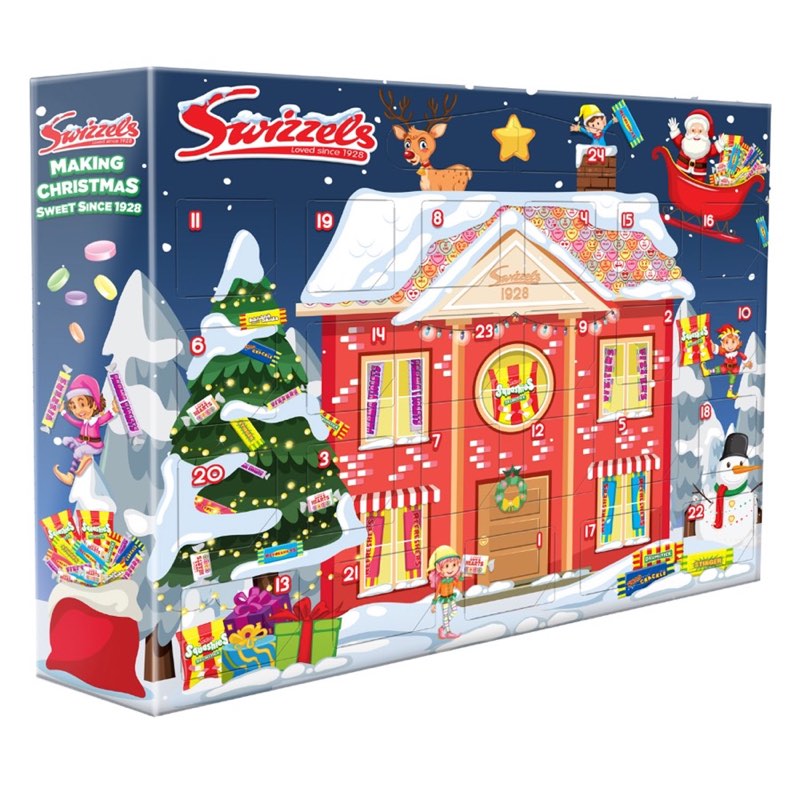
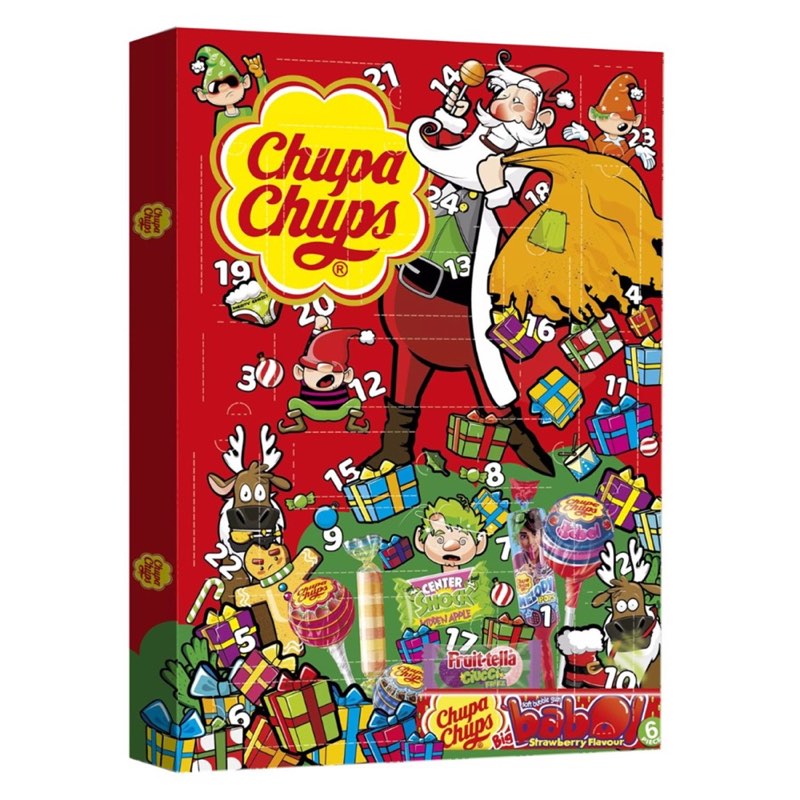
Christmas. If the buying occasion is December rather than a birthday, the calendars are the more appropriate anchor purchase. The Swizzels Sweet Shop Advent Calendar 220g at £8.99 puts a whole month's worth of small sweets on a schedule, and the 210 g Chupa Chups advent calendar at the same price is the lollipop-led alternative if the recipient prefers those. Both are a different kind of purchase to a bag — you are buying the twenty-four openings, not the weight.
£1.15 for 120 g — the value case
At £1.15 for 120 g, this works out at a shade under £10 a kilo, which puts it among the better-value branded bags in the shop. For comparison, sealed cartons and small novelty packs routinely run at two and a half to three times that rate per kilo, and large tubs come in cheaper per kilo but require you to commit to eight hundred grams of one thing.
The bag size is the reason it works. 120 g is large enough that the packaging cost is spread thinly and small enough that you can buy four different things without committing to any of them. That is the sweet spot for variety buying, and it is why bags in this weight class are the backbone of most party shops rather than the tubs people imagine.
Where the value case gets complicated is the moreishness problem. Foam is eaten faster than denser formats, so the practical cost per sitting is higher than the cost per kilo suggests. A 120 g bag of hard sweets might last a week; 120 g of foam very often does not last an evening. If you are budgeting by how long something lasts rather than what it weighs, adjust upwards.
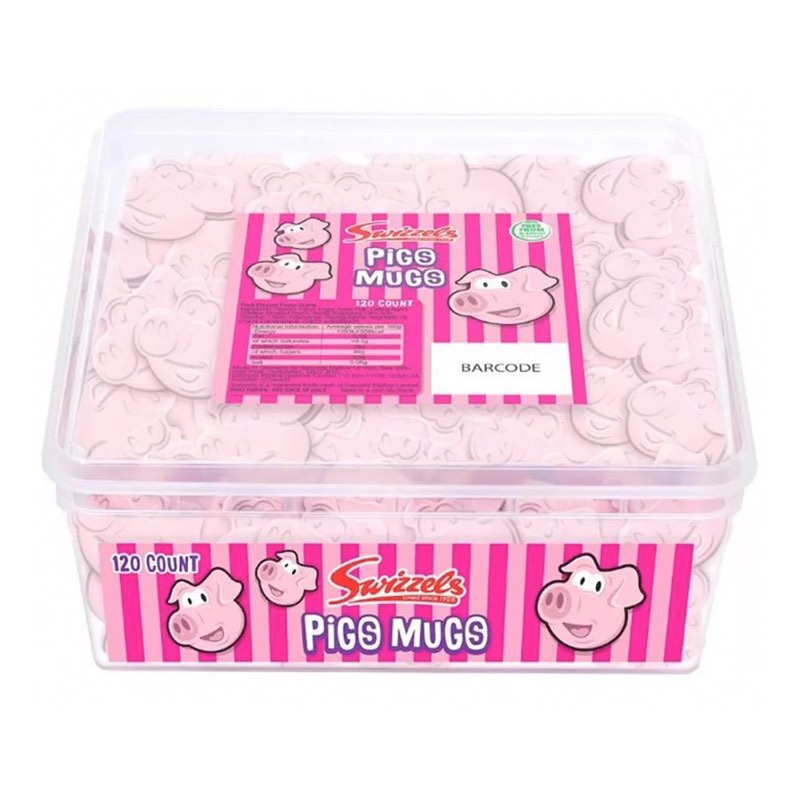
The other comparison worth making is against the tubs. The Swizzels Pigs Mugs Tub 576g at £8.99 and the Swizzels Giant Milk Bottles Tub at £9.99 are both roughly the price of eight of these bags, and both give you a single flavour in a resealable container rather than eight opened bags on a shelf. For a household that gets through sweets steadily, a tub is the cheaper and tidier answer. For a table that needs variety, eight different bags beat one tub every time. Decide which problem you actually have before you buy.
Storing foam sweets
Foam is the most weather-sensitive format in the shop, and the reason is structural rather than chemical. An aerated sweet is holding its shape against gravity with a very light framework, and both heat and moisture attack that framework directly.
Heat is the bigger problem. Warm foam goes limp and loses its spring, and pieces that were separate become one mass. This is not reversible in the way a warm chocolate bar is reversible — once the structure has collapsed and re-set, the bounce does not fully come back. The practical rule is simple: never leave a bag in a car, in a bag in the sun, or on a windowsill. A cool cupboard is the whole of the advice.
Moisture is the slower problem. Foam has an enormous surface area for its weight, which means it takes on damp from the air faster than a dense sweet does. Damp foam goes sticky on the outside first and then heavy and dull throughout. Keep the bag closed with a clip or decant into an airtight tub, and do not store it near a kettle, a hob or a bathroom.
Do not refrigerate. The instinct to cool something that has gone soft is understandable and it makes things worse: the condensation that forms when you take it out again puts moisture directly onto the surface. Cool and dry beats cold every time.
For a table, decant in small amounts and refill. Foam left out in open air for several hours dries at the surface and goes slightly crusted, which is not dangerous but is noticeably less pleasant than the same sweet fresh from the bag. This is another reason the small-bowl-refilled-often approach beats the big-bowl-filled-once approach.
One size — and what to do while it is out of stock
This line comes in one size only, the 120 g bag at £1.15, so there is no larger or smaller version to weigh up. The only decision is quantity, and the guidance above holds: one bag per two children for a table, more if it is the main soft item rather than one of several.
It is worth being straight about availability. This line is currently out of stock. If you have landed here while planning something with a date on it, do not build the table around it. The sensible approach is to substitute on texture or on flavour, depending on which of the two you actually care about.
If texture is what you want — the light, springy, disappears-in-seconds quality — the foam shelf is the substitution to make, and the seashells tub or the banana and caramel foam both deliver the same eating experience with a different flavour on top. If flavour is what you want, go to the rhubarb and custard shelf instead and accept a different format; the gummy version carries the same two-part flavour on a longer chew.
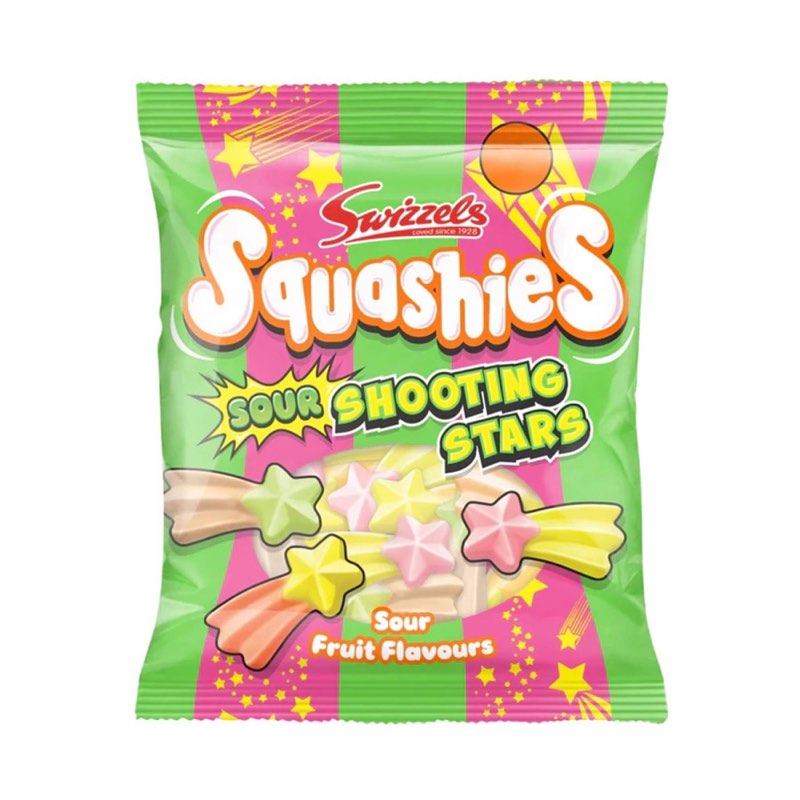
If what you want is specifically this brand in this squashy format, the Squashies Love Hearts mixed fruit bag at 120 g is the closest thing we hold — identical weight, £1.25, same squashy format, a mixed-fruit flavour set instead of the compound one. The Sour Shooting Stars gums squashies at 100 g and £1.29 take the same format in a sour direction, which is a bigger change of character but keeps the texture you came for. Both are the substitutions to make if you want the closest possible like-for-like.
Finding it and its neighbours on the site
Four shelves carry this bag. It sits in the Swizzels brand listing, which collects twelve lines and is the fastest route to the rest of the range if the brand is what you came for. It sits under foam, which is the right shelf if you are shopping by texture. It sits on the rhubarb and custard flavour shelf, which is small enough to read completely. And it appears under loose sweets, which at three hundred and fifty-six lines is the largest shelf in the shop and the one to browse when you are buying by weight rather than by name.
Two other brand shelves are worth knowing if you are filling a table rather than buying one thing. The Haribo listing is where most people's default party choices live, and it is the obvious place to cover the gummy jobs that foam cannot. The Kingsway listing is the traditional British end — bigger pieces, older shapes, the sort of thing that fills the bottom of the run-out order.
For a different kind of browse, the candy and chocolate category is where the branded cartons and imported lines sit, and it is the right shelf for adding a rich item to a spread that is otherwise all fruit. The full product listing shows everything at once if you would rather filter than browse, and buying by weight remains the cheapest way to cover the bulk of any table.
Questions people ask about this one
What does "Squashies" mean in practice?
It describes the eating experience rather than anything technical: a soft, light, springy piece that compresses easily under the teeth and is gone in a few seconds. Compared with a standard gummy it takes far less work to chew and delivers its flavour in one rush rather than gradually. If you have only eaten firm gums before, expect the biggest difference to be how little effort it takes rather than how it tastes.
Is rhubarb and custard sour?
Not in the way a dedicated sour sweet is. One half of the flavour is sharp and bright, which reads as tangy rather than sour, and the creamy half sits underneath and softens it considerably. If you want genuine mouth-puckering sourness, this is the wrong flavour and a mega sour line is the right one. If you want a flavour with an edge on it that is still comfortable for children, this is well pitched.
How many people does a 120 g bag serve?
Two children or three adults if it is one item among several on a table, or one person for an evening if it is the only thing. Foam disappears faster than its weight suggests, so for a party of ten or more, plan on several bags rather than one. The rough working figure for a children's table is 60–80 g a head across everything you put out.
Is it in stock?
Not at present — this line is showing as out of stock. If you need something for a fixed date, substitute rather than wait: the Love Hearts squashies bag is the nearest match on format and weight, and the foam shelf will give you the same texture in other flavours.
Why is it so much cheaper than the tubs?
Because you are buying less of it. At £1.15 for 120 g the rate works out just under £10 a kilo, which is good value for a branded bag, but the tubs hold five to seven times the weight and are correspondingly cheaper per kilo again. Bags win on variety and on not committing; tubs win on rate and on resealability. Neither is better in the abstract.
Can children eat these safely?
Sweets are a treat rather than an everyday food, and the standard advice applies: small hard sweets and whole gummies are a choking risk for young children, so supervision matters. Check the manufacturer's packaging on arrival before anyone with an allergy eats anything, since the pack is the definitive source on its own contents.
Will they survive being posted in summer?
Foam is more heat-sensitive than most formats. It does not melt in the way chocolate does, but it does go limp and can compress into a single mass if it gets genuinely warm. It is usually still perfectly edible, just less bouncy. If you are ordering in hot weather, open the bag somewhere cool and let it settle for an hour before judging it.
What is the best thing to put next to them on a table?
Something sharp and something with a long chew, because foam covers soft-and-fast and nothing else. A sour apple bag resets the palate between handfuls, and a substantial gummy slows the table down. Adding a second soft item is the most common mistake — it makes the whole spread read as one texture.
Do they work as cake decorations?
Yes, and better than most formats. They are light, so they do not sink into soft icing, and they are bulky for their weight, so a single bag covers a large cake. Add them shortly before serving rather than the night before, since foam left exposed on a damp icing surface softens at the base.
Is the flavour the same as the old hard sweet?
It is built on the same two-part idea — a sharp note over a creamy one — but the format changes how you experience it substantially. A hard sweet releases slowly over minutes and lets both halves unfold in sequence; a foam piece releases everything at once and is finished in seconds. People who strongly prefer one usually prefer it for the pace rather than the flavour itself.
Which should I buy if I want this flavour to last longer?
A format with a longer chew. The Haribo version at £5.49 is a much larger quantity in a gummy format, so you get both more of it and a slower experience per piece. Buying both and comparing them side by side is genuinely interesting if you like the flavour, and it is the fastest way to work out which format you are actually loyal to.
In short
A 120 g bag at £1.15 carrying one of the great British compound flavours in the lightest, fastest format there is. The sharp half arrives first, the creamy half stays behind, and the whole thing is over in seconds — which makes it the first item to vanish from any table it is put on, and the item to buy in multiples rather than singly. It is out of stock at the moment, so if you are planning around a date, take the format from the foam shelf or the flavour from the rhubarb and custard shelf and come back to this one when it returns.
More from Swizzels
More foam sweets
More rhubarb & custard sweets
Where this sits
Swizzels Drumstick Squashies Rhubarb & Custard Flavour Bag 120g appears on these shelves. Browse them, or jump to something nearby.
You might also like