Home / Loose Sweets / Oreo Sandwich Biscuits with Matcha Flavoured Cream Filling 97g
Oreo · 97g
Read the full guide
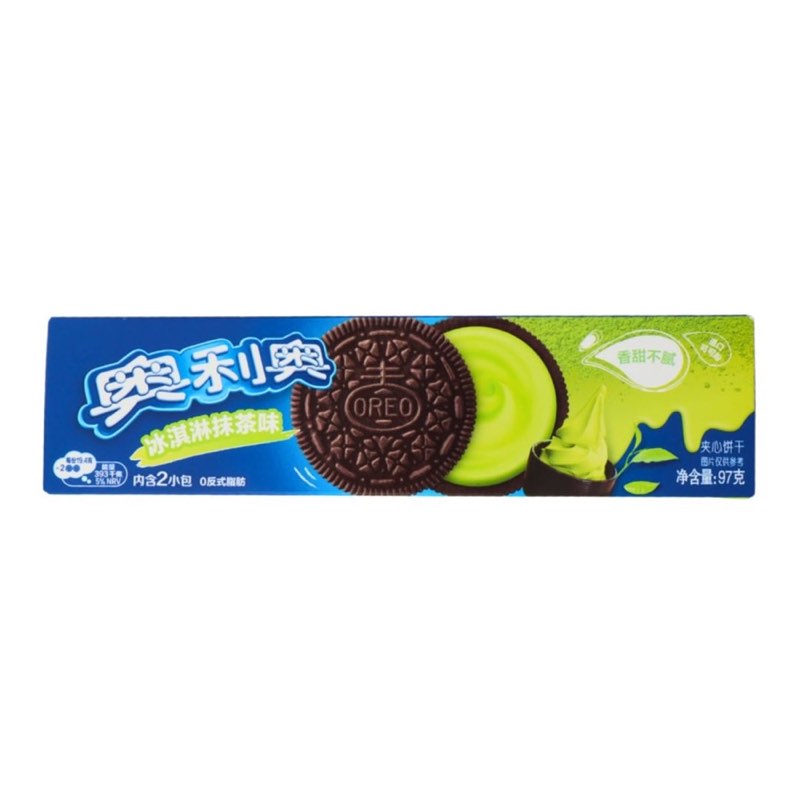
Oreo Sandwich Biscuits with Matcha Flavoured Cream Filling 97g
£2.29
✔ In stock — ready to ship
Fresh stock
Free over £20
Same-day dispatch
Secure checkout
Some sweets are for a party. This is not one of them, and knowing that up front will tell you more than any amount of description. The Oreo Sandwich Biscuits with Matcha Flavoured Cream Filling is a 97 g pack at £2.29, and it belongs to the quieter end of the shop — the things that get opened when there are two people in a kitchen rather than twenty in a room.
The most common moment is the afternoon one. Three o'clock, a pot of tea or a second coffee, and the specific want for something small and interesting rather than something large and sweet. A 97 g pack is exactly right for that hour. It is enough for two people to have a couple each and put the rest back, and because the pack is sealed and printed you can put the rest back without ceremony — no plate to wash, no tin to find.
The full guide to Oreo Sandwich Biscuits with Matcha Flavoured Cream Filling 97g
5,398 words on how it eats, who it suits, how to serve it and what to put beside it.
The moments this pack tends to get opened in
The second is the late-shift moment. Anyone who works evenings, or works from home and loses track of dinner, builds up a small library of things that live in a drawer and do not need preparing. Sandwich biscuits have always been on that list. What makes this one a better drawer item than most is that the flavour is unusual enough to register — you notice you are eating it, which is the whole difference between a treat and a habit.
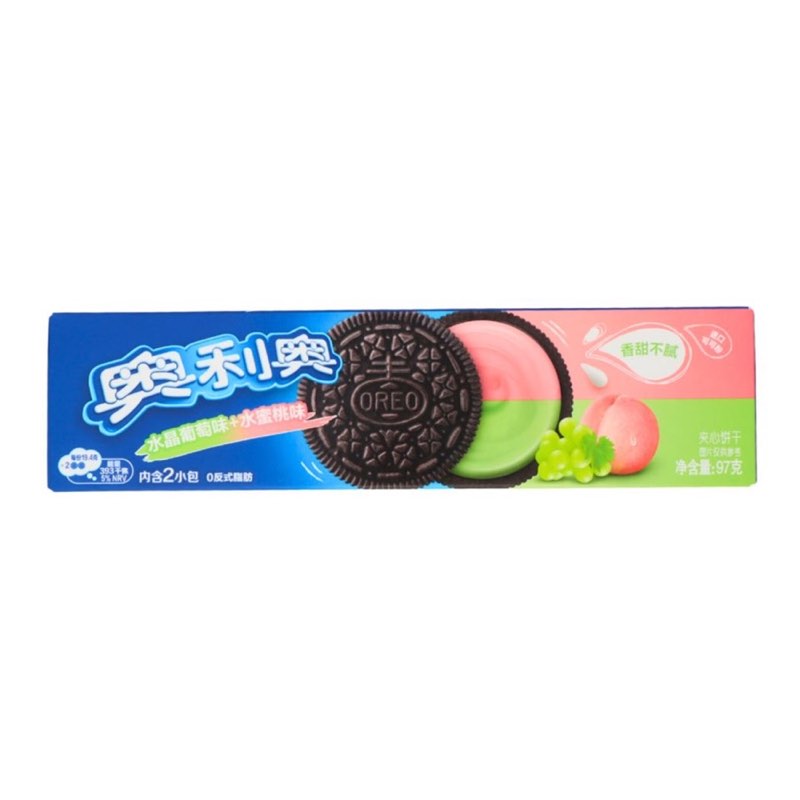
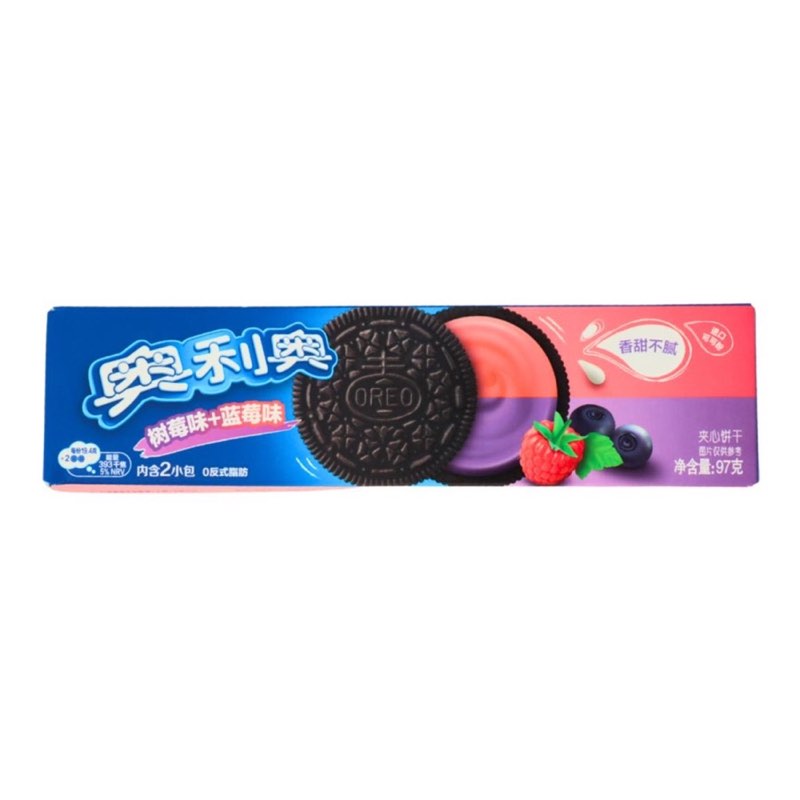
The third is the tasting moment, and it is the one we see most often on this particular line. Somebody buys it alongside one or two of its siblings specifically to line them up and compare. It is an unusually good product for that, because the format is identical across the range and the filling is the only variable. Buy this, Oreo Sandwich Biscuits with Grape & Peach Flavoured Cream Filling 97g and Oreo Sandwich Biscuits with Blueberry & Raspberry Flavoured Cream Filling 97g, all three at £2.29, and you have a proper side-by-side for under seven pounds, with one biscuit in the row that is not trying to be fruit at all.
Then there is the dessert-adjacent moment, which is where this flavour direction earns its place at a table rather than in a drawer. A matcha-flavoured biscuit alongside a plain scoop of ice cream, or crumbled over the top of it, is the sort of thing that reads as considered without being any trouble. It works because the flavour direction is a grown-up one — less sugary in character than most sweet-counter flavours — and it gives you something to say about the pudding without making anything.
Finally, the gift-with-curiosity moment. There is a particular kind of shopper who buys things specifically to hand them to someone and watch their face. Unusual imported flavours in universally familiar formats are made for that, and a £2.29 pack is the perfect denomination for it — cheap enough to be a joke, good enough not to be.
Where it is a bad fit, honestly
It is worth ruling out the occasions where it will disappoint, because a sweet shop that only tells you what works is not much use.
It is not a children's party item. Children at a party want colour, chew and sugar in that order, and a distinctive, slightly grown-up flavour direction will be picked up, bitten and abandoned on a paper plate. Put the money into something bright and bouncy instead — Barratt Jelly Babies at £5.49 will do more work at a children's table than four of these packs.
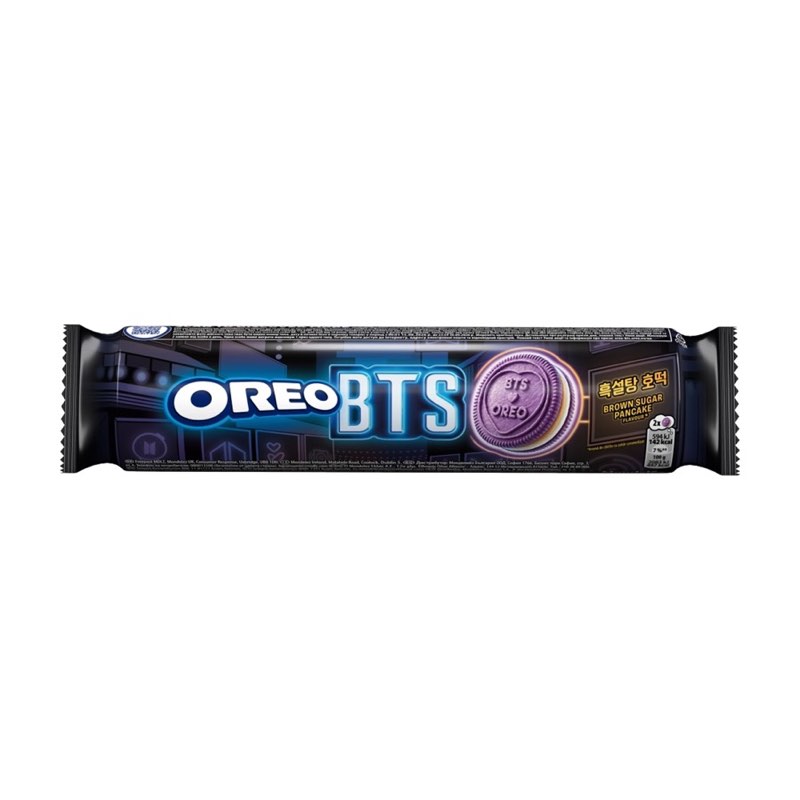
It is not a volume item. At 97 g this is a small pack, and if you are catering for a crowd you will spend a lot of money assembling enough of them. The Oreo BTS Brown Sugar Pancake Cocoa Sandwich Biscuit Pack 157g is the same £2.29 for sixty grams more, which makes it the better choice when weight matters more than the particular flavour.
And it is not a mixer. A crisp biscuit in a bag of weighed sweets will go soft and get crushed, every time. If a bag is what you want, start with Pick & Mix and leave the biscuits in their own packet.
Opening it
The pack is small, flat and printed, with 97 g stated on the front, and the first thing you notice on picking it up is how little it weighs for its footprint. That is a biscuit signature. Density is what separates a pack of biscuits from a pack of sweets in the hand before you have opened either, and it is the first honest clue about how the thing is going to eat.
Inside is a row of round sandwich biscuits — two discs with a layer of cream between them, which is exactly what the name on the front sets out. They stand in a line rather than lying in a heap, which is a structural decision as much as a packing one: a disc standing on its edge is far stronger than a disc lying flat under the weight of others.
Take one out and it sits in the hand the way sandwich biscuits always have, between finger and thumb, thin enough that you can feel the two-layer structure through your fingertips. This is a format with no learning curve whatsoever. Whatever you make of the flavour, you already know how to hold it, how to twist it and how long to dunk it, and there is real value in that when the flavour on the front is one most British shoppers will not have eaten in biscuit form before.
We are not going to describe the colour of anything inside the pack, and it is worth saying why rather than leaving an odd gap. Our fact pack for this line does not record a colour, and we do not publish product details we cannot stand behind. You will see it for yourself the moment you open it. Everything else on this page — the weight, the price, the format, the flavour the name declares — comes from what we do hold.
The bite
Bite straight through the middle and the sequence goes: resistance, snap, give, crumb. The resistance is brief — a thin biscuit disc does not argue for long — and then the break is clean and audible rather than soft and crumbling. The cream layer gives a fraction of a beat after the discs, which is the small staggered pleasure that makes a sandwich biscuit different from two plain biscuits.
The flavour behaves differently from the fruit-filled packs in the same range, and this is the genuinely interesting part. Fruit fillings tend to arrive fast and bright and then leave. A matcha-flavoured filling does the opposite. It comes up slowly, through the crumb rather than ahead of it, and it is at its strongest about two seconds after you would expect the flavour to have peaked. That late arrival is characteristic of the family and it is the main reason people either love this kind of thing immediately or need three biscuits to make their mind up.
What arrives is more savoury-leaning and more vegetal than almost anything else on a sweet counter — green, grassy, faintly bitter at the back, with a soft chalky edge on the finish. Against the plain sweetness of a biscuit and cream structure, that slight bitterness does the same job that cocoa does in a darker biscuit: it stops the sweetness running away with itself and gives the whole bite a floor.
The finish is where it differs most from its siblings. Fruit fillings clear quickly. This one sits on the middle of the tongue for a while and fades gradually rather than dropping off. It changes how you eat the pack: fewer, slower, with longer gaps. That is a compliment, not a warning, and it is also why a 97 g pack is a more sensible size for this flavour than a large one would be.
How a biscuit is engineered to eat like that
The crisp–soft–crisp stack is one of the oldest deliberate texture constructions in food, and it is much harder to hold together than it looks. Understanding the problem makes you appreciate the product, and it also tells you exactly how to look after it once it is open.
The central difficulty is moisture. A crisp biscuit is crisp because it is dry and because its internal structure is rigid and porous — a brittle scaffold full of tiny air spaces. Take that scaffold and press a soft layer against it, and you have created a gradient. Moisture always moves from the wetter side to the drier side, which means the soft filling is constantly, slowly, trying to soften the discs from the inside. Every sandwich biscuit ever made is in a quiet race against that migration.
The way that problem gets solved is by making the filling itself very low in available moisture, so that there is almost nothing to migrate. That is why the filling in a sandwich biscuit is soft in the way a firm paste is soft, rather than soft in the way a jam is soft. It yields under pressure and it melts against the warmth of the mouth, but it does not wet what it touches. Once you notice that distinction you can feel it happening: the filling gives, but the disc either side of it is still audibly crisp at the moment your teeth meet in the middle.
The snap is a matter of geometry as much as anything. A disc snaps rather than bends because it is thin relative to its diameter and because the internal structure is brittle rather than elastic. Make the same biscuit half again as thick and it would break messily rather than cleanly. Make it thinner and it would shatter in the pack before you got to it. The thickness you get in a sandwich biscuit is a narrow compromise between the break you want in the mouth and the survival you need in transit, and it is the same across nearly every brand in the world because the physics does not vary.
The embossing on the face of a biscuit is not only decoration either. Patterned surfaces bake more evenly than flat ones, because the raised and recessed areas change how heat and steam move at the surface, and a patterned disc is stiffer than a smooth disc of the same weight for the same reason corrugated card is stiffer than flat card. The design is doing structural work while it is doing brand work.
Why the twist works, and what it tells you
The twist-and-separate ritual is worth taking seriously as an engineering outcome, because it only works within a narrow band of conditions and it is a genuinely good test of whether your pack is still in good condition.
When you twist, you are applying shear to the filling layer while the two discs stay rigid. For the biscuit to come apart cleanly, the filling has to be weaker in shear than the discs are in torsion — soft enough to fail along its own plane, but firm enough not to smear. If the filling were any softer it would squeeze out at the edges instead of splitting. If it were firmer, the discs would crack before it did.
That balance is also temperature-sensitive, which is the practical bit. Cold from a fridge, the filling stiffens and the discs will tend to crack instead of separating. Warm from a sunny windowsill, the filling softens and smears rather than splitting. A biscuit that twists cleanly is a biscuit that has been stored at a sensible room temperature, and a biscuit that will not twist is telling you something about where it has been.
The same logic explains dunking, which is the one moment where all that careful moisture engineering is deliberately thrown away. Hot liquid floods the porous scaffold, the structure goes from rigid to soft in a couple of seconds, and the filling softens faster than the discs do. The window is genuinely short — shorter for a thin disc than for a thick digestive — and the reason your biscuit ended up in the bottom of the mug is that the scaffold gave way before you lifted it. Two seconds, not five. The thinness that gives you a clean snap is the same thinness that costs you a slow dunk.
Why does any of this matter for a flavour like this one? Because a late-arriving, slightly bitter, vegetal filling needs the crumb around it to carry it. If the discs have gone soft, the filling has nothing to work against and the flavour reads muddier and flatter. On a fruit-filled biscuit you would forgive a stale disc, because the fruit note is loud enough to survive it. Here you would notice immediately. This is a line where keeping the pack properly closed genuinely changes what you taste.
A foreign flavour on a British sweet counter
There is a long British habit, worth describing properly, of a sweet counter being the most internationally curious shelf in the shop long before anyone used that language about it.
Picture the two rooms that most British sweet buying has happened in. The first is the corner shop: a newsagent counter, a wall of jars behind it, a bank of boxed bars at elbow height, and a row of penny trays at exactly the eye level of an eight-year-old with forty pence. The second is the seaside sweet shop: bigger, brighter, rock in the window, fudge on a marble slab, tubs of things in colours that do not occur in nature, and the specific holiday licence that makes people buy a kilo of something they would never buy at home.
Both of those rooms ran on the same basic principle, which is that a sweet counter is a place where you are allowed to take a small risk. The stakes are low by design. A few pence, or a couple of pounds, and if you do not like it you have learned something. That is a completely different shopping posture from the one people bring to the rest of a grocery shop, and it is why sweet counters have always carried the odd, the imported and the faintly ridiculous alongside the reliable.
The jar wall is the purest expression of it. Pear drops, aniseed balls, rhubarb and custard, sherbet lemons, cough candy — a list that looks conservative now but which was, in its own time, a display of the most far-flung flavour ideas the trade could get hold of. Aniseed, liquorice, ginger, lemon, cola: none of those are indigenous notes. A British sweet shop has been selling imported flavour ideas in familiar formats for as long as there have been British sweet shops. You can still taste that habit in something like Barratt Black Jack Chews, where an aniseed note that arrived from somewhere else entirely is now so thoroughly naturalised that it reads as nostalgia rather than novelty.
What has changed is the format the novelty arrives in. The jar has given ground to the printed pack, and the printed pack travels. A shelf that once mixed local jar lines with a few imported boiled sweets now mixes them with packs from all over the world, and the customer posture is exactly the same as it ever was: small money, small risk, real curiosity. That is the shelf this product lives on, and it is why an imported biscuit with an unfamiliar filling does not look out of place sitting a few inches from Bristow's Traditional Salted Caramel Bon Bons at £5.49. The two of them are doing the same job on the same counter, from opposite ends of the tradition: taking a flavour idea a shopper has not tried, and handing it over in a shape they already know exactly how to eat.
Where a matcha biscuit fits into that tradition
The reason this pack works on a British counter is that it follows the oldest rule in the trade: keep the format familiar and put the novelty in the flavour.
Almost every successful imported confectionery line in this country has done exactly that. A shape your hand already knows, a ritual you already have, and one variable changed. It is the same logic that made cola-flavoured everything work, and the same logic behind sour coatings on otherwise ordinary gums. Change two things at once and the shopper has nothing to hold on to; change one and they can place it immediately.
This pack changes precisely one thing. The disc, the cream layer, the twist, the dunk, the way it sits in the hand — all completely standard. The flavour direction is the single unfamiliar element, and because everything else is anchored, most people are willing to try it. That is not an accident and it is not a small piece of craft.
There is a second, more modern reason it lands. British sweet buying has spent the last stretch getting comfortable with flavours that are not straightforwardly sweet. Salted caramel did an enormous amount of the groundwork there, and you can see the result across our shelves — the salted bon bons above, the caramel-and-banana combination in BUBS Banana & Caramel Foam Sweets at £7.50, even the way sour has gone from a children's dare to an adult flavour preference. A biscuit with a faintly bitter, grassy, savoury-leaning filling would have been a much harder sell on a counter that had not already accepted salt in a sweet.
The pier-and-promenade end of the tradition has its own version of this. Seaside shops have always sold the visually extreme — sticks of rock with lettering through them, enormous lollies, things in improbable colours — because on holiday people buy the story as much as the sweet. This pack is the quiet indoor cousin of that instinct. The story is "try this, it is nothing like you expect", and at £2.29 the story is affordable. That is a corner-shop transaction, not a seaside one, but it comes from the same place.
Matcha as a flavour family
It is worth setting out what the flavour family generally does, because it is the least familiar one on this page and because knowing the family is how you predict whether you will get on with the specific.
Matcha as a flavour direction is defined by three things working at once. There is a grassy, vegetal quality — closer to fresh green things than to anything fruity. There is a gentle bitterness, present but not aggressive, sitting at the back of the tongue rather than the front. And there is a distinctive savoury depth that food writers reach for the word "umami" to describe, which is the part that makes it feel grown-up and the part that catches people out.
Put that against sugar and something interesting happens: the bitterness and the sweetness each make the other more legible. Sweetness on its own gets boring fast, because there is nothing for it to contrast against. This is the same reason salted caramel works, the same reason a sour coating makes a plain gum more interesting, and the same reason dark chocolate is more moreish than very sweet chocolate for a lot of adults. The bitterness is not a flaw to be tolerated, it is the structure.
Where matcha differs from the other bitter-sweet pairings on our shelves is in its pace. Salt is instant. Sour is instant and then gone. Matcha is slow at both ends — slow to arrive, slow to leave. That is why it suits a biscuit better than it would suit a boiled sweet, which is over too quickly to give the flavour room, and why it suits an afternoon rather than a party.
If you like this family, you probably already like the savoury-tinged end of sweet things generally, and the caramel-and-salt direction is your most obvious next stop on our shelves. If you find it strange, the cure is not more of it but contrast: eat one, then eat something bright and fruity, then go back. A lot of people who bounce off it on the first biscuit like it on the third.
What to put beside it
This is a pack that wants company of a particular kind, and the wrong company does it no favours.
The best pairing is something plainly sweet and fruity, because the contrast lets both sides be themselves. A bag of soft fruit jellies beside a plate of these is a genuinely good combination for a table, and at £5.49 one bag stretches a long way. If you want the fruit note louder, Candy Paradise Juicy Grenade Gummies at £1.39 is the cheapest way to get a bright, juicy register onto the table.
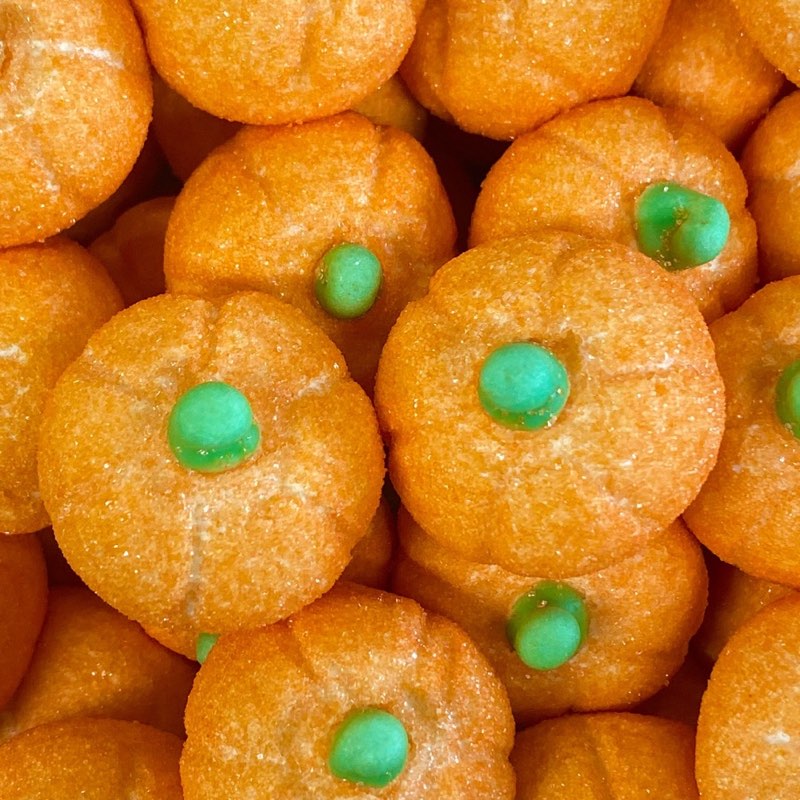
The second pairing is something rich and dairy-toned, which sits very comfortably on the same side of the palate. Buchanan's Butter Tablet Carton 150g at £3.49 is a proper foil for this — dense, rich, slow — and the two together make an unexpectedly grown-up plate for a coffee. Bulgari Pumpkin Mallows at £5.49 play the same role more softly, and look better on a table.
The third is a deliberate collision, if you are the kind of host who enjoys one. Put something sharp next to it and watch people ricochet between the two. Barnett's Mega Sour Apple Candy Bags 104g at £3.99 is the most extreme option on this page, and you need very little of it.
What to avoid is anything with a strong competing personality that occupies the same slow, lingering territory. A very divisive line like Briquette at £5.49 is a wonderful bag in its own right, but putting it directly alongside a slow, faintly bitter biscuit gives your mouth two arguments to have at once. Space them out on the table.
And for a seasonal plate, the simplest addition is something obviously festive that asks nothing of anyone: a 77 g bag of Christmas chocolate robins at £2.49 will do it without competing for attention.
97 grams at £2.29, examined
The unit price is £2.36 per 100 g, which places this in the middle of our shelf rather than at either end. It is dearer per gram than the larger pack in the same family, and considerably cheaper per gram than most of the small imported and seasonal packs sitting near it.
In practical terms, treat 97 g as two or three sittings for one person, or one round for two people with a bit left. Because of the slow finish, this flavour paces you naturally — most people take two and stop, where with a fruit-filled biscuit they would take four. That is worth factoring in: a 97 g pack of this will last a single person longer than a 97 g pack of something bright.
The honest value comparison is against the 157 g pack at the same £2.29, which comes out at about £1.46 per 100 g. If you want maximum biscuit for your money, that is the pack and it is not a close contest. What you are paying the difference for here is a specific flavour direction that the larger pack does not offer. That is a perfectly sensible thing to pay for — it is the same reason people buy a small jar of a good thing rather than a big jar of a dull one — but it should be a decision you make knowingly rather than one you discover later.
If you are buying several, the sensible basket is one of each flavour in the family rather than three of the same. Four packs, four directions, £9.16. That is a tasting flight for the price of one large bag of loose sweets, and it is by a distance the most interesting nine pounds you can spend on this part of the shop.
Looking after an open pack
Everything in the texture section above turns into one simple instruction: keep the air out.
Once the seal is broken, the crisp discs begin trading moisture with the room. In a dry cupboard that is slow; in a kitchen with a kettle going it is quick. Fold the pack over and clip it, or tip the remainder into a tub with a lid, and you will keep the snap for days rather than hours. On this flavour it matters more than on most, because a slow, subtle filling needs a crisp crumb to carry it.
Store at normal room temperature, in a cupboard, away from sunlight and away from the hob. Heat softens the filling, which ruins the twist and makes the biscuit smear rather than break.
Do not refrigerate. Cold makes the filling brittle and the discs crack instead of separating, and taking a cold pack back out into a warm room brings condensation to the surface — the exact enemy of a crisp biscuit. There is nothing to be gained and a fair amount to lose.
Keep the pack flat or upright, not squashed. And treat the manufacturer's packaging as the only authority on the contents: we do not publish ingredient, nutrition or allergen information for this line because we do not hold verified data for it, so please check the pack on arrival before eating, especially where there is an allergy in the house. Sweets and biscuits are a treat, not an everyday food, and young children should be supervised while eating anything from our shelves.
One size here, three directions next door
This line is sold in a single size — one 97 g pack at £2.29 — so there is no size decision to make. The real choosing is between filling directions, and the family gives you four.
This pack is the outlier and the interesting one: the only filling in the range that is not built on fruit or caramel, and the only one with a bitter edge to it. The grape and peach filling is the softest and most immediately likeable of the four, the one to buy if you are choosing for someone whose taste you do not know. The blueberry and raspberry pack, also 97 g at £2.29, is the sharper berry option and the better foil for a coffee. And the brown sugar pancake pack, at 157 g, is the caramel-toned one and the value buy of the set.
If you are only buying two, take this one and a fruit one. The contrast is the point, and two packs at £4.58 tells you far more about your own taste than either would on its own.
Finding your way round the rest of the shop
This pack lives on our Loose Sweets shelf, which runs to 356 lines and is the broadest shelf we have. It is worth browsing rather than searching, because it is where the imported packs, the traditional bags and the odd one-offs all sit next to each other, and that adjacency is how most people find the thing they did not know they wanted.
If the biscuit-and-cream side of this is what appeals, Candy & Chocolate is the next shelf along and holds the bars, boxes and chocolate-forward packs. If you would rather buy by weight and build your own bag, the pick and mix counter is where to do it — just keep the biscuits out of the bag itself. And if you have no particular target, the full range across every shelf is the place to wander, which is genuinely how the best baskets get built.
For a sideways step from here, the three most different things on this page are worth a look in turn: the aniseed chew bag at £5.49 for the old-fashioned end, the foam sweets at £7.50 for the soft and unusual end, and the 104 g sour apple bags for the extreme end. Between them they cover most of what a sweet shop can do.
Questions shoppers ask about this one
What does matcha taste like if I have never had it?
Grassy and green, with a gentle bitterness at the back and a savoury depth underneath it. It is not a fruit flavour and it is not trying to be. Against a sweet biscuit and cream structure, that bitterness works the way cocoa or salt works — it gives the sweetness something to push against. It also arrives slowly and leaves slowly, which is unusual on a sweet counter and is the single biggest thing to expect.
Is it very sweet?
It reads less sweet than the fruit-filled packs in the same range, because the bitter and savoury side of the flavour direction cuts across the sweetness rather than adding to it. That is a matter of how it comes across rather than a nutritional statement — we do not publish nutrition figures for this line. If you find most sweet-counter flavours too sugary, this is the one in the family most likely to suit you.
How many biscuits are in the pack?
We do not hold a verified piece count for this line, so we will not quote one. The weight is stated: 97 g. For planning, treat it as two or three small sittings for one person, or one round for two.
Can I dunk them?
Yes, but be quick. A thin sandwich biscuit has a much shorter dunking window than a thick plain biscuit — think two seconds rather than five. The same thinness that gives you a clean snap is what makes the structure give way fast in hot liquid. If you prefer a longer dunk, hold the biscuit by its edge and take it out earlier than instinct tells you to.
How does it compare with the other Oreo packs you stock?
It is the only one of the four that is not built on fruit or caramel, which makes it the most distinctive and the most divisive. Two siblings are fruit-filled at 97 g and £2.29. The fourth is a 157 g pack at the same £2.29 with a brown sugar and cocoa direction, which makes it the better-value pack if flavour is not the deciding factor.
Is there anything in it I should know about before eating?
We do not publish ingredient, nutrition or allergen details for this line, because we do not hold verified data for it and we will not guess on a food page. The manufacturer's packaging is the authority. Please read it on arrival and before eating, and take particular care if anyone eating has an allergy.
Will children like it?
Some will, many will not, and it is not the way we would spend a children's party budget. The bitter and vegetal side of the flavour is an acquired taste and children generally reach for bright and sweet first. As a curiosity to try at home it is fine and cheap; as party volume it is the wrong buy.
Does it work as a gift?
Very well as a small one, because it is flat, sealed, inexpensive and genuinely surprising. It is a good "try this" present and a good addition to a hamper or a flat parcel. Give it alongside something conventionally sweet so the recipient has a fallback if the flavour is not for them.
Can I put them in a pick and mix bag?
We would not recommend it. Crisp biscuits go soft against sugar-coated and chewy sweets, and they crush under the weight of a filled bag. Build the weighed bag separately and serve the biscuits on a plate beside it.
How should I store the pack once it is open?
Clipped shut or tipped into a lidded tub, in a cupboard at room temperature, out of sunlight and away from steam. Not the fridge — cold makes the filling brittle and brings condensation onto the discs when it comes back out. Stored properly you will keep the snap for days; left open in a warm kitchen it will soften noticeably within a day or two.
What should I drink with it?
Coffee is the most reliable partner, because the roasted bitterness meets the flavour's own bitterness and the two sit comfortably together. Plain black tea works well for the same reason. Anything very sweet — a sugary soft drink, a milkshake — flattens the flavour and wastes what makes it interesting.
Is it in stock, and does it come any bigger?
It is in stock at £2.29, and it is sold in one size only: the 97 g pack. There is no larger version of this flavour. If you want more, buy more packs, or buy the 157 g pack in the same family for a different filling at the same price.
Last word
A small, sealed, inexpensive pack that does one brave thing inside a completely familiar shape. The format is the one every British shopper already knows how to eat; the filling is the one flavour direction on this shelf that is not trying to be sweeter than everything around it. Buy it for an afternoon rather than a party, keep the pack properly closed, drink coffee with it, and give it three biscuits before you make your mind up.
More from Oreo
More loose sweets sweets



Where this sits
Oreo Sandwich Biscuits with Matcha Flavoured Cream Filling 97g appears on these shelves. Browse them, or jump to something nearby.
You might also like