3D · 340g
Read the full guide
Taffy Town Stars and Stripes 340g
£7.49
✔ In stock — ready to ship
Fresh stock
Free over £20
Same-day dispatch
Secure checkout
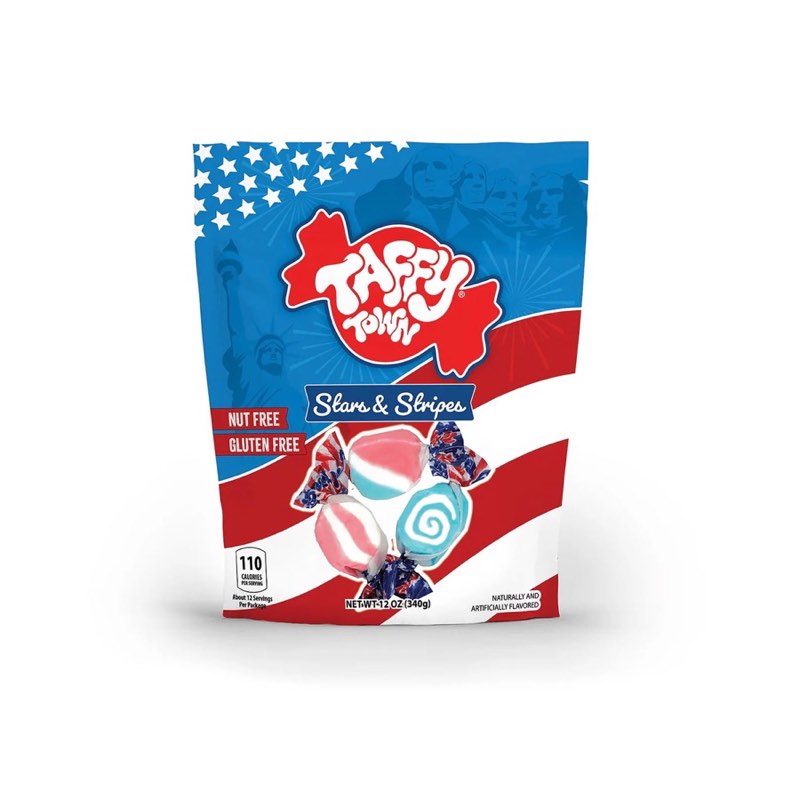
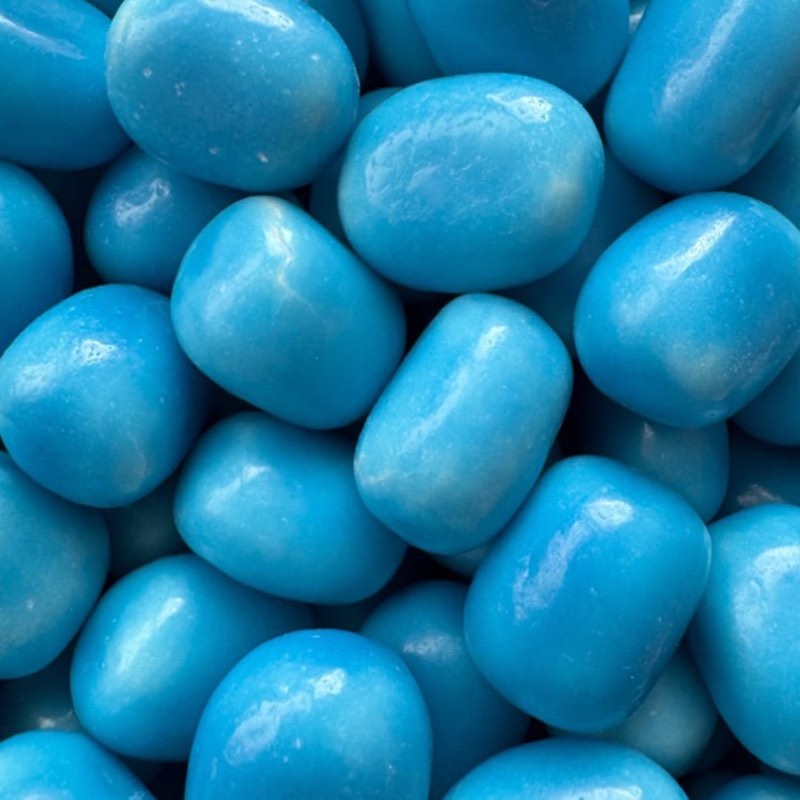
The first thing you notice about Taffy Town Stars and Stripes is that it is genuinely blue. Not a hint of blue, not a blue-ish wash over a pale sweet, but a proper confectionery blue that reads from across a room and looks almost artificial next to anything on a kitchen worktop. That is the point of it. The pack is built around a red-white-and-blue idea, the name says so, and the colour in the bag carries the look rather than leaving it all to the printing. When you tip a handful out, the blue pieces are the ones your eye lands on first, and the strawberry pieces sit alongside them doing the warmer half of the job.
Each piece is a small wrapped chew, twisted at both ends the way taffy almost always is. The wrapper matters more than people expect. A twist-wrap means you can put a bowl of these out for hours without anything going tacky, without pieces welding into a single mass at the bottom, and without anyone needing a napkin. It also means one piece is a decision. Nobody grabs a fistful of twist-wrapped chews the way they grab a fistful of loose jellies; they take one, unwrap it, and that small ceremony slows the whole thing down. At 340g you are getting a bag that behaves like a bowl-filler but eats like a one-at-a-time sweet, which is an unusual combination and one of the genuine reasons to buy it.
The full guide to Taffy Town Stars and Stripes 340g
6,472 words on how it eats, who it suits, how to serve it and what to put beside it.
Opening the bag: blue and red in the hand
In the hand a piece has a specific weight to it. It is denser than a gummy of the same size and it does not spring back when you press it. Squeeze one through the wrapper and it gives slowly, then holds the dent. If the bag has been somewhere cool the pieces are firm enough to need a proper press; if it has been sitting in a warm room they are noticeably softer and the twist ends come apart more easily. Neither state is wrong, but they eat quite differently, and that is worth knowing before you decide whether to leave the bag by a radiator or in a cupboard.
Unwrapping is part of it. The paper releases with a small crackle and the piece underneath is smooth and faintly matte rather than glossy. There is no sugar dust on the outside, nothing to leave on your fingers, nothing to shed into the bag. That makes this an unusually tidy sweet for something so brightly coloured, and it is the reason a bag like this survives being carried around in a coat pocket or a car door pocket far better than a loose jelly or anything fizzy-coated.
The chew: what the first thirty seconds actually feel like
Put a piece in your mouth and nothing happens immediately. That is the correct behaviour for a taffy-style chew and it is the single thing that most separates it from the rest of the shelf. A jelly gives you flavour on contact. A boiled sweet gives you flavour on contact. A chew like this needs warming first, and for the first few seconds it is simply a firm object you are working on. Then body heat does its job, the piece softens from the outside inwards, and the chew turns from stiff to pliable in the space of about ten seconds.
Once it is warm the texture becomes the main event. It pulls rather than snaps. You can feel it stretching between your teeth rather than breaking into pieces, and it keeps a slight elasticity right the way through instead of collapsing into paste. A well-made taffy chew has air worked into it, and you can tell, because it is lighter on the tongue than the density in your hand suggests it will be. The chew is long — noticeably longer than a Maoam-style chew and far longer than a soft gummy — and a single piece will occupy you for a couple of minutes if you let it.
That long chew is why the bag lasts. A 340g bag of small loose sweets can disappear in one evening between two people without anyone really noticing. A 340g bag of chews cannot, because each piece takes time, and the rhythm of unwrap-warm-chew-swallow imposes a pace that a bowl of jellies never does. People who buy this bag and expect it to vanish are usually surprised by how far into the following week it is still sitting on the side.
The flavour arrives on a delay and then stays. Where a hard sweet front-loads everything and fades, a chew releases gradually across the whole time it is in your mouth, because the flavour is distributed through a material that is slowly dissolving rather than sitting on a surface that dissolves quickly. The practical consequence is that the last ten seconds of a taffy piece taste much more like the first ten seconds than you would get from almost any other format. It is a very even sweet.
There is a warmth in the finish that has nothing to do with fruit. Chews of this type have a soft, creamy background note under whatever fruit is on top — it is a property of the texture and the way the sugar is worked rather than anything added on purpose — and it rounds the edges of both flavours in the pack. If you have ever wondered why a fruit chew tastes gentler than a fruit jelly of the same flavour, that background is why.
Blueberry and strawberry: how the two notes sit together
This is a two-flavour pack, and two is a good number. Big assortments are fun but they make every piece a lottery; a two-flavour bag lets people work out a preference within four pieces and then eat to it. Here the split is blueberry and strawberry, which is a deliberate pairing rather than a random one, and the two do genuinely different jobs.
Blueberry is the unusual one. It is not a note that turns up often in British confectionery, where the blue slot is almost always given over to raspberry or to a generic bubblegum-adjacent "blue" that is not pretending to be any fruit at all. Blueberry as a flavour direction is rounder and duller than raspberry — less sharp at the top, more of a jammy middle, with a faintly floral edge that only really shows up once the piece has been in your mouth long enough to soften. In a chew it works better than it does in a boiled sweet, because the slow release suits a flavour whose interest is in the middle rather than the top.
Strawberry is the opposite: the single most attempted flavour in the entire trade, so familiar that most people have a fixed idea of what it should taste like before they open the bag. Confectionery strawberry is not the strawberry of a punnet in June. It is a sweeter, jammier, more rounded thing that sits somewhere between fresh fruit and jam, and in a chew that is exactly where you want it, because the creamy background of the format leans into the jam end rather than fighting it. Eaten straight after a blueberry piece, the strawberry reads brighter and warmer than it does on its own, which is one of the small pleasures of a two-flavour pack.
Alternate them and you get a genuine contrast; eat three of one in a row and you notice the palate settling and the flavour flattening slightly, as it will with any chew. That is not a fault of this bag — it is what sugar does to your perception after a few minutes — and the fix is a sharp sweet in between, which is the argument for putting something acidic on the table alongside it. More on that further down.
Building a recognisable fruit note from nothing
It is worth understanding what a confectioner is actually doing when they set out to make a sweet taste of blueberry, because it changes how you eat one. A sweet does not taste of fruit because fruit is present in any meaningful quantity — it tastes of fruit because someone has assembled a small set of aroma impressions in the right proportions and the right order, and your brain has filled in the rest from memory. Flavour in confectionery is an act of construction, not extraction, and the good ones are built the way a sketch is built: a few confident lines that suggest a whole object.
Every fruit note has what the trade calls a top, a middle and a tail. The top is the bit that hits in the first second — bright, volatile, usually the part that tells you which fruit you are dealing with. The middle is the body, the part that makes it feel like a fruit rather than a smell. The tail is what is left after you swallow. Get the top wrong and the sweet is unidentifiable; get the tail wrong and it is identifiable but unpleasant, because the tail is where a fruit note goes soapy, chemical or medicinal if it has been pushed too hard.
Why blueberry is genuinely difficult
Blueberry is one of the hardest fruits to render in confectionery, and it is worth saying why. Fruits that work easily in sweets are the ones with a loud, distinctive top note — lemon, orange, banana, pear drop. You can reduce them to a single confident impression and everyone recognises it. Blueberry has almost no top note at all. Its character lives in the middle: soft, slightly winey, faintly floral, with a skin-bitterness that gives a real blueberry its structure. None of that is easy to suggest in a sweet, and if you push the floral element too far you land in violet or parma violet territory, which is a completely different sweet and one most people either love or refuse.
So the practical solution across the trade has been to build blueberry as a composite: a berry base that leans on the same broad family as blackcurrant and raspberry, a rounding-off that removes the sharpness those two carry, and a small floral top to suggest the skin. That is why confectionery blueberry always tastes a little like a blend rather than a single fruit, and why it works so much better in a format with a long release. A boiled sweet gives you two seconds to identify the fruit, and blueberry cannot win in two seconds. A chew gives you ninety, and in ninety seconds the middle has time to do its work. This is not a small technical point — it is the reason a blueberry chew is generally a better idea than a blueberry hard sweet, and the reason this pack chose the format it did.
Strawberry: the most-attempted note in the business
Strawberry has the opposite problem. It is easy to make something that reads as strawberry, and consequently almost every manufacturer does, which means a strawberry sweet is judged not on whether you recognise it but on whether it is any good. The public reference point is not fresh fruit at all; it is jam, and specifically the strawberry of a cheap jam, which is why "tastes like proper strawberries" is usually said about sweets that taste nothing like the fruit.
A well-built confectionery strawberry has a green edge somewhere in it — a faint, almost leafy freshness that stops the whole thing collapsing into syrup. Without it the sweet reads flat and cloying no matter how much flavour is loaded in. With it the note gets a suggestion of the fruit being picked rather than boiled. In a chew the creamy background of the format means that green edge has to be pitched slightly higher than it would be in a jelly, because the texture is already rounding everything off. You can taste this working if you pay attention: hold a strawberry piece and notice that the brightest moment arrives not at the start but about a third of the way through, once the softening has released it.
Why colour does half the work
The other thing the confectioner is relying on is your eyes. Flavour perception is strongly led by colour, and a blue sweet primes you for a berry before you have tasted anything at all. This is not a trick so much as a tool — it means the flavour itself does not have to shout, and the sweet can be built gentler and rounder than it would need to be if it were colourless. It also means that a two-flavour pack with a strong visual split, as this one has, is easier to eat thoughtfully than a bag of identical-looking pieces, because you know what you are getting before you unwrap it and your palate has already started preparing.
If you want to test how much of your tasting is visual, do the obvious experiment: have someone hand you pieces with your eyes shut. Most people find blueberry harder to name blind than they expect, and most people find the gap between the two flavours narrower than they expect. That is not a criticism of the sweets. It is how flavour works, and it is worth knowing because it explains why the visual identity of a bag like this is not decoration — it is half the recipe.
What this means for how you eat them
Three practical consequences fall out of all this. First, eat them warm rather than straight from a cold cupboard: the flavour only starts moving once the piece softens, and a cold piece spends its first thirty seconds tasting of very little. Second, do not rush — the construction of both notes is back-loaded, and someone who chews hard and swallows fast will genuinely taste less than someone who does not. Third, do not eat them alongside anything strongly sour, at least not simultaneously; acid flattens the middle of a berry note, which is precisely the part these two flavours are built around. Sour sweets as a palate reset between pieces, yes. Sour sweets in the same mouthful, no.
If this way of thinking about flavour appeals, it is worth working through the rest of our chewy sweets shelf, where the same principles show up in wildly different forms. Seventy-eight lines sit on that shelf, from long-chew taffies through to the short, springy chews that are over in twenty seconds, and comparing two of them side by side teaches you more about how flavour is built than any amount of reading.
Which sweet counter this belongs to
Every sweet carries a era with it, and part of what you are buying with a bag like this is a specific set of memories — not necessarily your own. Taffy in twist wrappers belongs to a very particular tier of confectionery memory: the holiday tier. It is not a school-lunchbox sweet and it never was. It is the thing bought on a day out, from a place with a counter, in a bag that was handed over rather than picked off a shelf, and that context clings to the format long after the context itself has gone.
There is a reason twist-wrapped chews feel like seaside sweets even to people who have never bought one at the seaside. The format was built for a shop that sells by weight from open trays — pieces that can be scooped, that do not stick to each other, that can be mixed by colour into a paper bag, and that survive an afternoon in a pocket. Every design decision in a taffy chew is a decision made for that kind of shop. The twist wrap exists so pieces can sit loose in a tray. The firmness exists so they do not slump in a warm shop window. The bright colour exists so the tray looks like something from six feet away. Buy a bag today and you are buying the descendants of those decisions, even though the bag arrives sealed and the tray is long gone.
The generational split you can actually watch
Put a bowl of these out at a gathering with three generations in the room and you can watch the split happen. The oldest group tends to recognise the format immediately and treat it with a kind of familiarity — they know to warm it, they know it will take a while, and they are not surprised when it pulls. The middle group often treats it as a novelty; wrapped chews were around but were rarely the thing you spent your own money on, and there is a small re-learning that happens in the first piece. The youngest group frequently does not know what to do with it at all, because their sweet vocabulary is built on gummies and sour coatings, both of which deliver instantly. You can see the moment someone under twelve realises that nothing is going to happen for ten seconds, and then the moment it does.
That is a genuinely nice thing to have on a table. Sweets that everyone eats identically do not generate conversation. Sweets that different people approach differently do, and a format with a small learning curve is unusually good at getting a room talking about what they ate as children — which is, in the end, most of what confectionery nostalgia is for.
Nostalgia that is not your own
There is a second kind of memory attached to a bag like this, and it is borrowed rather than lived. A great many people in Britain have a clear mental image of an American sweet counter — the rows of glass jars, the scoops, the paper bags, the specific palette of colours — assembled entirely from films and television rather than from ever having stood in one. A red, white and blue bag of taffy plugs straight into that image. It is not a claim about where anything comes from; it is a design speaking a visual language that most people can read fluently despite having no first-hand experience of it. Stars and Stripes here is the name of a product and a description of a look, and it works precisely because the look is so legible.
That borrowed nostalgia is why this bag turns up at themed parties and film nights so often. If you are putting together a table with a particular visual idea, a bag where the colour does the talking is worth more than three bags where the flavour does, because a table is looked at far more than it is tasted. Our retro shelf runs on the same logic from the opposite direction — sweets whose whole appeal is that they look like something remembered — and the two shelves are worth browsing together if you are building a spread with a theme rather than just filling bowls.
Why the format survived when others did not
Plenty of confectionery formats have simply died out. Twist-wrapped pulled chews have not, and the reason is unglamorous: they keep well, they travel well, they portion themselves, and they cost a shop almost nothing in wastage. A sweet that solves practical problems tends to outlive sweets that solve only aesthetic ones. What that means for you as a buyer is that this is one of the few genuinely old-format sweets that is not a compromise — it is not surviving on nostalgia alone, it is surviving because the engineering is good. You can taste the difference between a format that persists because people remember it fondly and a format that persists because it works, and this is firmly the second kind.
Who this bag actually suits
It suits anyone who wants a sweet that lasts. If you are the sort of person who finds a bag of jellies gone before you have decided whether you liked them, a chew this long is a different proposition entirely — it is a sweet you can have one of, which is not something you can say about most of the shelf. For the same reason it suits people buying for a household rather than for themselves, because a bag that portions itself into wrapped pieces is a bag that does not get demolished by whoever gets there first.
It suits people who want colour on a table. The blue in particular is hard to match elsewhere, and if you are assembling something where the look matters — a themed spread, a photographed table, a party where the food is part of the decoration — a bright wrapped chew earns its place before anyone eats one.
It suits people buying a gift who do not know the recipient's tastes well. Two flavours means fewer ways to get it wrong than a ten-flavour assortment, wrapped pieces mean it can sit in a hamper alongside other things without anyone worrying about it, and 340g is a proper size rather than a token one.
It suits people posting sweets. Wrapped chews are among the most postable confectionery there is — nothing to crush, nothing to melt into a mess, nothing to leak. If you are sending something to a student, to someone working away, or overseas to somebody who asked for British sweets, this travels far better than chocolate and far better than anything with a powder coating.
It suits less well anyone who wants an instant hit, anyone who dislikes working at a sweet, and anyone who needs to hand something round quickly. Wrapped pieces are slow to distribute as well as slow to eat, and at a children's party where speed matters you may want something you can simply tip into bowls. If that is the job, a £1.99 bag of Maoam Pinballs does it far more efficiently — small, loose, quick, and cheap enough to put out in quantity without thinking about it.
Putting a mix together around it
A good spread has four roles filled, and this bag fills exactly one of them very well. It is the slow item: the thing that occupies one person for two minutes and keeps them at the table. What it cannot do is graze, reset, or provide bulk, and a table made entirely of wrapped chews feels strangely sparse no matter how much is on it.
For the grazing role you want something loose and small that people take without deciding to. Vidal Strawberry Pencil Bites at £5.49 are a sensible companion here because they share the strawberry direction without sharing the format — soft, bite-sized, gone in seconds — so the two sit next to each other as variations rather than competitors. If you would rather the loose item be entirely your own choice, the full sweet shop is the place to browse from scratch, and building a bowl to your own specification is usually better value than buying three bags and hoping the balance works.
For the sharp reset — the thing people eat between chews to wake the palate up — acid is what you want. Kingsway Fizzy Strawberries at £5.49 are the obvious pick precisely because the flavour rhymes while the sensation does not: same fruit direction, completely different attack, so the contrast lands as variety rather than clash. If you want the reset to be more dramatic than that, the £2.99 box of Bean Boozled jelly beans turns the whole thing into a game, and a pairing of long slow chews with a box where half the beans are a gamble is a surprisingly good table dynamic — one item to settle into, one item to dare each other over.
For the bulk role, tubs beat bags. The big tubs on the Sweetzone shelf exist for exactly this: cheap volume that stops the interesting things running out in the first half hour. The same argument applies to our Haribo section, where the familiar bags do the unglamorous work of keeping a bowl full while the more unusual items get talked about.
Then there are the deliberate contrasts. BUBS Wild Strawberry & Pomegranate Ovals at £7.50 sit at a similar price point and take the strawberry idea somewhere far less sweet, which makes them a genuinely interesting thing to serve alongside rather than a repetition. Barratt Black Jack Chews at £5.49 are the other end of the chew family altogether — a dark, aniseed-led direction that nobody is neutral about — and putting two chew formats with completely opposite flavour philosophies on the same table gets more conversation than any single bag can. Briquette, also £5.49, is another of those lines that people either recognise instantly or have never encountered, which makes it useful on a table where you want at least one thing that has to be explained.
If the spread needs a grown-up corner, Bristow's Traditional Salted Caramel Bon Bons at £5.49 do that job without anyone having to buy chocolates — a soft, slow, caramel-led sweet that adults reach for and children tend to leave alone, which is sometimes exactly what you want. And for a smaller, sharper contrast in a different texture entirely, the jelly and gummy shelf is where to go for the springy, instant-flavour end of the range that this bag deliberately is not.
Occasions where a red, white and blue bag earns its place
Themed tables. Anything built around a red-white-and-blue idea — a film night, a themed birthday, a sports fixture, a diner-style party — gets more from a bag where the colour is the design than from three bags where it is not. The blue is the hard colour to source in confectionery and this bag supplies it in quantity.
Film nights. A long chew is close to the perfect cinema sweet. It is quiet once unwrapped, it lasts through a scene, and it does not need a bowl in your lap. The one caveat is the wrapper noise, which is real; unwrap several in advance if you are watching something with people who care about that sort of thing.
Car journeys. Wrapped pieces that do not melt, do not dust and do not need hands washed afterwards are worth their weight on a long drive. Keep the bag in the door pocket rather than on the dashboard, for reasons covered under storage below.
Hampers and gift boxes. At £7.49 this is a solid mid-weight item for a hamper — substantial enough to look like a real inclusion, priced sensibly enough that it does not eat the whole budget. It also has visual presence in a box full of brown and beige packaging. If you would rather the taffy itself arrive already presented, the Boardwalk gift box of salt water taffy is the same 340g in a giftable box for £9.49, and the £2 difference buys you the packaging and a wider spread of flavours rather than more sweets.
Posting to someone. Already covered above but worth repeating in the occasions list, because "what can I actually send?" is one of the most common questions we get. Wrapped chews are near the top of the answer.
Office tins and communal bowls. Twist wrappers are the only honest way to leave sweets out in a shared space. Nothing is exposed, nothing goes stale, and people can take one three days later without wondering how long it has been sitting there.
Children's parties, with supervision. Chews are a treat, and as with all sweets, small pieces need supervision with young children. Chews in particular need chewing rather than swallowing, so they suit slightly older children better than very young ones.
What £7.49 for 340g actually buys
Work it out properly and the picture is clearer than the headline price suggests. £7.49 for 340g comes to roughly £2.20 per 100g. That sits it above the cheap bagged sweets and below the premium single-origin end of the shop, which is about where a wrapped specialist chew ought to sit.
| What you are measuring | Figure |
|---|---|
| Bag price | £7.49 |
| Bag weight | 340g |
| Cost per 100g | about £2.20 |
| Rough cost per 50g handful | about £1.10 |
| 50g servings in the bag | just under 7 |
| Flavours included | 2 — blueberry and strawberry |
The per-gram figure is only half the value question, though, because the other half is how long the bag lasts, and that is where a chew quietly outperforms. A 340g bag of small soft jellies at a similar price will be eaten roughly twice as fast, because nothing about the format slows anyone down. With wrapped chews, the unwrapping and the long chew impose a pace, and in practice a bag like this stretches noticeably further than its weight suggests. If you measure value in sweet-minutes rather than sweet-grams, this is one of the better-value things on the shelf.
For a party, the useful sum is different again. Budget roughly four to six pieces per person for a table where this is one item among several, and rather more if it is the only chew on offer. A 340g bag covers a small gathering comfortably as part of a spread; for a larger group, buy it as the interesting item and let a cheaper tub carry the volume, rather than trying to make this bag do a job it is not priced for.
Compared against its own siblings, £7.49 is the standard Taffy Town bag price — Sassy Taffy at the same 340g and the same £7.49 and Go Bananas, also 340g, sit at exactly the same figure, so choosing between them is purely a flavour decision and never a value one. That is genuinely useful: you can pick on taste alone and know you are not paying a premium for one direction over another.
Keeping them at the texture you want
Taffy is more sensitive to temperature than almost anything else in the shop, and the good news is that this works in both directions — you can tune the eating experience just by choosing where you store the bag.
Cool cupboard. The default, and the right one for most people. Pieces stay firm, wrappers stay easy to open, and the chew has proper resistance. A cupboard away from the oven and off any sunlit surface is all it takes.
Warm room. Pieces soften, the chew becomes noticeably easier and shorter, and the wrappers start to cling. Some people prefer this — it is a gentler eat and better for anyone who finds a firm chew hard work. What you lose is the long pull, which is most of the character.
Direct sun or a hot car. Avoid. Pieces will slump inside their wrappers and can take on the twist shape permanently. They are not ruined, but they stop being tidy, and the wrapper becomes a genuine nuisance to remove.
Fridge. Works, and some people swear by it in summer, but chilled pieces need a real warm-up in the mouth before any flavour appears. If you do fridge them, take a piece out a few minutes before eating it.
Freezer. Not recommended. It makes the pieces very hard, and hard chews are an unnecessary risk to fillings.
Once the bag is open, roll the top down and clip it, or tip the contents into a lidded tub. The wrappers do most of the protective work, so an opened bag of taffy is far more forgiving than an opened bag of anything loose. As with all sweets, check the manufacturer's packaging on arrival if you or anyone eating them has an allergy — the pack itself is the only authoritative source for that, and it is worth a proper look before anything goes into a bowl.
One size, and what to buy if you want something different
This line comes in one size only: the 340g bag at £7.49. There is no smaller trial pack and no larger catering bag, so the size decision is really a decision about how many bags rather than which bag.
If 340g feels like a lot to commit to a flavour direction you are not sure about, the sensible route is to buy this alongside a cheaper, smaller chew from elsewhere in the shop and see which format your household actually goes for. Sour Patch Kids Chews in the 60g bag at £2.79 make a good low-cost comparison because they are a chew in name but a completely different eat — short, coated and sharp rather than long and rounded — so you learn quickly which direction people in your house prefer.
If you want the same format with different flavours, stay within the range. The brand shelf this sits on carries 22 lines in total, and it is the quickest way to see everything filed alongside it in one place. Within that group, the two Taffy Town siblings mentioned above are the direct format-for-format comparisons, while Candy Pop Butterfinger Popcorn at £4.49 and Doughbrik's Extra Cheesy Wavers Crisps at £4.99 are there for anyone building a mixed snack box rather than a sweet bowl, where you want something savoury to break the sugar up.
And if what you actually want is the strawberry note in a different format entirely, that is easy enough. Bolci Freeze Dried Dark Chocolate Strawberry at £4.49 takes it in a completely different direction, and Royal Family Mochi Minis in strawberry cheesecake at £1.99 is a cheap way to try the same fruit family in a soft, chilled-feeling format that has nothing in common with a chew except the fruit on the label.
Where this sits on the site
Three shelves carry this product, and each one is a different way of arriving at it. The strawberry flavour shelf is the largest of the three at 78 lines, and it is the right place to start if you are shopping by taste rather than by brand — it runs from jellies through pencils to chocolate, all connected by one note. The chewy shelf, linked earlier, is where to go if the texture is what you are after. The brand shelf groups everything filed under the same name.
Beyond those, the shelves worth knowing about are the ones people end up on next. The Kingsway shelf is where a lot of the traditional-counter lines live, and it overlaps heavily with what people buy alongside a bag of taffy. The jelly and gummy shelf and the retro shelf, both linked further up, cover the two most common "what else?" directions. And if none of that narrows it down, the whole shop is browsable in one list.
Questions people ask before adding this to a basket
How many flavours are in the bag?
Two: blueberry and strawberry. That is the whole assortment, which is unusual — most bags of this size carry four or more. The advantage is that you can work out a preference within a handful of pieces and then eat to it, rather than playing a lottery with every wrapper. The disadvantage is that if you dislike one of the two, half the bag is doing nothing for you. If you want a wider spread in the same format, the boardwalk-style gift box linked above carries more directions across the same 340g.
Why is it called Stars and Stripes?
It is the product name, and it describes the red-white-and-blue look of the bag and the colour of the sweets inside. It is not a statement about where anything is made — we do not hold that information and so we do not claim it. What you can take from the name is the visual idea: a bright blue sweet alongside a red-fruit one, in a pack designed to read as a set of colours from across a room.
How long does one piece last?
Longer than almost anything else on the shelf. A piece that has warmed properly will occupy you for a couple of minutes, and the flavour stays fairly even across that whole time rather than fading after the first few seconds. This is the main practical difference between a taffy-style chew and a jelly or a boiled sweet, and it is why a 340g bag stretches further than its weight suggests.
Are they hard work to chew?
Straight from a cold cupboard, the first few seconds are firm. Once body heat has softened the piece — about ten seconds — it becomes pliable and the chew is comfortable. If you find them too firm, simply keep the bag somewhere warmer; the format responds very directly to temperature, and a piece from a warm room is a much gentler eat than one from a cold one.
Will they stick to my teeth?
Any long chew will cling somewhat, and this is no exception. It is less clingy than a toffee and more clingy than a gummy. If you have crowns, bridges or anything else you are careful with, treat a taffy chew with the same caution you would treat a toffee, and let the piece warm fully before you start working on it rather than biting into it cold.
Do they melt in warm weather?
They soften rather than melt — there is no chocolate here to go liquid. In real heat the pieces will slump inside their wrappers and may set into the twist shape, which makes them awkward to unwrap but does not spoil them. The wrapper is doing a lot of protective work, which is why this is one of the better sweets to carry around in summer.
Can I post these?
They are one of the most postable things we sell. Individually wrapped pieces, nothing to crush, nothing to leak, and no chocolate to bloom. If you are sending a parcel to a student, to someone working away, or abroad to somebody who has asked for sweets, wrapped chews arrive in the condition they left in far more reliably than most of the shop.
Is this suitable for a children's party?
It works, with two caveats. Sweets are a treat, and small pieces should always be eaten with adult supervision where young children are involved — a chew needs to be chewed rather than swallowed, so it suits slightly older children better. The second caveat is practical: wrapped pieces are slow to hand round. If you need something you can tip straight into bowls and get on with the party, a loose bagged sweet is the more efficient choice.
What should I put alongside it on a table?
Something loose to graze on, something sharp to reset the palate, and something cheap to provide volume. The chews themselves are the slow item and they do that job on their own. A sharp fizzy sweet between pieces genuinely improves the experience, because a run of three chews in a row flattens the palate and an acidic sweet brings it back.
Is there a bigger or smaller pack?
No. This line is 340g at £7.49 and nothing else. If you need more, buy more bags; if you want less commitment to one flavour direction, a small bag of a different chew from elsewhere in the shop is a cheaper way to test the water before you commit to a full 340g.
How does it compare with the other Taffy Town bags?
Same weight, same price, different flavour directions. That makes the choice between them purely a matter of taste — you are not trading off value for preference. If you are buying two, picking two different flavour directions gives a table far more to talk about than two bags of the same thing.
What does it work out at per 100g?
Roughly £2.20 per 100g, which puts it in the middle of the shop. For a wrapped, single-flavour-family specialist chew that is a fair figure, and the slow eat means the effective cost per sitting is lower than the per-gram number implies.
The short of it
A 340g bag of twist-wrapped taffy chews in blueberry and strawberry, for £7.49, in a colour scheme that does half the work before anyone has eaten anything. It is slow, tidy, postable and unusually good value if you measure how long a bag lasts rather than what it weighs. Buy it as the item on a table that people stay at, put something loose and something sharp beside it, and keep it somewhere cool if you want the full chew.
More from 3D
More chewy sweets
More strawberry sweets
Where this sits
Taffy Town Stars and Stripes 340g appears on these shelves. Browse them, or jump to something nearby.
You might also like