Home / Loose Sweets / Haribo Rotella Tub 800g
Haribo · 800g
Read the full guide
Haribo Rotella Tub 800g
£8.99
✔ In stock — ready to ship
Fresh stock
Free over £20
Same-day dispatch
Secure checkout
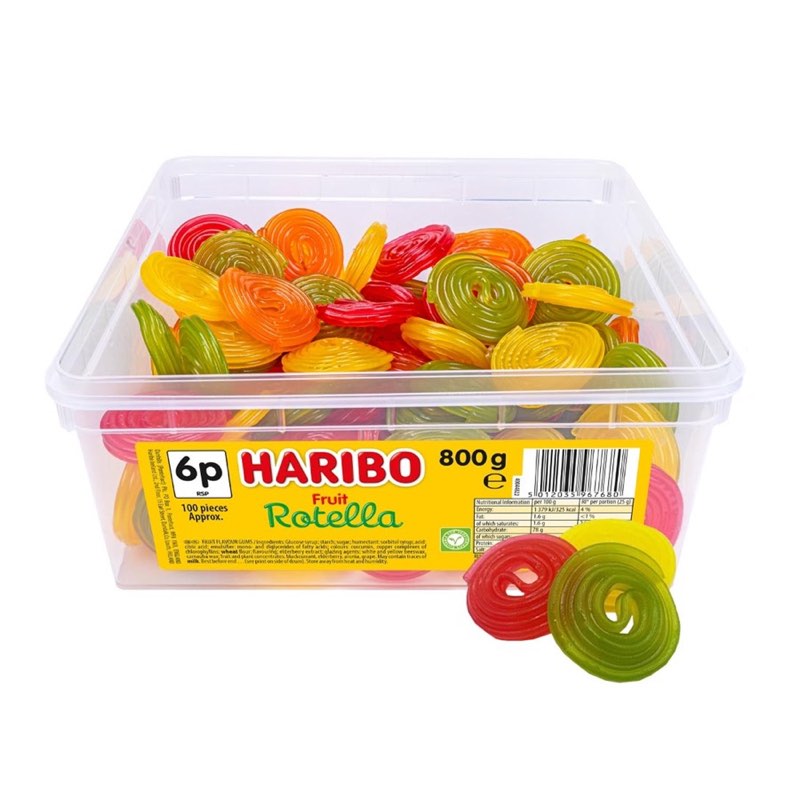
The interesting thing about a Rotella happens before you taste anything. You reach into an 800g tub expecting to bring out a sweet and you bring out an object — a coil, wound round on itself, sitting flat in the palm the way a small wheel does rather than rolling about the way a gummy bear does. The name tells you the shape before you open the lid, and the shape is most of what makes this line different from every other tub on the shelf.
In the hand it is light for its footprint. A rolled sweet spreads its weight over a wider area than a moulded one does, so it reads as bigger than it weighs. Hold one flat on the fingers and you notice the edge first: a rolled sweet has a rim you can feel, and a spiral you can see running into the middle of it. There is no mistaking which way up it goes, because there is no up.
The full guide to Haribo Rotella Tub 800g
5,179 words on how it eats, who it suits, how to serve it and what to put beside it.
Taking the first one out
Then there is the decision, which is genuinely part of the eating experience and not a flourish. You can unroll it or you can bite it. These produce two different sweets out of one product.
Unrolled, it becomes a long strip, and eating a long strip is a slow, deliberate, faintly ridiculous business that children find very entertaining and adults quietly enjoy more than they admit. It stretches out further than you expect. It takes time. You end up eating it end to end rather than in a mouthful, which changes the pace completely — one Rotella eaten this way lasts several times longer than one eaten in a bite, and the flavour arrives in a long even wash rather than a single hit.
Bitten whole, it is a much denser proposition. Folding the coil into the mouth and biting through it means biting through several thicknesses at once, and the resistance is considerably higher than a single-thickness sweet gives. There is a moment of proper push-back before it yields, then a chew that has some work in it. That is a specific pleasure and it is the reason some people will only ever eat these one way.
The chew itself is the long kind rather than the quick kind. It does not dissolve, it does not shatter, and it does not disappear on you. It occupies the mouth for a while, and by the end of it the jaw has done something. Sweets that behave this way are the ones that keep a bowl going, because they slow everybody down.
The colour recorded for this line is green, which on a table full of reds, oranges and browns is unusually useful — green is the tone most sweet spreads are missing, and a green element pulls an arrangement together in a way another red one cannot.
What we deliberately are not going to do on this page is tell you what it tastes like in specifics. Our supplier has not given us flavour data for this line, and we would rather leave a gap than fill it with a guess. What we can tell you is everything about how it behaves — the shape, the chew, the pace, the way it sits in a mix — and in practice that is what decides whether a sweet suits you far more often than the flavour name does.
The tub, the weight and the price
The Haribo Rotella Tub is 800g for £8.99, in stock, sold in one size only. There is no small version to trade down to and no larger one to trade up to; the only quantity decision is how many tubs.
Eight hundred grams is a specific and well-chosen number. It is more than a household gets through in a weekend, which means the closing lid earns its keep, and it is enough to be the main event on a table rather than one contribution among several. It also happens to be the same weight as the brand's gift boxes, which makes it easy to compare formats directly — an exercise worth doing before you buy, and one this page comes back to further down.
The tub itself is the right container for a rolled sweet, and that is not a small point. Coiled sweets are awkward in a bag: they lie flat, they slide past each other, and the bag ends up as a flat slab you cannot get a hand into. In a tub they stack loosely with air between them, you can reach in and take one cleanly, and they do not get compressed under their own weight. If you have ever fought with a bag of belts or laces, you already understand why the format matters here.
Building a bag around a big sweet
Most advice about building a pick and mix is about flavour. This section is about size and structure, because with a large-format sweet like this the physical problem comes first and the flavour problem comes second. Get the architecture wrong and no amount of clever flavour matching saves the bag.
A large sweet changes how generous a bag looks. This is the first and most useful thing to know. Two or three coils in a bag occupy a lot of visible volume, so a bag containing them looks fuller than the same weight of small gummies would. That cuts both ways. If you are making gift bags and want them to look substantial, a large-format item is the cheapest way to achieve that. If you are selling by weight or dividing fairly between children, be aware that the bag that looks biggest is not necessarily the heaviest one, and somebody will notice.
Big sweets and small sweets separate in a bag. Physics does this for you whether you want it or not. Shake a mixed bag and the small items work their way down through the gaps while the large ones ride up. By the time it reaches the bottom of a rucksack, the top of the bag is coils and the bottom is everything else. If the bag is going to be handed over or displayed, put the large items in last so they are visible at the top; if it is going to be carried, accept that it will sort itself and do not fight it.
Count large-format sweets, do not weigh them. A 25g scoop of small gummies is a sensible unit. Twenty-five grams of coiled sweets is one or two objects, and one or two objects is a portion that either feels mean or feels enormous with nothing in between. The right way to build with a large-format item is to decide how many go in each bag — one, two, three — and let the weight be whatever it is. This is the single most common mistake people make when they first put a big sweet into a mix.
One big thing, several small things. The proportion that works almost universally is a single large-format item, two or three mid-sized items, and one small filler. The large item gives the bag a centre and a talking point. The mid-sized items carry most of the weight. The filler fills the gaps the big one leaves. Invert that — three large items and a scattering of small — and the bag becomes unwieldy, hard to close and oddly unsatisfying to eat from, because every choice is a big commitment.
For the mid-sized band, the sensible partners are the familiar moulded shapes. Barratt Jelly Babies at £5.49 are the most neutral mid-sized item we sell and will sit alongside almost anything without argument. Haribo Giant Cola Bottles at £5.49 are a step up in size and bring a shape people recognise instantly, which is useful when the bag is going to a child. And Barratt Black Jack Chews at £5.49 bring an individually-wrapped element, which solves a different problem entirely: wrapped sweets are the ones you can put in a coat pocket or a lunchbox without them picking up everything else in there.
Match the duration, not just the flavour. A bag where every sweet takes thirty seconds to eat is over quickly and feels slight. A bag where everything takes three minutes is exhausting. The best mixes span the range, and a long-chewing coil sits firmly at the slow end, which means it wants fast company. Something that melts rather than chews is the natural counterweight — Bulgari Pumpkin Mallows at £5.49 collapse quickly and cleanly, and a 140g bag of Haribo Chamallows Pink & White at £1.99 does the same job in a smaller, cheaper unit that is easy to add to an order as an afterthought.
Keep the sharp element small and deliberate. In a bag built around a long-chewing sweet, anything genuinely sour needs to be present in small numbers, because a sour sweet followed immediately by three minutes of chewing is not a pleasant sequence. One or two pieces of Barnett's Mega Sour Apple at £3.99 per bag is the right dose — enough to be a feature, not enough to dominate the experience of everything that comes after it.
Think about what the bag is for. A bag for a car journey wants long-lasting sweets and no mess. A bag for a party table wants variety and visual interest. A bag for a lunchbox wants individually manageable portions. A bag for a gift wants one thing that looks impressive. A coil suits the first, second and fourth of those very well and the third not at all, which is worth knowing before you build forty of them.
If you would rather not engineer any of this yourself, the ready-built mix selections have already solved the size-and-duration problem, and they are a reasonable place to look at proportions before you commit to your own.
Texture is the thing you are actually buying
Ask people what sweet they like and they will name a flavour. Watch what they actually reach for twice and it is almost always a texture. Flavour decides whether you enjoy the first one; texture decides whether you want another. This is the most underrated idea in confectionery and it is the right lens for a product like this one, where the format is the whole proposition.
There are five broad texture families, and almost everything in the shop sits in one of them or deliberately straddles two.
The dissolve. Nothing to bite. The sweet gives up its structure to the mouth and disappears. Foams and mallows live here, and so does anything aerated — the air in them is the reason they collapse rather than resist. BUBS Banana & Caramel Foam Sweets at £7.50 are a good example of the family at its most distinct: they yield almost immediately and are gone before you have properly started. Sweets in this family feel generous because you can eat a lot of them quickly, and they are the ones people say they could eat endlessly.
The shatter. Hard, brittle, with a definite break point. All the drama is in a single instant and then there is a long slow tail while what is left of it goes down. Boiled sweets and anything with a hard shell belong here. This family is the slowest overall but the least demanding — no jaw work, just time.
The crumble. Structure that breaks into pieces under light pressure rather than snapping cleanly. Buchanan's Butter Tablet Carton 150g at £3.49 is the clearest example we stock of a texture that is firm in the hand and then falls apart in the mouth, which is a very specific and very old-fashioned pleasure.
The chew. Resistance that does not give up. You push, it pushes back, and the interaction lasts. This is the family with the widest internal range — a soft chew that yields in two bites and a dense chew that occupies you for minutes are both called chews and they are barely the same experience. A rolled coil sits at the dense, long-lasting end of it, particularly if you eat it folded rather than unrolled.
The composite. Two textures in one object, where the interest is in the transition. A shell over a centre, a coating over a chew, a hard outside over a soft inside. Bristow's Traditional Salted Caramel Bon Bons at £5.49 work on exactly this principle — the outside and the inside behave differently and the sweet is really about the moment between them.
Now, why the family matters more than the flavour name.
Texture sets the pace, and the pace sets the portion. A dissolving sweet has no natural stopping point, which is why bowls of mallows empty faster than anybody plans. A long chew imposes one: you cannot eat the second until you have finished the first, and the finishing takes time. If you are putting out sweets for a group and want them to last the evening, the texture you choose does more than the quantity you buy.
Texture determines who the sweet suits. Dense chews are hard work for very young children and for anyone with dental work they would rather not disturb. Dissolving sweets suit both. This is a far more practical way to choose a sweet for someone else than guessing at their favourite fruit.
Texture survives storage badly or well. A dense chew that has been kept warm becomes softer and loses the resistance that was the point of it. A hard sweet that has been kept damp goes tacky on the outside. A mallow that has dried out goes firm and stops collapsing. In every case what fails first is the texture, not the flavour — which is why the storage section below is mostly about temperature and air rather than about age.
Temperature changes the family. This is the most useful practical trick on this page. A dense chew taken from a cold room is markedly firmer and harder work; the same sweet at room temperature is noticeably more yielding. If you find a coil too tough, leave the tub somewhere warmer for an hour. If you find it too soft, a cooler cupboard firms it up. You can move a sweet a meaningful distance within its own family without doing anything to it except waiting.
Texture is why a mix works or does not. A bowl containing five sweets from the same texture family is monotonous however different their flavours are. A bowl containing one from each family is interesting even if three of them taste broadly of fruit. When a mix feels flat, check the textures before you check the flavours — nine times out of ten that is where the problem is.
Applied to this tub, the conclusion is simple. You are buying a long, dense, slow item with an unusual physical format. It is the strongest possible candidate for the "one big thing" slot in any mix, and it is a poor candidate for being the only thing in a bowl, because a bowl of nothing but hard work is not a bowl people return to.
Who this tub suits
People who like eating to take a while. There is a genuine divide between shoppers who want a sweet to be over and shoppers who want it to last. If you are in the second group — the sort of person who makes a packet of chews last a whole film — this is squarely your kind of product.
Households with older children. A coil is an entertaining object and a long chew keeps a child occupied for a useful length of time. It is less suitable for the very young: whole sweets of this kind need supervision, small hard sweets and whole gummies are a choking risk for young children, and they should be sitting down while eating. Sweets are a treat rather than a staple, and anyone in the house with an allergy should check the manufacturer's packaging on the tub before eating.
The mix builder who is short of a centrepiece. If your bags all look the same and none of them has a focal point, this is the missing item.
Anyone who needs green. Colour-scheme buying sounds frivolous until you have tried to make a table look deliberate and realised every sweet you own is warm-toned. A green element is scarce and useful.
People buying for a car journey or a long wait. Slow sweets are the right sweets for slow situations. Nothing else in the tub range lasts as long per piece.
Occasions that call for slow sweets
Car journeys and travel. The obvious one. Long-lasting, not messy, does not melt, and the format is entertaining enough to be a distraction in itself.
Film nights and long games. A bowl of fast sweets is empty by the second act. A bowl of slow ones is still going at the end.
Children's parties where the sweets need to last. If you are putting out a table an hour before the food arrives, slow sweets are how you stop the whole table disappearing in ten minutes.
Sweet carts and display jars. A coiled sweet in a clear jar is visually interesting in a way small moulded sweets are not, because the spiral reads through the glass. It is one of the better jar-filling shapes for that reason.
Christmas and seasonal tables. Green is in short supply on a Christmas sweet table and it is one of the two colours the season is built on. Pair it with a deliberately dark element — the Cadbury Dairy Milk Little Robins bag at £2.49 is inexpensive, seasonal in shape, and the right tonal counterweight.
Halloween. A coil is a serviceable prop shape as well as a sweet, which is a niche advantage but a real one for anyone decorating a table.
Putting them out: bowls, boards and the cutting question
A large-format sweet needs more thought at the serving stage than a small one, and most of the thought is about how people take them.
Use a shallow, wide vessel rather than a deep bowl. Coils lie flat, so in a deep bowl they stack into a column and the only ones anybody can see are the top two. On a plate, a board or a shallow dish they overlap like scales and the whole quantity is visible at once, which makes a modest amount look like plenty. This is the single easiest improvement to make and it costs nothing but a change of crockery.
Put out fewer than you think. Because each piece is a substantial portion in itself, a serving plate needs far fewer objects than a bowl of small gummies does. Eight or ten on a board is a generous offer. Thirty looks like a shop display and guests take them less freely, not more, because an obviously enormous pile reads as someone else's stock rather than as hospitality.
Decide in advance whether you are cutting them. For a grown-up table, or a buffet where people are also eating other things, halving the coils turns one long commitment into two manageable ones and doubles the apparent count. For a children's table, leave them whole — the size is the appeal and the unrolling is the entertainment, and cutting them removes both. Whichever you choose, do all of them the same way. A plate of halves and wholes looks like somebody got interrupted.
Give them their own vessel if the table has anything delicate on it. Long-chewing sweets get handled more than small ones — picked up, examined, unrolled, put down again — and that handling means they benefit from a dish of their own rather than being buried in a communal mix where people have to dig for them.
Keep the tub out of sight but within reach. Top up the plate during the evening rather than emptying the tub at the start. A plate that is refilled twice feels more generous than one that was full at eight o'clock and empty by nine, even when the total is identical, and the sweets that spent the evening in the sealed tub will be in better condition than the ones that spent it on the table.
What 800g at £8.99 works out at
At £8.99 for 800g, this tub costs £1.12 per 100g, or a shade under 1.13p per gram. That figure is the headline, and it is better than it first looks.
- A 25g portion costs about 28p. The tub holds 32 of them.
- A 50g portion costs about 56p. The tub holds 16.
- A 100g gift bag costs £1.12 in sweets, and the tub makes eight of them.
- Filling forty party bags from this tub gives each bag 20g, at about 22p a bag.
Here is the comparison that matters. The Supermix kilo tub at £11.99 and the Tangfastics kilo tub at the same £11.99 both work out at about £1.20 per 100g — which means this 800g tub is actually the cheaper rate per gram despite being the smaller container. That is unusual. Bulk normally wins, and here it does not. If pence per gram is your measure, the 800g tub beats both kilos, and it costs three pounds less to buy.
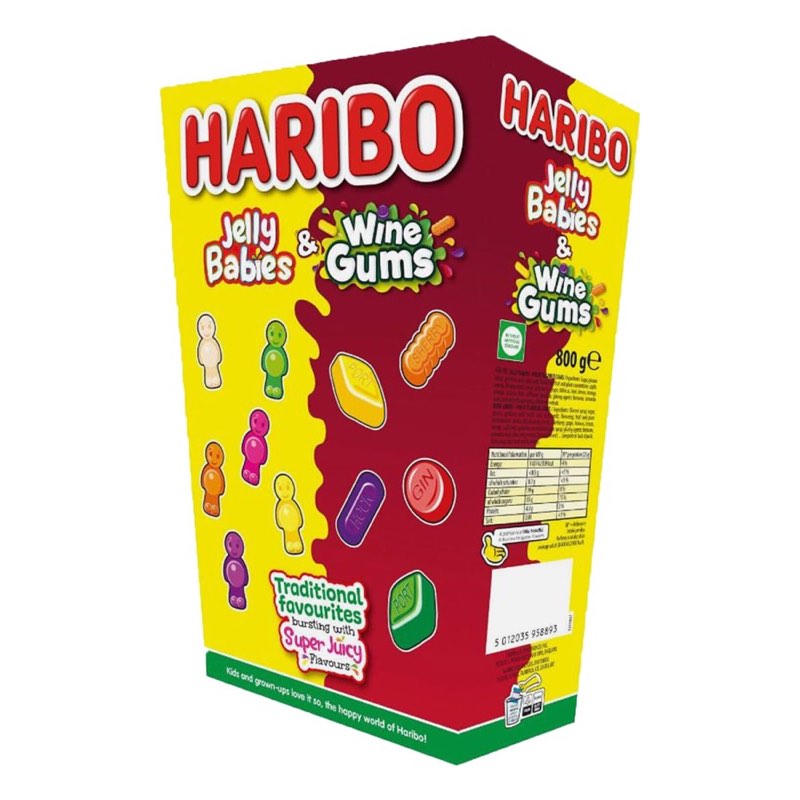
Against the gift boxes the picture reverses. The Megastars gift box at £6.99 for 800g and the Jelly Babies and Wine Gum gift box at £6.99 are the same weight as this tub for two pounds less — about 87p per 100g. If raw quantity at the lowest price is the goal and you do not care what shape it comes in, those are the better buy and it would be silly to pretend otherwise. What you give up is the format, the resealable tub and the slow-eating property, all of which are the actual reasons to choose this one.
And at the bottom of the range, the Starmix tub at £4.99 remains the cheapest way into a tub at all. It is the right answer when the basket is already heavy and you want to add a tub without adding nine pounds.
The honest summary: £1.12 per 100g is a good rate for a tub, better than the kilo tubs on the same shelf, and the format gives you something the cheaper gift boxes do not. If you want the most sweets for the money, buy a gift box. If you want the most time for the money, buy this.
Storing a long chew properly
Everything that matters here follows from the texture section above: what degrades in a dense chew is the resistance, and the two things that take resistance away are heat and air.
Seal the lid every time. Air dries the surface and changes the way the sweet behaves before it changes the way it tastes. A tub with the lid properly seated holds its condition for a long time; a tub with the lid balanced on top does not.
Cool cupboard, not fridge, not windowsill. Warmth softens a chew and makes coils more likely to cling to each other. Direct sun through a window is worse than general kitchen warmth because it is concentrated. The fridge overcorrects: it makes a dense chew genuinely hard work and condensation on removal leaves the surface tacky.
Keep coils flat and loose, not compressed. If you decant into a bag and then put something heavy on it, rolled sweets will press into each other and become one object. In the tub they have room, which is the point of the tub.
If they have gone firm, warm them up. An hour in a normal room is usually enough. This is not a repair — nothing has gone wrong — it is just that temperature moves a chew several steps along its own scale, and most people have eaten a cold sweet and concluded the product was tough when it simply needed twenty minutes.
Always go by the date on the manufacturer's packaging, and keep that packaging if you are decanting into jars or bags so the information is still to hand.
One size, and how to scale up
There is a single variant: 800g at £8.99. Scaling is therefore linear — two tubs is 1.6kg for £17.98, three is 2.4kg for £26.97 — and the per-gram rate does not improve with quantity, so there is no reason to over-buy.
The more interesting scaling question is whether to buy two of these or one of these plus something else. For almost every purpose the answer is the latter. Two tubs of an identical slow-chewing sweet gives you 1.6kg of one texture, which is the mistake the texture section warns about. One of these plus a fast-eating item gives you a spread across the families for the same money and a far better table. If you want to keep it in the family, the Haribo shelf runs to forty-three lines, which covers most of the texture range on its own.
If quantity rather than brand is the thing you are optimising, the loose sweets category holds 356 lines and is the right place to shop by weight. It is also where to go if you want the coil format alongside several other large-format sweets rather than as the only big thing in the basket.
Where this sits on the site
This product lives on two shelves. The loose listings are the broader of the two by a long way and the natural route if you are assembling a mix. The brand pages are the route if the maker is what you are buying, and with forty-three lines on them they are deep enough to browse properly rather than skim.
From there, the full shop is the open-ended option, the candy and chocolate hub collects the wider category for when you want chocolate alongside the sweets, and the Kingsway shelf is the most useful neighbouring brand to look at because it covers a great deal of the same loose-sweet territory in different formats. If it is a pre-built selection you are after rather than components, the mix pages are the shortcut. And if you simply want to see what else is around this price point, Briquette at £5.49 is another distinctive loose line worth a look for anyone shopping by format rather than flavour.
Questions we get asked
What flavour is it?
We do not hold verified flavour information for this line, so we are not going to name one. That is a deliberate gap rather than an oversight — it is better to tell you we do not know than to guess and be wrong. The manufacturer's packaging on the tub carries the definitive description, and everything else on this page about how the sweet behaves, how it eats and how to use it holds regardless.
Do you unroll them or eat them whole?
Both, and they are genuinely different experiences. Unrolled, the sweet becomes a long strip and takes several times longer to eat, with the flavour arriving as a long even wash. Folded and bitten, you are biting through several thicknesses at once, the resistance is much higher and the chew is denser. Most households end up with people who firmly prefer one method, which is part of the fun of putting a tub on the table.
Is 800g a lot?
It is enough to be the main item on a party table with some left over, or to keep a household going for several weeks of occasional sweets. It makes eight 100g gift bags, thirty-two adult handfuls, or forty party bags at 20g each. It is not a quantity most people finish quickly, which is exactly why the resealable tub matters.
Are these too tough for young children?
A dense chew is harder work than a small moulded gummy, so for very young children they are not the easiest choice. Whatever the sweet, young children should be supervised and sitting down while eating — whole gummies and small hard sweets are a choking risk. If in doubt, the softer, faster-dissolving options on the site are the better pick for that age group.
Why is the 800g tub cheaper per gram than the 1kg tubs?
Prices across a range are set line by line rather than by a single formula, so it happens more often than people expect. On the current prices, this tub is about £1.12 per 100g while the kilo tubs are about £1.20. If per-gram value is your priority, it is worth doing that sum on any shelf before assuming the biggest pack wins — it frequently does not.
Will they stick together?
Rolled sweets kept somewhere warm can cling a little, which is normal and not a fault. Keeping the tub in a cool cupboard rather than near the oven or in sunlight prevents most of it. If they have settled together, letting the tub cool for an hour before opening usually makes them separate easily.
What should I put with them in a mix?
Something fast. The whole argument of this page is that a slow, dense sweet needs quick company — something that dissolves or melts rather than chews. Mallows and foams are the natural counterweights, and a neutral mid-sized moulded sweet in between gives the bag a middle register. One large item, two or three mid, one filler is the proportion that works.
Are they suitable for vegetarians or vegans?
Our supplier has not provided dietary tags for this line, so we will not state anything either way. Anyone shopping to a dietary requirement should check the manufacturer's packaging on the tub when it arrives, which is the only source that reflects the batch you actually receive.
Can I use these for a sweet cart or a wedding table?
They work well in a jar because the spiral reads clearly through glass, which small moulded sweets do not. The practical advice is the same as for any display: fill the visible jar with a working amount and keep the rest sealed in the tub, topping up rather than filling to the brim on day one. Sweets left open to the air for a week lose condition faster than sweets kept sealed.
Do they travel well?
Very well. They do not melt, they hold their shape, and they are sturdy enough not to be crushed by whatever else is in the bag. The one caution is that in a mixed bag the large coils will work their way to the top while smaller sweets sink, so if the presentation matters, pack them last.
Is there a smaller size?
No — this line is sold as a single 800g tub at £8.99. If you want a smaller quantity of a Haribo tub, the Starmix tub at £4.99 is the lowest entry price in the range, and the gift boxes at £6.99 are an 800g alternative in a different format. Otherwise, buying by weight from the loose shelf is the way to get exactly the amount you want.
What goes with it if I want the table to look right rather than just taste right?
Use the green. It is the scarce colour on most sweet tables, so build outward from it rather than burying it — a dark element and one pale element alongside gives you three tones and a table that looks arranged. Small, cheap items are the easiest way to add those tones without adding much to the total.
To sum up
An 800g tub for £8.99, one size, in stock, listed green, and built around a format rather than a flavour. It works out at £1.12 per 100g — better than the kilo tubs on the same shelf — and what you are really buying is time: a dense, slow, unrollable coil that occupies the mouth for far longer per piece than anything else in the tub range. Put it in a mix as the one big thing, give it fast company, keep the lid on, and it will do a job nothing smaller can.
More from Haribo
More loose sweets sweets


Where this sits
Haribo Rotella Tub 800g appears on these shelves. Browse them, or jump to something nearby.
You might also like